Pineapple NFC Juice
Single-strength pineapple juice with bright tropical aroma, natural sweetness and refreshing citric acidity for beverages, smoothies, dairy, fermentation, frozen desserts, sauces and commercial food applications.
Bright tropical flavor at natural single strength.
Pineapple (Ananas comosus) is a tropical multiple fruit formed when many individual flowers develop together around a central core. Ripe fruit contains yellow to golden flesh with a characteristic sweet-tart flavor and highly recognizable tropical aroma.
NFC pineapple juice is extracted directly from ripe fruit and supplied without the concentration-and-reconstitution step used for juice concentrate. Depending on extraction and finishing, commercial juice can retain measurable pulp and natural cloud or be processed toward a cleaner, lower-pulp appearance.
- Botanical species: Ananas comosus
- Yellow to golden-yellow characteristic appearance
- Sweet tropical aroma balanced by natural citric acidity
- Commercial NFC commonly around 10.5–14 °Brix
- Standard-pulp and lower-pulp styles may be available
- Conventional and certified organic programs are commercially available
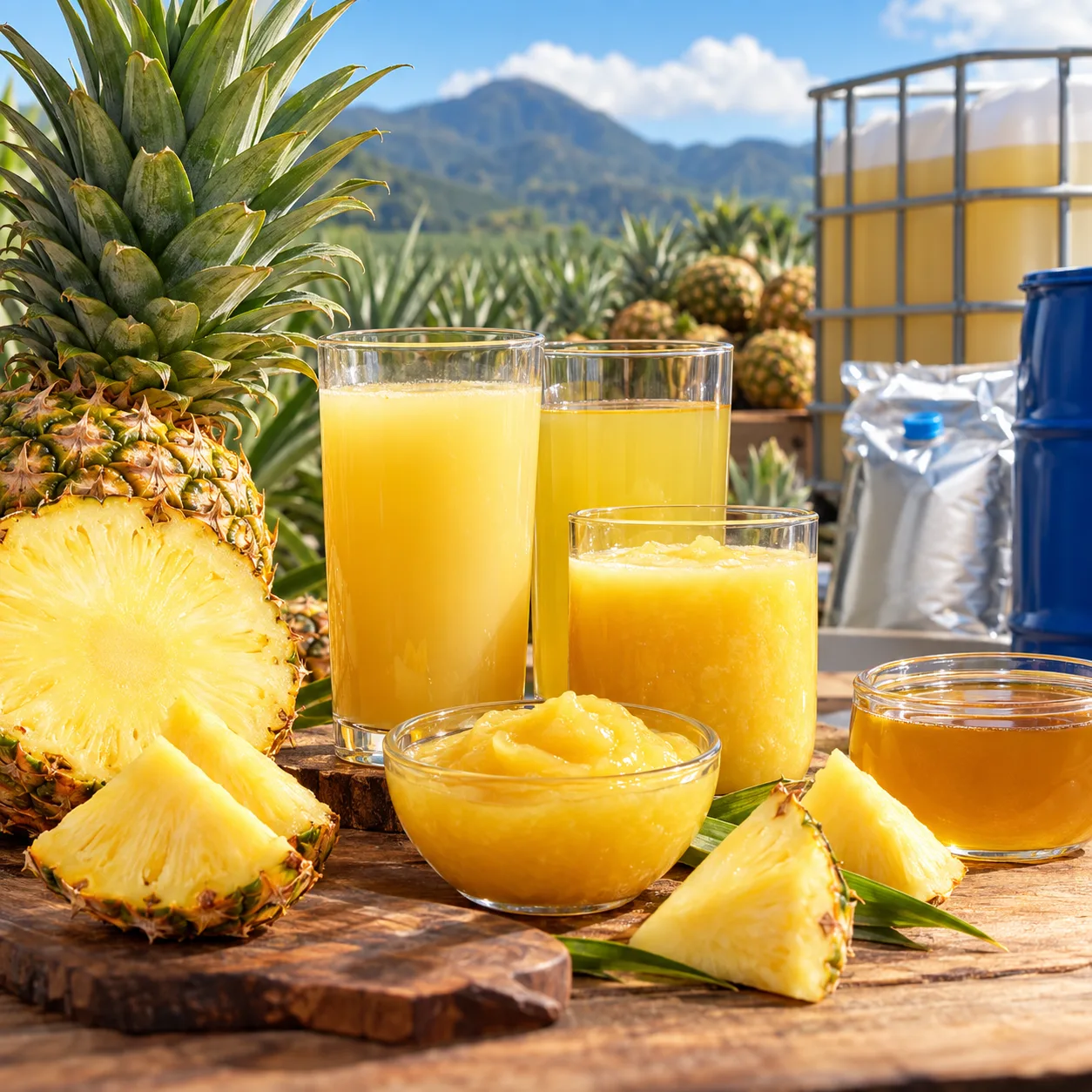
Cultivar strongly influences sweetness, acidity and juice character.
MD2
MD2 is one of the world's most important modern commercial pineapples. Mature fruit typically develops golden-yellow flesh, relatively high soluble solids and a sweet, aromatic profile.
Compared with traditional Smooth Cayenne fruit, MD2 is generally associated with somewhat higher soluble solids and lower acidity.
Smooth Cayenne
Smooth Cayenne has a long history in industrial pineapple processing and remains a recognized benchmark for canned fruit, juice and other processed pineapple products.
It provides good juice yield, characteristic yellow color and a stronger sugar-acid balance than some milder cultivars.
Queen & Regional Cultivars
Queen-group pineapples are typically aromatic and sweet with moderate acidity. Other regional cultivars can produce different juice colors, flavor intensity and soluble-solids levels.
Origin and cultivar are useful commercial specifications where a consistent premium flavor profile is required.
Cultivar, growing region and maturity can materially change pineapple Brix, acidity and aroma. Where sensory consistency matters, qualify both the analytical specification and a representative production sample.
Brix and acidity should be evaluated as a balance, not separately.
Commercial pineapple NFC is commonly controlled by direct Brix, pH, titratable acidity, Brix-to-acid ratio, pulp, appearance, flavor and microbiological criteria.
Typical Purchasing Parameters
- Direct soluble solids measured as °Brix
- pH and titratable acidity as citric acid
- Brix-to-acid ratio
- Pulp or insoluble-solids level
- Yellow / golden-yellow color specification
- Characteristic ripe-pineapple aroma and flavor
- Specific gravity where required
- Microbiological acceptance limits
Published Commercial Examples
One current aseptic NFC specification lists approximately 11.5–14.0 °Brix, pH 3.30–3.90, acidity of 0.50–0.80% as citric acid and 5–15% insoluble solids.
Another U.S. commercial program specifies 13.0 ±2.5 °Brix, acidity of 0.55 ±0.25% as citric acid and a pulp range of approximately 8–20.
These are commercial reference values, not universal pineapple specifications. The current supplier specification and lot-specific Certificate of Analysis should govern purchasing and lot acceptance.
Direct juice and reconstituted juice use different Brix references.
Direct Pineapple Juice
Under the U.S. standard of quality for pineapple juice, soluble solids in juice obtained without added water must be at least 10.5 °Brix.
The standard also sets maximum acidity at 1.35 grams of anhydrous citric acid per 100 mL and a minimum Brix-to-acid ratio of 12.
Juice Reconstituted From Concentrate
FDA uses 12.8 °Brix as the minimum single-strength reference for pineapple juice when calculating juice percentage from concentrate.
This regulatory reference should not be interpreted as a requirement that every directly expressed NFC lot must measure exactly 12.8 °Brix.
The ratio is one of the best indicators of perceived fruit balance.
Higher Ratio
A higher Brix-to-acid ratio generally produces a sweeter, softer sensory impression when other factors are similar.
Naturally sweet cultivars such as mature MD2 can be attractive in beverages where less sharp acidity is desired.
Lower Ratio
A lower ratio creates a more tart and refreshing pineapple impression that can be useful in tropical juice blends, cocktails and culinary formulations.
Commercial Specification
Current industrial programs can use Brix-to-acid ratios as a purchasing parameter, with commercial NFC examples extending from the high teens into the 30s.
Ratio should always be interpreted together with aroma and cultivar.
Fine pineapple solids influence cloud, mouthfeel and sediment.
Standard / Pulpy NFC
Pineapple extraction and finishing can retain fine pulp and insoluble fruit material, giving the juice natural cloud, stronger mouthfeel and a direct-fruit appearance.
One current industrial NFC specification lists approximately 5–15% insoluble solids, while another reports pulp around 8–20.
Lower-Pulp Juice
Additional finishing or filtration can reduce suspended material for applications requiring smoother texture, lower sediment or improved compatibility with certain filling systems.
State the required pulp or insoluble-solids range rather than relying only on terms such as “clear” or “cloudy.”
Pineapple's natural protease activity can matter in protein-based formulations.
Natural Bromelain
Pineapple naturally contains bromelain, a group of proteolytic enzymes capable of breaking down proteins.
Remaining activity in finished NFC depends on raw material, extraction and the applied thermal or pressure process.
Dairy & Protein Systems
Active protease can affect protein structure in sensitive formulations. This can matter in dairy, gelatin and selected plant-protein systems.
Test the actual commercial juice at intended use level rather than assuming all pineapple NFC has the same enzyme activity.
Heat Treatment
Bromelain activity generally decreases as thermal processing becomes more severe, although exact inactivation depends on temperature and time.
Heat treatment can simultaneously alter fresh pineapple aroma, so enzyme control and sensory retention must be balanced.
Where pineapple NFC juice is used commercially.
100% Juice & Premium Beverages
Pineapple NFC can serve as the primary juice in premium tropical beverages where direct juice character and not-from-concentrate positioning are important.
Brix-to-acid ratio is particularly useful when maintaining consistent flavor between crop lots.
Tropical Juice Blends
Pineapple is one of the most versatile tropical blending juices and combines naturally with mango, passion fruit, guava, orange, apple, banana and coconut flavor systems.
Its acidity can brighten sweeter or less aromatic fruits.
Smoothies & Functional Beverages
Pineapple NFC contributes tropical flavor, acidity and natural juice solids to smoothies and fruit-forward functional beverages.
Its strong aroma can help balance botanical, vegetable or protein ingredients.
Sparkling & Carbonated Drinks
Lower-pulp pineapple NFC can be used in sparkling juices, sodas, spritz-style drinks and carbonated tropical beverages.
Pulp level and sediment should be matched to the carbonation and filling system.
Yogurt & Dairy Beverages
Pineapple is used in drinking yogurt, cultured dairy beverages, fruit preparations and desserts.
Acidity and any residual bromelain activity should be evaluated when the juice contacts dairy proteins.
Plant-Based Beverages
Pineapple works well in coconut, oat and other plant-based beverages and yogurt alternatives.
Protein stability and enzyme interaction should be assessed after the complete heat process and expected shelf life.
Beer, Cider & Hard Seltzer
Pineapple NFC can contribute fermentable sugars and tropical aroma to fruit beer, cider-style beverages and hard seltzer.
Fermentation can reduce fresh pineapple aroma, making dosage and addition timing important formulation decisions.
Wine, Mead & Kombucha
Pineapple juice is used in fruit wine, mead, kombucha and other fermented beverage programs.
Incoming Brix, acidity and pH should be measured when establishing fermentation and final sweetness targets.
Cocktails & Mocktails
Pineapple NFC is a natural base for cocktail mixers, mocktails, punches, frozen drinks and tropical foodservice beverages.
It pairs effectively with citrus, coconut, ginger, mint, chili and other tropical flavors.
Ice Cream, Sorbet & Frozen Desserts
Pineapple NFC can provide tropical flavor in ice cream, frozen yogurt, sorbet, ice pops and granita-style products.
Natural juice sugars and acidity should be included when balancing sweetness, total solids and freezing behavior.
Jams, Jellies & Fruit Preparations
Applications include jams, jellies, fruit preparations, dessert sauces and tropical multi-fruit systems.
Puree or fruit pieces can be combined with NFC where additional body or visible pineapple texture is required.
Confectionery
Pineapple NFC can contribute natural fruit juice, acidity and flavor to gummies, jellies, fruit chews and confectionery centers.
Concentrate may be preferred where higher solids are required without adding as much water.
Bakery & Desserts
Pineapple juice is used in cakes, muffins, glazes, fillings, dessert sauces and tropical bakery products.
Baking and cooking can reduce volatile fresh-pineapple aroma, so final dosage should be validated after processing.
Sauces, Marinades & Glazes
Pineapple NFC works in sweet-and-sour sauces, barbecue sauces, marinades, glazes and tropical dressings.
Its natural acidity, sweetness and tropical aroma complement chili, ginger, soy-style seasonings and roasted flavors.
Prepared Foods
Pineapple juice can be incorporated into ready meals, tropical sauces, rice dishes and other prepared-food systems.
Water contribution and acidity should be included in the overall formulation balance.
Foodservice & Central Kitchens
Bulk NFC can simplify beverage, sauce, cocktail and dessert production without peeling, coring and pressing whole pineapples.
Bag-in-box and smaller aseptic packs can be useful when full industrial drums exceed normal throughput.
Select the format around fruit solids, body and logistics.
Pineapple NFC Juice
NFC remains near natural single strength and is appropriate where direct pineapple juice and not-from-concentrate positioning are desired.
Pineapple Juice Concentrate
Pineapple concentrate removes substantial natural water and is commonly supplied around 60–65 °Brix depending on product style and processor.
Concentrate provides much greater freight efficiency and higher soluble solids per pound.
Pineapple Puree
Puree retains considerably more fruit tissue and therefore provides greater body and texture than pressed juice.
It is useful for smoothies, fruit preparations, desserts and applications where a thicker pineapple ingredient is preferred.
Aseptic and frozen formats support different production volumes.
Bag-in-Box
Pineapple NFC is commercially available in aseptic bag-in-box formats, including approximately 20 kg packs for development, foodservice and lower-volume manufacturing.
Industrial Drums
Aseptic and frozen drums are widely used for industrial supply, commonly in the approximately 180–200 kg range depending on processor and product specification.
Tankers & Larger Bulk
Tanker and other high-volume bulk programs can be available from major pineapple processors for established industrial demand.
Receiving and refrigerated or aseptic handling capability should be confirmed before approving the logistics format.
Storage is supplier-specific. Some aseptic pineapple NFC products permit unopened ambient storage, while other programs specify refrigerated or frozen handling. Follow the current product specification rather than inferring shelf life from the package alone.
Specify cultivar, ratio and pulp level before comparing offers.
Technical Requirements
- True directly expressed NFC juice
- Preferred cultivar or acceptable varietal blend
- Target Brix and acceptable crop range
- pH and titratable acidity
- Brix-to-acid ratio
- Pulp / insoluble-solids requirement
- Color and sensory specification
- Microbiological acceptance criteria
Commercial Requirements
- Conventional or certified organic grade
- Preferred country or region of origin
- Trial quantity and annual-volume forecast
- Bag-in-box, drum or tanker preference
- Aseptic, refrigerated or frozen receiving capability
- Delivery destination in the United States
- Required shipment timing
- Certification and documentation requirements
Pineapple NFC offers should not be compared by Brix alone. Cultivar, acidity, Brix-to-acid ratio, pulp, aroma and process history can create noticeably different finished-product performance.
Documents commonly reviewed during supplier approval.
Technical Documentation
- Current product specification
- Lot-specific Certificate of Analysis
- Complete ingredient declaration
- Pulp / insoluble-solids specification
- Microbiological acceptance limits
- Storage and shelf-life instructions
- Packaging and handling specification
Certification & Supply Documents
- Organic certificate when applicable
- Food-safety certification information
- Kosher or Halal documentation when requested
- GMO statement where required
- Country-of-origin information
- Traceability and lot identification
- Commercial quotation and delivery terms
Explore formulation and sourcing considerations.
Ice Cream
Using Juice Ingredients in Ice Cream: Formulation Guide
Juice IngredientsJams & Preserves
Jams & Preserves with Juice Ingredients: Sourcing & Process Considerations
Juice IngredientsOatmeal & Hot Cereals
Using Juice Ingredients in Oatmeal & Hot Cereals: Formulation Guide
Pineapple NFC juice sourcing questions
What is pineapple NFC juice?
NFC means not from concentrate. Pineapple NFC is directly extracted single-strength juice from ripe Ananas comosus fruit and is supplied without first concentrating and then reconstituting the juice.
What is the typical Brix?
Commercial pineapple NFC commonly falls around 10.5–14 °Brix, with many current products around 11.5–14 °Brix. Actual values depend on cultivar, maturity, origin and processor.
Why does FDA also use 12.8 °Brix for pineapple juice?
FDA uses 12.8 °Brix as the single-strength reference when calculating juice percentage from pineapple concentrate. Direct pineapple juice without added water has a separate U.S. quality minimum of 10.5 °Brix.
What are typical pH and acidity values?
Current industrial NFC examples commonly show pH around 3.3–3.9 and titratable acidity around 0.5–0.8% as citric acid. Crop and cultivar can create wider commercial ranges.
Which pineapple varieties are important for industrial juice?
MD2, Smooth Cayenne and Queen are important commercial groups. Smooth Cayenne has a long processing history, while MD2 generally provides relatively high sweetness and somewhat lower acidity.
Why is the Brix-to-acid ratio important?
The ratio gives a useful indication of perceived sweetness versus tartness. Two juices with the same Brix can taste noticeably different when acidity differs.
Does pineapple NFC contain bromelain?
Pineapple naturally contains bromelain protease enzymes. Residual activity depends on fruit portion and processing, particularly heat and pressure treatment. Test the actual commercial juice in protein-sensitive formulations.
What is bulk pineapple NFC used for?
Major applications include 100% juice, tropical beverage blends, smoothies, sparkling drinks, dairy and plant-based products, beer, cider, kombucha, cocktails, frozen desserts, jams, confectionery, bakery, sauces, marinades and foodservice.
How does NFC differ from pineapple concentrate?
NFC remains near natural single strength. Pineapple juice concentrate has substantial water removed and is commonly supplied around 60–65 °Brix, providing much greater freight and storage efficiency.
Is organic pineapple NFC available?
Yes. Certified organic pineapple NFC is commercially available from selected processors. Request current certification covering the exact product, origin and production program being quoted.
How is commercial pineapple NFC packaged?
Commercial formats include aseptic bag-in-box, frozen or aseptic industrial drums and tanker-scale supply. Current programs range from approximately 20 kg bag-in-box to drums around 180–200 kg.