Mango Juice Concentrate
Bulk mango juice concentrate for beverages, dairy, baby food, bakery, confectionery, frozen desserts, fruit preparations and other commercial applications, with conventional and organic sourcing options subject to current availability.
Rich tropical aroma, natural sweetness and varietal character.
Mango (Mangifera indica) is a tropical stone fruit cultivated across Asia, Latin America, Africa and other warm growing regions. The fruit contains a large central stone surrounded by yellow-to-orange flesh whose sweetness, acidity, aroma, fiber and color vary substantially by cultivar.
Ripe mango develops a complex tropical aroma together with naturally occurring sugars and organic acids. The balance between sweetness, acidity and aroma is particularly variety-dependent, which makes cultivar an important commercial consideration when mango flavor is central to the finished product.
Commercial mango juice concentrate is produced by processing sound, ripe fruit, extracting juice, reducing pulp and insoluble material through enzymatic treatment and clarification, and then concentrating the clarified juice. The result is a high-Brix ingredient with much less body than mango puree.
- Clarified mango juice concentrate commonly available around 65° Brix
- Rich tropical flavor with yellow, orange or amber appearance
- Alphonso, Totapuri and other varieties are used commercially
- Juice concentrate, puree and puree concentrate are distinct formats
- Frozen and aseptic commercial programs are available
- Conventional and certified organic options depend on format and origin
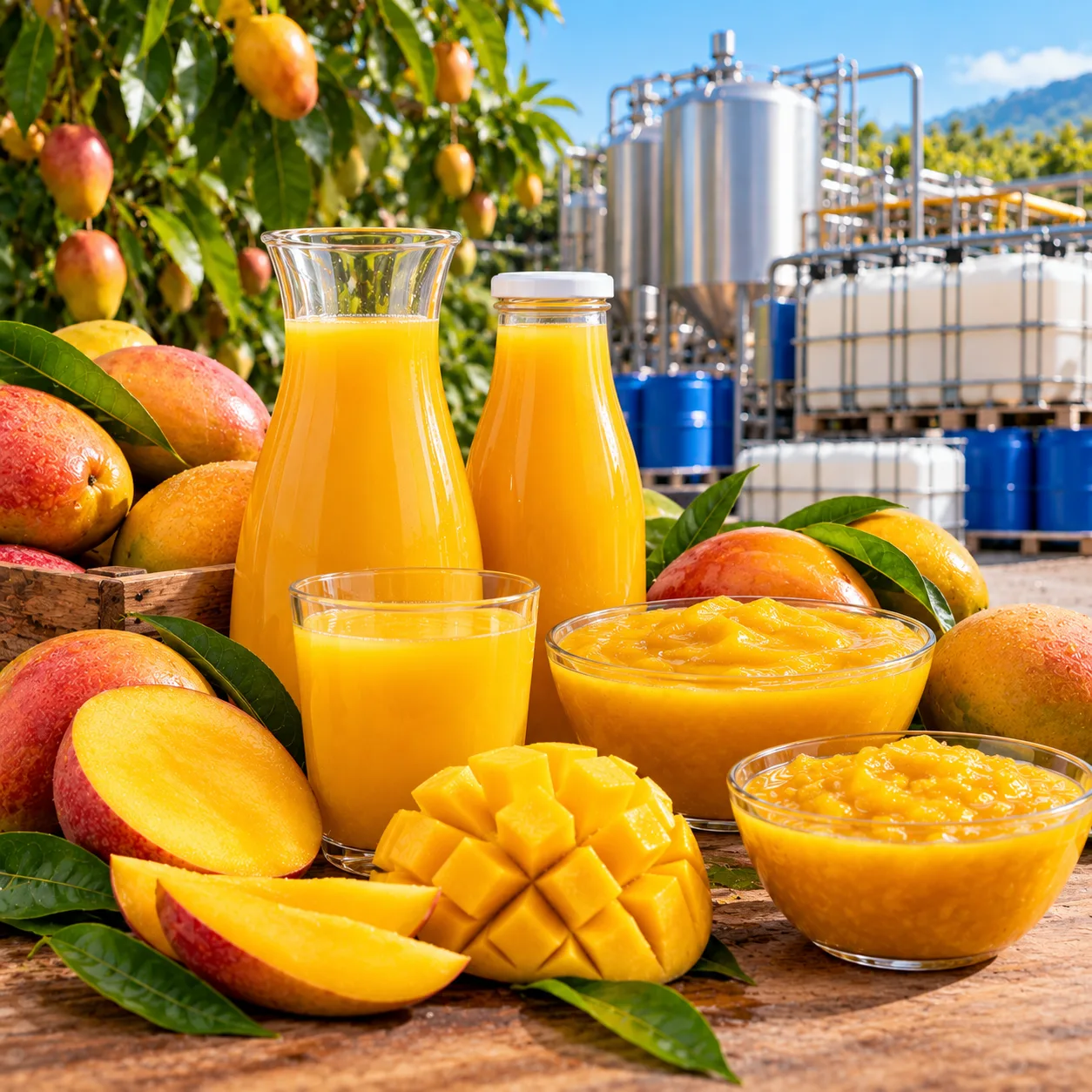
Variety influences flavor, color, acidity and commercial value.
Alphonso
Alphonso is valued for its pronounced aromatic profile, rich orange-yellow color and premium mango character. It is frequently selected when a distinctive mango flavor is more important than achieving the lowest ingredient cost.
Totapuri
Totapuri is an important industrial-processing mango with bright yellow flesh, useful yield and balanced sweetness and acidity. It is widely processed into puree, puree concentrate and clarified juice concentrate.
Kesar & Other Indian Varieties
Kesar, Neelam, Sindhura and other regional varieties can provide different combinations of aroma, soluble solids, color and viscosity. Availability depends on crop region and processing program.
Kent, Tommy Atkins & Other Global Varieties
Commercial mango processing outside India may use Kent, Tommy Atkins and other cultivars. Buyers should evaluate the actual concentrate rather than assuming that different varieties will deliver identical finished-product flavor.
Clarified concentrate and mango puree serve different formulation roles.
Clarified Mango Juice Concentrate
Clarified concentrate has most pulp and insoluble material removed before evaporation. Commercial grades around 65° Brix provide strong soluble-solids concentration with much lower viscosity than mango puree, making them useful in beverages, syrups and smooth formulations.
Mango Puree
Mango puree retains natural pulp and fruit body. Depending on variety, single-strength commercial puree is commonly around 14–18° Brix and is widely used in smoothies, nectars, lassi, baby food, dairy and frozen desserts.
Mango Puree Concentrate
Puree concentrate retains substantial pulp while removing additional water. Totapuri and similar commercial grades are commonly around 28° Brix and provide more body than clarified juice concentrate.
NFC Mango Juice
Not-from-concentrate mango juice remains much closer to single-strength solids and can be selected where less concentrated juice character is preferred. It requires more storage and freight volume than concentrate.
Format note: Do not compare a 65° Brix clarified mango juice concentrate directly with a 28° Brix mango puree concentrate. They differ substantially in pulp, viscosity, flavor delivery, dilution and application performance.
Commercial specifications to review.
Clarified mango concentrate should be purchased against a current technical specification. Variety, maturity, origin, clarification method and evaporation conditions can influence flavor, acidity, color and physical characteristics.
Soluble Solids / °Brix
Commercial clarified mango juice concentrate is commonly supplied around 65° Brix, with representative specifications near 64–66°. Brix controls dilution, yield and the concentrate's contribution to finished-product solids.
pH & Titratable Acidity
Representative 65° Brix clarified grades can range approximately from pH 2.8 to 4.1. Acidity can vary widely by variety and processor; one commercial specification uses approximately 2.45 ±1.85% expressed as citric acid.
Specific Gravity
Representative 65° Brix clarified mango concentrate has specific gravity around 1.315–1.330 under specified test conditions. This helps convert between weight and volume for plant dosing and inventory calculations.
Color
Clarified concentrate commonly ranges from amber to dark orange. Color varies with mango variety, fruit maturity and thermal history and can become darker during processing or prolonged storage.
Flavor & Aroma
The concentrate should have full, characteristic mango flavor without scorched, fermented, heavily caramelized or otherwise undesirable notes. Variety can produce substantial differences in aroma intensity.
Clarity
Clarified mango concentrate can be produced with high light transmittance and low suspended solids. One representative specification sets clarity at a minimum of 90%, making the format suitable for smoother beverage systems.
Microbiological Specification
Representative commercial clarified concentrates may specify total plate count below 1,000 CFU/g, with defined yeast and mold limits. Actual microbiological criteria should match the supplier specification and intended finished-product process.
Ingredient Statement
Confirm whether the product is 100% clarified mango juice concentrate and whether acids, flavors, preservatives or other ingredients are present. Some commercial grades consist solely of mango with no additives.
Specification note: These figures are representative commercial reference values rather than universal mango concentrate standards. Final formulation and purchasing should always use the supplier's current specification and lot-specific certificate of analysis.
For applications that require mango body and texture.
Mango puree concentrate is an important alternative to clarified juice concentrate when the formulation requires substantial pulp, viscosity and fuller mango mouthfeel.
Organic Totapuri mango puree concentrate is commercially available around 28 ±1° Brix. Representative specifications use approximately 13° Brix as the single-strength reference and about one part concentrate to 1.29 parts water for reconstitution.
Calculate juice equivalent from the actual product specification.
65° Brix Clarified Concentrate
A representative commercial 65° Brix clarified mango concentrate uses a 13° Brix single-strength reference and approximately one part concentrate to 5.26 parts water for reconstitution.
28° Brix Puree Concentrate
A representative 28° Brix Totapuri puree concentrate uses approximately one part concentrate to 1.29 parts water. The much smaller dilution reflects the lower concentration and greater pulp content.
Where juice-equivalent or fruit-content declarations are relevant, manufacturers should calculate from the actual product specification and applicable labeling requirements rather than transferring a dilution ratio from another mango format.
Where mango juice concentrate is used.
Juices, Nectars & Fruit Drinks
Mango concentrate can provide recognizable tropical flavor and fruit solids in mixed-fruit juices, nectars and beverage bases. It combines especially well with orange, pineapple, passion fruit, guava, peach, banana and lime.
Smoothies & Lassi-Style Beverages
Mango puree or puree concentrate is usually selected where body is important, while clarified concentrate can reinforce mango sweetness and aroma without substantially increasing pulp.
Carbonated & Sparkling Drinks
Clarified mango concentrate is useful in sparkling tropical beverages, mocktails and mixers because lower pulp can simplify carbonation and filling compared with thick mango puree.
Sports & Nutrition Beverages
Mango's familiar tropical flavor works well in protein drinks, nutrition beverages and hydration products. Clarified concentrate can provide flavor and soluble solids without the heavy viscosity of puree.
Yogurt & Cultured Dairy
Mango is widely used in yogurt, drinking yogurt and cultured dairy products. Puree provides body and characteristic fruit texture, while concentrate can intensify flavor and sweetness in fruit preparations.
Plant-Based Products
Mango works well in oat, coconut, almond and soy-based beverages and cultured products. Acidity, protein stability and viscosity should be assessed in the complete formulation.
Baby Food & Toddler Products
Mango puree is commonly used for body in pouches and fruit blends, while juice or puree concentrate can support flavor and soluble solids. Supplier documentation and contaminant controls should be reviewed for the intended age group.
Ice Cream, Sorbet & Frozen Desserts
Mango ingredients are widely used in ice cream, gelato, sorbet, frozen yogurt, paletas and fruit bars. Natural sugars and soluble solids should be included when setting freezing point and final texture.
Confectionery & Gummies
Gummies, chews, fruit snacks, hard candy and filled confectionery can use mango concentrate for tropical fruit flavor, acidity and soluble solids without requiring large amounts of puree.
Bakery & Fruit Fillings
Mango concentrate can be used in pastry fillings, cake layers, glazes, cereal bars and snack fillings. Puree concentrate may be preferred where stronger fruit body is required.
Sauces, Chutneys & Condiments
Mango ingredients are used in chutneys, mango-habanero sauces, tropical barbecue glazes, salad dressings, dipping sauces and sweet-savory condiments where fruit sweetness balances acid and heat.
Brewing & Fermentation
Mango concentrate can provide fermentable sugars and tropical aroma in beer, hard seltzer, kombucha, mead and other fermented products. Fermentation changes sweetness and aroma, so addition timing should be validated at pilot scale.
Protect tropical aroma while managing solids and viscosity.
Manage Heat Exposure
Mango aroma can become less fresh and more cooked during extended thermal processing. Evaluate flavor after the actual pasteurization, baking, hot-fill or retort process rather than relying only on the incoming ingredient.
Protect Color
Mango's yellow-to-orange color is associated partly with naturally occurring carotenoid pigments. Excessive heat, oxygen and prolonged storage can reduce brightness, particularly in puree-based products.
Manage Viscosity
Clarified concentrate is comparatively easy to pump once properly tempered, while puree concentrate is substantially more viscous. Production equipment should be selected for the specific mango format rather than Brix alone.
Account for Natural Sugars
Both clarified concentrate and puree concentrate contribute significant naturally occurring sugars and soluble solids. Include these contributions when setting finished Brix, sweetness and total solids.
When mango is blended with highly acidic fruits such as passion fruit, lime or pineapple, it can provide rounded tropical sweetness and body. Conversely, citrus or passion fruit can brighten mango formulations that otherwise taste excessively sweet or heavy.
Specify variety, format and sensory requirements before comparing offers.
Mango is particularly sensitive to cultivar and origin. Two ingredients sold simply as “mango concentrate” can differ substantially in Brix, pulp, viscosity, aroma intensity and color, so the exact format should be established before evaluating price.
Information to include in a sourcing request
- Clarified mango juice concentrate, puree or puree concentrate
- Target Brix and existing technical specification
- Preferred mango variety if sensory profile is important
- Required pulp, clarity or viscosity characteristics
- Critical pH, acidity or color parameters
- Conventional or certified organic requirement
- Preferred or restricted country of origin
- Initial sample or production-trial quantity
- Commercial order size and estimated annual volume
- Frozen, refrigerated or aseptic requirement
- Preferred packaging format
- Required certifications and quality documentation
- Delivery destination and requested timing
Commercial note: Compare mango ingredients on cost-in-use rather than price per pound alone. A high-Brix clarified concentrate, a 28° Brix puree concentrate and a single-strength puree can require very different inclusion rates and deliver very different texture.
Match pack format to product type and plant capability.
Clarified Concentrate Drums
65° Brix clarified mango concentrate is commonly supplied in lined steel drums. Current commercial programs range roughly from about 200 to 275 kg net weight per drum depending on supplier and packaging configuration.
Puree & Puree Concentrate Drums
Aseptic mango puree and puree concentrate are commonly packed in sterile bags inside drums. Net weights are generally lower than high-Brix clarified concentrate because puree products have lower density and different handling requirements.
Frozen Storage
Frozen storage is widely used for clarified mango concentrate. Representative products specify approximately 24–36 months of unopened shelf life under defined frozen conditions.
Aseptic Supply
Aseptic mango puree and selected concentrate formats may allow unopened storage without a conventional frozen program. Exact temperature and shelf-life requirements depend on the supplier process and package.
Approve both technical data and sensory performance.
Certificate of Analysis
Review each lot against the contracted specification for Brix, pH, acidity and microbiological criteria together with any product-specific parameters important to the application.
Variety & Sensory Standard
Where mango flavor is a major product attribute, confirm the mango variety or approved sensory profile and retain a reference sample or clearly defined acceptance standard.
Origin & Traceability
Request country of origin, processor and lot traceability as required. Origin and variety can materially affect aroma, color, seasonality and commercial price.
Organic & Other Certifications
For organic projects, request current certification covering the exact product and processing facility. Kosher, Halal, GMO-status, allergen and recognized food-safety documentation can also be requested where relevant.
See how ingredient format affects formulation.
Ice Cream
Using Juice Concentrates in Ice Cream: Formulation Guide
Juice ConcentratesJams & Preserves
Jams & Preserves with Juice Concentrates: Sourcing & Process Considerations
Juice ConcentratesOatmeal & Hot Cereals
Using Juice Concentrates in Oatmeal & Hot Cereals: Formulation Guide
Questions mango concentrate buyers often ask
What is mango juice concentrate?
Mango juice concentrate is produced from ripe mangoes by extracting and clarifying the juice and then removing a substantial portion of its water. Commercial clarified grades provide high soluble solids with much lower pulp and viscosity than mango puree.
What Brix is commercial mango juice concentrate?
Clarified mango juice concentrate is commonly supplied around 65° Brix, generally with a small supplier-defined tolerance. Mango puree concentrate is a different product and is commonly supplied around 28° Brix.
What pH is typical for clarified mango concentrate?
Representative 65° Brix commercial specifications broadly range around pH 2.8–4.1, although cultivar, maturity and processor can produce meaningful differences.
What is the difference between mango juice concentrate and mango puree concentrate?
Clarified juice concentrate has most pulp and insoluble solids removed and commonly reaches about 65° Brix. Puree concentrate retains substantial fruit pulp and body and is commonly around 28° Brix.
Which mango varieties are commonly used for processing?
Commercial processors use Alphonso, Totapuri, Kesar, Kent, Tommy Atkins and other varieties. Totapuri is widely used for puree and concentrate, while Alphonso is particularly valued for its distinctive aromatic profile.
What is bulk mango juice concentrate used for?
Applications include juices, nectars, smoothies, sparkling beverages, sports and nutrition drinks, yogurt, plant-based foods, baby food, ice cream, sorbet, gummies, bakery fillings, sauces, chutneys and fermented beverages.
Is organic mango concentrate available?
Certified organic mango ingredients are commercially available, including organic Totapuri puree concentrate around 28° Brix. Availability of organic clarified juice concentrate varies by origin and processor.
What should I include in a quote request?
Specify the mango format, target Brix, preferred variety, pulp or clarity requirement, quantity, annual volume, organic or conventional status, preferred origin, packaging, storage capability, destination, certifications and requested delivery timing.