Orange Juice Concentrate
Bulk orange juice concentrate for juice, beverages, dairy, bakery, confectionery, sauces, fermentation and other commercial food applications, with conventional and organic sourcing options subject to current availability.
Recognizable citrus aroma with natural sweetness and acidity.
Sweet orange (Citrus sinensis) is one of the world's major commercial citrus fruits. Juice-processing programs use varieties selected for juice yield, soluble solids, acidity, color and aroma. Valencia-type oranges are especially important for juice, while Hamlin, Pera and other regional cultivars can also contribute to industrial supply.
Orange flavor is defined by a balance of naturally occurring sugars and citric acid together with volatile citrus aroma compounds. The juice also contains suspended pulp and cloud components that contribute to the familiar appearance and mouthfeel of orange juice.
Orange juice concentrate is made by extracting juice and removing a significant portion of the water, generally under vacuum to reduce the severity of heat exposure. Commercial processing may also recover aroma or essence fractions that can be recombined to support the finished orange profile.
- Approximately 65° Brix is a common commercial concentrate grade
- Characteristic sweet-acid orange flavor with strong citrus aroma
- Commercial pulp levels can be specified for the intended application
- Frozen and aseptic formats are available in the market
- Conventional and certified organic programs may be available
- Origin, variety and crop season influence flavor, acidity and color
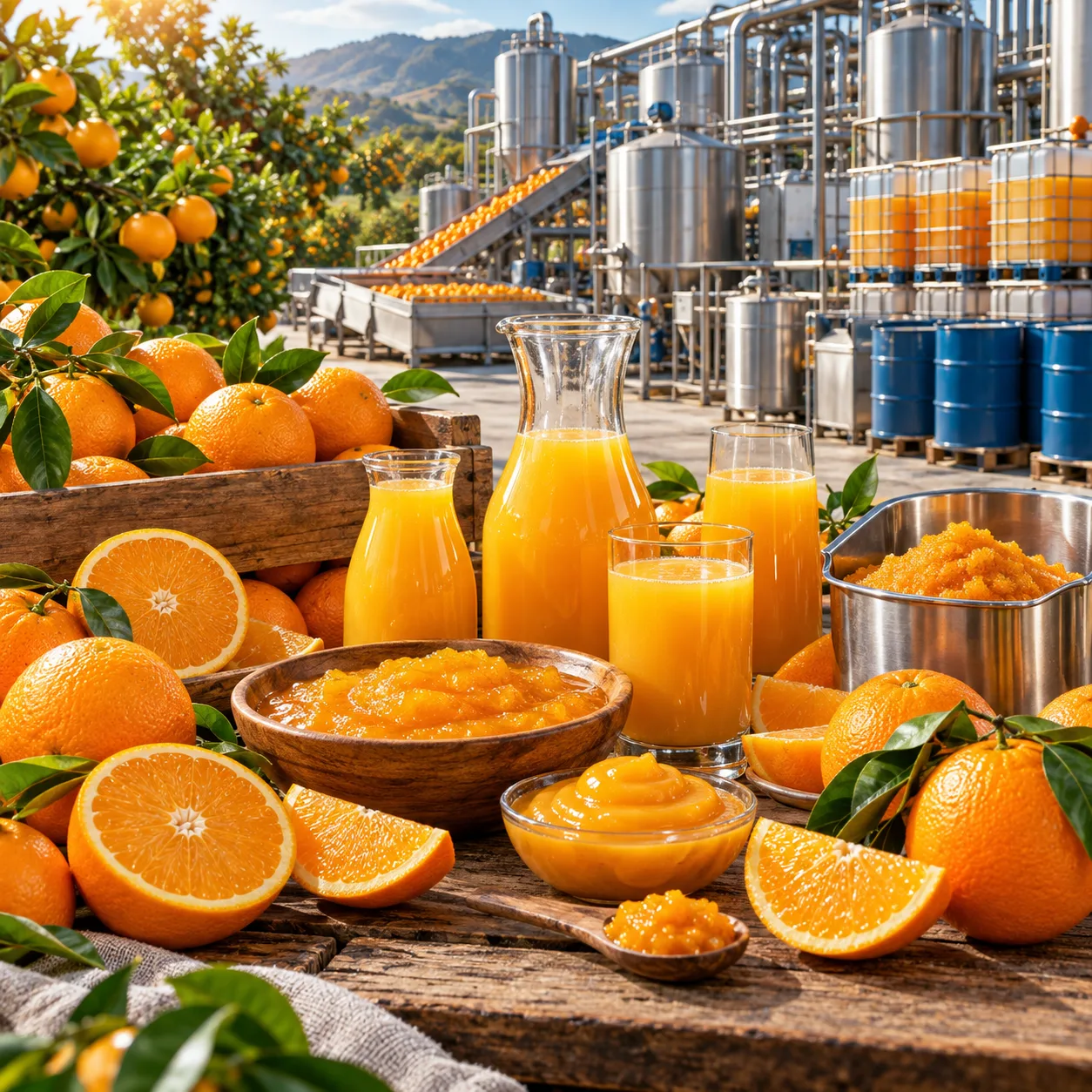
Specify concentration, pulp and processing format.
65° Brix Orange Concentrate
Approximately 65° Brix is a widely used industrial concentrate strength. It provides high soluble solids and significantly reduces water compared with single-strength orange juice, improving transport and storage efficiency.
Pulp-Containing Concentrate
Commercial orange concentrate can retain measurable pulp. Representative 65° Brix products specify approximately 4–12% pulp, although different levels can be produced depending on the supplier and intended beverage style.
Low-Pulp / Clarified Options
Lower-pulp or more highly clarified products may be preferred for syrups, confectionery, clear beverage systems or processes where suspended solids could interfere with filtration or filling equipment.
NFC Orange Juice
Not-from-concentrate orange juice is a separate commercial format that remains close to single-strength juice solids. It requires more storage and transportation volume but may suit products positioned specifically around NFC juice.
Specifications commercial buyers should review.
Orange concentrate should be purchased against a complete technical specification rather than Brix alone. Fruit origin, variety, maturity, acidity, pulp and processing method can materially affect sensory performance.
Soluble Solids / °Brix
Representative 65° Brix orange concentrate specifications commonly show direct or acid-corrected Brix close to 64–66°. The agreed target and test method should be stated clearly because acid correction can affect the reported value.
pH & Titratable Acidity
Commercial orange concentrate remains strongly acidic. Representative 65° Brix products may show pH around 2.4–4.4 and titratable acidity around 3.95 ±1.05% expressed as citric acid, although crop and origin can produce substantial variation.
Brix-to-Acid Ratio
The relationship between soluble solids and acidity strongly influences perceived sweetness and overall orange flavor. Concentrates with similar Brix can taste noticeably different if acid levels differ.
Pulp
Pulp affects mouthfeel, cloud, sedimentation and beverage appearance. Representative industrial 65° Brix specifications can use approximately 4–12% pulp, but the appropriate target depends on the finished product.
Specific Gravity
Representative 65° Brix orange concentrate can have specific gravity around 1.313–1.331 at the defined test temperature. Specific gravity is useful when converting plant dosing between volume and weight.
Color & Appearance
Good-quality concentrate should show characteristic orange to deep-orange coloration. Variety, maturity, heat history and storage can affect the final color and should be evaluated after reconstitution.
Flavor & Aroma
The concentrate should have a full, characteristic orange profile and be free from fermented, scorched, excessively caramelized or otherwise objectionable flavor. Aroma recovery and blending practices can affect the final sensory profile.
Microbiological Specification
Commercial specifications typically establish limits for total plate count, yeast and mold. Appropriate acceptance criteria depend on the concentrate process, package, storage conditions and intended finished-product treatment.
Specification note: Values shown here are typical commercial reference points rather than universal orange concentrate standards. Always formulate and purchase against the supplier's current specification and lot-specific certificate of analysis.
Single-strength orange juice reference.
For U.S. percentage-juice calculations, FDA uses 11.8° Brix as the minimum single-strength reference for orange juice. Actual commercial reconstitution should use the concentrate's measured Brix, density and supplier instructions.
65° Brix Concentrate
A representative commercial 65° Brix orange concentrate specifies reconstitution at approximately one volume of concentrate to 5.93 volumes of water to reach its single-strength target. Weight-based calculations should account for concentrate density rather than using the same numerical ratio.
Percentage-Juice Calculations
Where a finished beverage is represented as containing fruit juice, calculate juice equivalent from the actual concentrate specification and current regulatory requirements rather than relying on a generic dilution estimate.
Where orange juice concentrate is used.
Reconstituted Orange Juice
One of the largest applications is production of orange juice from concentrate. Water is added back to the concentrate and the final product is standardized for soluble solids, acidity, pulp and sensory profile before packaging.
Juice Blends & Fruit Drinks
Orange concentrate is used in mixed-fruit juices, nectars, breakfast drinks and juice beverages. It pairs well with mango, pineapple, peach, passion fruit, apple, carrot, berry and other citrus ingredients.
Carbonated & Sparkling Beverages
Orange concentrate can contribute real fruit solids, acidity and citrus flavor to carbonated soft drinks, sparkling juice drinks and mixers. Pulp level should be chosen with carbonation and filling performance in mind.
Sports & Nutrition Drinks
The familiar citrus profile suits sports beverages, nutrition drinks and hydration products. The concentrate's natural acidity and soluble solids should be included when balancing sweeteners, minerals and other functional ingredients.
Smoothies & Tropical Blends
Orange adds brightness and acidity to smoothie formulations and works particularly well with banana, mango, pineapple, strawberry, peach and passion fruit.
Yogurt & Dairy Applications
Orange can be used in drinking yogurt, fruit preparations and selected cultured products. Because citrus acidity can destabilize proteins, pH, addition sequence and stabilizer system should be validated carefully.
Confectionery & Gummies
Gummies, chews, hard candy, fruit snacks and confectionery fillings can use orange concentrate for recognizable citrus flavor, natural acidity and fruit-derived soluble solids.
Bakery & Dessert Products
Applications include cake systems, fillings, glazes, dessert sauces and bakery preparations. Heat can reduce fresh citrus aroma, so flavor should be evaluated after the actual baking or thermal process.
Ice Cream & Frozen Desserts
Orange concentrate can be used in sorbets, sherbet-style products, frozen fruit bars, ice cream preparations and frozen yogurt. Sugar and acidity influence freezing behavior and should be included in formulation calculations.
Sauces, Syrups & Marinades
Orange concentrate provides sweet citrus character in dessert syrups, glazes, marmalade-style preparations, savory sauces and marinades. It pairs especially well with ginger, chili, soy, herbs and warm spices.
Brewing & Fermentation
Brewers and fermentation producers can use orange concentrate in beer, cider blends, kombucha, mead and other fermented beverages. Fermentation changes sweetness and citrus aroma, so addition timing should be evaluated at pilot scale.
Foodservice & Beverage Syrups
Concentrated orange is used in fountain beverages, smoothie bases, beverage syrups and foodservice drink systems where standardized flavor, convenient storage and controlled dilution are important.
Protect citrus aroma while controlling pulp and acidity.
Protect Volatile Aroma
Orange aroma contains highly volatile compounds that can be lost during evaporation, heating and storage. Commercial processors may recover essence or aroma fractions for later recombination, while finished-product manufacturers should minimize unnecessary heat exposure.
Balance Natural Acidity
Orange concentrate already contributes substantial citric acidity. Additional acids should be adjusted only after the contribution from the concentrate has been evaluated in the complete formulation.
Manage Pulp & Cloud
Pulp can improve authentic orange-juice mouthfeel but can also affect settling, pumps, homogenization and filling. Specify pulp level based on the finished product rather than assuming all 65° Brix orange concentrates are equivalent.
Limit Oxidation
Oxygen exposure can reduce fresh citrus aroma and contribute to flavor deterioration. Where product quality is sensitive, consider deaeration, controlled headspace and appropriate package oxygen protection.
Orange flavor should always be evaluated after the complete commercial process. Pasteurization, hot filling, freezing, carbonation and extended storage can all change the balance between sweetness, acidity, aroma and bitterness.
Compare Brix, acidity, pulp and sensory profile together.
Two orange concentrates sold at the same nominal Brix can differ substantially in acidity, pulp, color, bitterness, aroma intensity and origin. These differences can affect required dosage and finished-product quality.
Information to include in a sourcing request
- Orange juice concentrate and required Brix
- Direct or acid-corrected Brix requirements if applicable
- Target acidity or Brix-to-acid ratio
- Pulp range or clarification requirement
- Color and sensory requirements
- Conventional or certified organic requirement
- Preferred origin or variety if important
- Sample or pilot quantity
- Commercial order size and estimated annual volume
- Frozen or aseptic preference
- Required certifications and documentation
- Delivery destination and requested timing
Major orange-processing programs operate across several producing regions, and crop timing, weather, disease pressure, fruit quality and processing capacity can affect global concentrate availability. Large recurring programs should consider forecasting requirements and qualifying alternate approved origins where practical.
Commercial note: Do not compare orange concentrate offers by price per pound alone. Evaluate actual Brix, acidity, pulp, flavor intensity, packaging, freight, storage requirements and required formulation dosage.
Match the supply format to production requirements.
Frozen Drums
Frozen orange concentrate is commonly supplied in lined drums and smaller pails. Maintaining the specified frozen temperature helps preserve flavor and supports extended unopened shelf life.
Aseptic Packaging
Aseptic bag-in-box or drum formats may offer more flexible unopened storage than conventional frozen concentrate. Storage conditions still depend on the specific product and supplier process.
Certificate of Analysis
Review each commercial lot against the agreed specification. Relevant parameters may include direct and corrected Brix, acidity, pH, pulp, microbiological results and any customer-specific requirements.
Traceability & Certifications
Request country of origin, lot traceability, ingredient and allergen documentation and applicable food-safety certifications. Organic projects should also verify current certification for the exact product and supplying facility.
Storage life varies substantially with packaging. For example, current commercial 65° Brix programs include both conventional frozen drum products and aseptic formats with different refrigerated and ambient storage allowances. Follow the exact supplier storage specification rather than applying one shelf-life assumption to all orange concentrate.
See how ingredient format affects formulation.
Gummies & Chews
Using Juice Concentrates in Gummies & Chews: Formulation Guide
Juice ConcentratesToddler Snacks
Toddler Snacks with Juice Concentrates: Sourcing & Process Considerations
Juice ConcentratesHotel & Catering
Using Juice Concentrates in Hotel & Catering: Formulation Guide
Questions orange concentrate buyers often ask
What is orange juice concentrate?
Orange juice concentrate is produced by extracting juice from oranges and removing a substantial portion of its water. This creates a high-solids ingredient with concentrated orange flavor, natural sugars and acidity.
What Brix is commercial orange juice concentrate?
Approximately 65° Brix is a common industrial grade. Representative specifications typically fall around 64–66° Brix, although direct and acid-corrected measurements may be reported separately.
What pH and acidity are typical?
A representative commercial 65° Brix concentrate may fall around pH 2.4–4.4 with titratable acidity near 3.95 ±1.05% expressed as citric acid. Actual values vary by fruit origin, crop and processor.
What is the single-strength Brix reference for orange juice?
For U.S. percentage-juice calculations, FDA uses 11.8° Brix as the minimum single-strength reference for orange juice.
Why should pulp be specified?
Pulp influences beverage mouthfeel, cloud, settling and filling performance. Representative orange concentrate grades may contain approximately 4–12% pulp, while lower-pulp products are also available for different applications.
What is bulk orange juice concentrate used for?
Applications include reconstituted orange juice, mixed-fruit beverages, smoothies, carbonated drinks, sports and nutrition beverages, yogurt, confectionery, bakery, frozen desserts, sauces, syrups, foodservice beverages and fermented products.
Is organic orange juice concentrate available?
Certified organic orange concentrate is available from some suppliers, but supply can vary by crop, origin and processor. Request current organic certification and lot-specific documentation for the exact offered product.
What should I include in a quote request?
Provide the target Brix, acidity or ratio requirements, pulp specification, quantity, annual demand, organic or conventional status, preferred origin, packaging, storage capability, destination, certifications and requested delivery timing.