Onion Juice Concentrate
Bulk onion juice concentrate for soups, sauces, dressings, marinades, ready meals, meat and plant-based products, seasonings and other commercial savory applications, with conventional and organic sourcing options subject to availability.
Concentrated savory flavor from fresh onion juice.
Onion (Allium cepa) is one of the most widely used culinary vegetables and a foundational flavor ingredient in savory food manufacturing. White, yellow, brown, red and sweet onion types differ in pungency, sweetness, color and aroma, while growing conditions and maturity also influence their processing characteristics.
Fresh onion develops its characteristic pungent aroma when plant tissue is cut or crushed and naturally occurring sulfur-containing precursors are converted into volatile flavor compounds. Heating changes this profile, reducing sharp raw notes and developing softer, sweeter and more cooked onion character.
Onion juice concentrate is typically produced by pressing or extracting onion juice, removing insoluble material as required and evaporating water under controlled conditions. Vacuum concentration can reduce processing temperature and help retain more characteristic onion flavor than severe open heating.
- Highly concentrated grades commonly fall around 68–76° Brix
- Flavor may range from pungent fresh onion to balanced or cooked onion
- Typical appearance ranges from amber to medium or dark brown
- Water-soluble and suitable for liquid food-processing systems
- Conventional and certified organic programs may be available
- Bulk drums, pails, aseptic packs or IBC formats vary by supplier
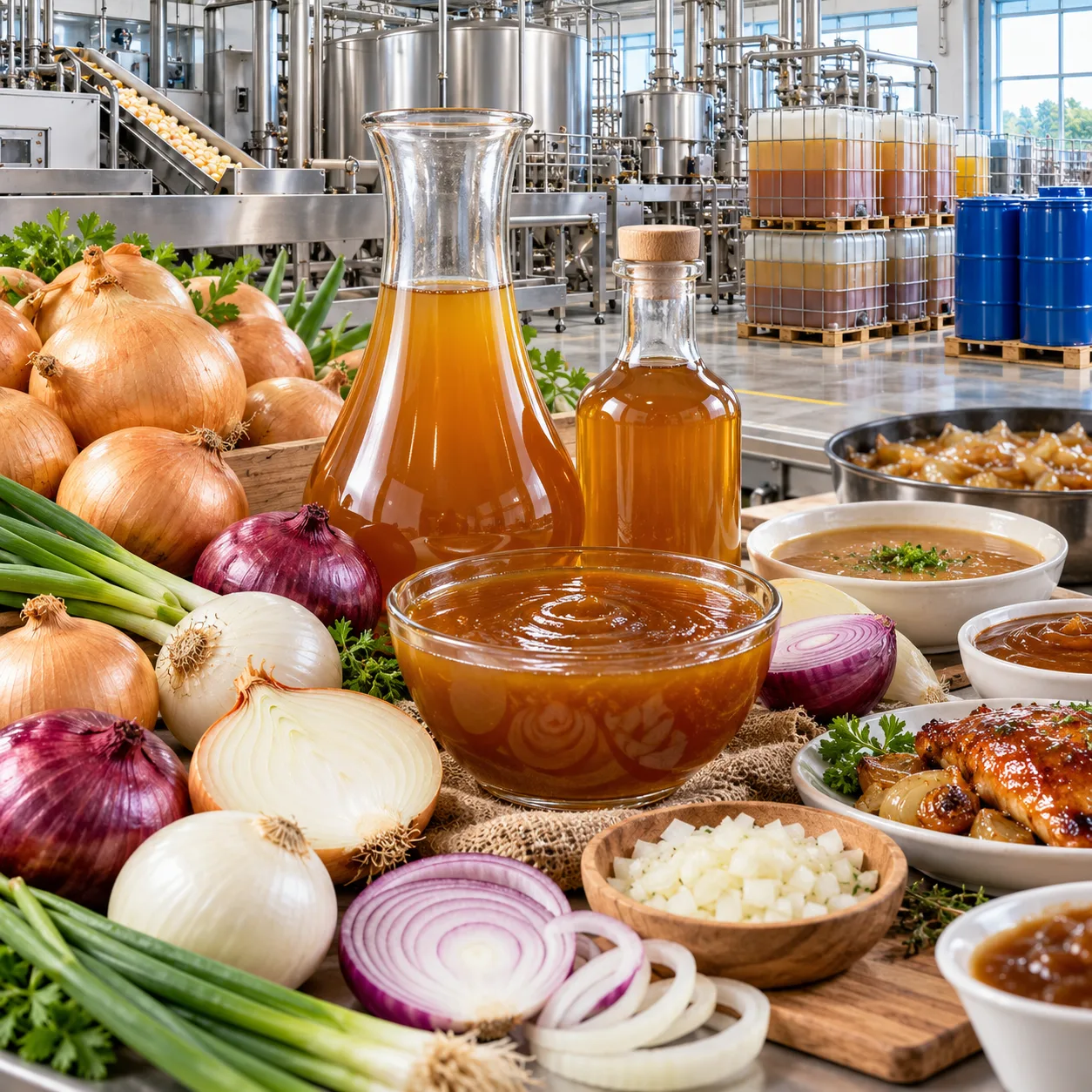
Not every onion concentrate tastes the same.
Fresh / Pungent Onion
Grades processed to retain sharper sulfurous notes can provide a more immediate raw-onion impression. These are useful in dressings, dips, marinades and other applications where a bright onion top note is desired.
Balanced Onion
Some concentrates combine fresh and cooked characteristics, providing a broad onion foundation suitable for soups, sauces, gravies, meat products and prepared foods.
Cooked / Sweet Onion
Greater thermal development can create softer, sweeter and more rounded onion character. This profile can fit gravies, stews, roasted flavor systems, ready meals and caramelized-style sauces.
Umami-Oriented Grades
Specialized onion concentrates may be standardized for savory depth rather than strong raw-onion identity. These can support soups, sauces, seasonings, meat systems and plant-based foods where overall taste enhancement is important.
Commercial specifications buyers should review.
Onion concentrate should be purchased against a detailed technical and sensory specification. Brix alone does not define flavor performance because onion variety, pungency, concentration method and heat history can significantly affect the finished ingredient.
Soluble Solids / °Brix
Current commercial specifications include concentrated onion juice in approximately the 68–76° Brix range, while other suppliers offer about 65–72° Brix or standardized 70–72° grades. The exact target and tolerance should be confirmed before formulation.
pH
Representative commercial specifications commonly place concentrated onion juice around pH 4.0–5.6. Actual values vary with onion source and process and should be checked where pH affects preservation or finished-product stability.
Specific Gravity
A high-solids onion concentrate may have apparent specific gravity around 1.33–1.39 under defined test conditions. Density data are useful for plant dosing, inventory calculations and weight-to-volume conversions.
Color & Appearance
Concentrate commonly ranges from pale amber to medium or dark brown. Color depends on concentration level, onion type, heat history and the intended flavor profile.
Flavor & Odor
The ingredient should have the agreed onion profile—fresh, pungent, balanced, cooked or sweet—with no putrid, fermented, burnt or otherwise objectionable odor. Sensory standards are especially important because flavor intensity is difficult to define by Brix alone.
Insoluble Material
Clear commercial concentrate can contain very little insoluble material; one current specification sets insolubles below 1%. Low insolubles can simplify pumping, blending and use in smooth sauces or liquid seasoning systems.
Pungency / Pyruvate
Some suppliers report pyruvate or related analytical values as an indication of onion pungency. Where sharp onion character is commercially important, sensory evaluation and supplier-defined pungency measurements can be included in the purchasing specification.
Microbiological Criteria
Microbiological specifications vary substantially with concentration, process and storage system. Review total plate count, yeast, mold and relevant pathogen criteria against the intended manufacturing process rather than assuming one limit for every concentrate.
Specification note: The figures above are representative market references, not universal standards. Formulation and purchasing should use the supplier's current technical specification, sensory standard and lot-specific certificate of analysis.
Where onion juice concentrate is used.
Soups, Stocks & Broths
Onion concentrate can provide a consistent savory foundation in vegetable, chicken, beef, cream and blended soups. Its liquid format disperses quickly and avoids the preparation and yield variation associated with fresh onion.
Sauces & Gravies
Pasta sauces, brown gravies, cooking sauces, barbecue sauces and savory reductions can use onion concentrate as a base flavor or supporting taste component. Cooked-onion grades are particularly suitable for long-cooked profiles.
Dressings & Dips
Fresh or balanced onion profiles can be used in salad dressings, creamy dips, vegetable spreads, sour-cream-style products and emulsified sauces where rapid flavor dispersion is useful.
Marinades & Glazes
Onion concentrate combines well with garlic, soy, tomato, vinegar, herbs, spices and sweeteners in marinades for meat, poultry, seafood and vegetables.
Ready Meals & Prepared Foods
Frozen entrées, meal kits, prepared sides, fillings, rice dishes and convenience foods can use concentrated onion to standardize savory flavor without storing or processing fresh onions at the manufacturing plant.
Meat & Poultry Products
Burgers, meatballs, sausages, meatloaf, cooked poultry and other processed-meat systems can use onion concentrate for a uniform savory base without introducing visible onion pieces or additional particulate texture.
Plant-Based & Hybrid Foods
Plant-based burgers, meat alternatives, protein fillings and hybrid products can use onion concentrate to build cooked, roasted and savory depth while maintaining a simple vegetable-derived ingredient declaration.
Seasonings & Flavor Bases
Liquid seasonings and intermediate flavor bases can use onion concentrate alongside garlic, celery, carrot, tomato, herbs, spices and yeast-derived ingredients. Concentrate may also serve as feedstock for dried or encapsulated flavor systems.
Snack Foods
Crackers, extruded snacks, coated nuts and savory snack products can use onion-derived liquid flavor systems directly or through converted dry seasoning formats.
Pizza, Pasta & Culinary Fillings
Pizza sauces, pasta fillings, vegetable fillings and savory bakery preparations can use onion concentrate to create a consistent onion background without adding fresh vegetable pieces.
Vegetable Bases & Mirepoix Systems
Onion concentrate can be combined with carrot and celery ingredients in liquid mirepoix-style bases for soups, sauces, stocks, prepared meals and institutional food production.
Foodservice Concentrates
Soup bases, gravy concentrates, sauce bases and other foodservice products can use high-Brix onion concentrate to reduce storage volume while delivering repeatable flavor after dilution.
Control flavor development through heat, dosage and addition point.
Fresh vs. Cooked Character
Onion flavor changes significantly with heat. Sharp sulfurous notes decrease during prolonged cooking while sweeter and more rounded cooked flavors develop. Select the concentrate grade and addition point according to the desired finished profile.
Protect Volatile Flavor
Some characteristic onion sulfur compounds are volatile. Long heating or excessive aeration can reduce fresh-onion impact, so later addition may help where a brighter top note is required and the process allows it.
Account for High Solids
Concentrated onion contributes soluble vegetable solids and naturally occurring sugars. In sauces and gravies, these solids can influence sweetness, viscosity, browning and final flavor intensity.
Validate Plant Handling
High-Brix onion concentrate is viscous, particularly at lower temperatures. Pump capacity, transfer lines, dosing equipment and mixing should be evaluated at the actual plant handling temperature.
Because onion concentrate can be many times more flavor-intense than fresh onion juice, direct weight-for-weight replacement of fresh onion is rarely appropriate. Establish the inclusion level through sensory trials in the complete formulation.
Why manufacturers use concentrated onion instead of fresh onion.
Consistent Dosing
Liquid concentrate can provide tighter control over onion flavor from batch to batch than fresh onions, whose pungency, dry matter and moisture change with variety, crop and storage conditions.
Reduced Preparation
Concentrate eliminates peeling, chopping, trimming and fresh-onion preparation at the food plant and can reduce vegetable waste associated with raw onion handling.
Lower Storage Volume
Removing water produces a compact ingredient with substantially less volume than fresh onion or single-strength juice, which can simplify warehouse and transport requirements.
No Added Particulate Texture
Clear or low-insoluble concentrate provides onion taste without visible onion pieces, making it useful in smooth sauces, gravies, marinades, dressings and processed-protein systems.
Specify flavor profile as carefully as Brix.
Two onion concentrates at the same soluble-solids level can deliver very different sensory results. Buyers should evaluate raw-material origin, fresh-versus-cooked profile, pungency, color and processing method together with Brix and price.
Information to include in a sourcing request
- Onion juice concentrate and preferred flavor profile
- Target Brix or existing technical specification
- Fresh, balanced, cooked or sweet-onion character
- Required color or clarity
- Critical pH or pungency requirement if applicable
- Conventional or certified organic status
- Preferred origin if relevant
- Initial sample or production-trial quantity
- Commercial order size and estimated annual volume
- Preferred pack format and storage conditions
- Required certifications and quality documentation
- Delivery destination and requested timing
Commercial note: Compare onion concentrates on delivered flavor performance rather than price per pound alone. A more concentrated or more flavor-intense grade may require a lower use rate and therefore produce a different cost-in-use.
Select a supply format that fits plant volume and handling.
Drums
Industrial onion concentrate is commonly supplied in lined or sealed drums. Drum format is well suited to regular commercial production and allows controlled lot identification and inventory management.
Pails & Smaller Packs
Smaller pails or containers may be available for product development, pilot trials or lower-volume manufacturing, depending on the supplier program.
Aseptic & Shelf-Stable Formats
Some high-Brix onion concentrates are supplied in shelf-stable or aseptic systems. Storage temperature and unopened shelf life vary by processor and should be confirmed on the technical specification.
IBCs & Larger Bulk
Higher-volume customers may be able to source IBC or larger formats. Evaluate pump compatibility, partial-container handling and expected usage rate before selecting the largest available package.
Even where high soluble solids provide good inherent stability, onion aroma can slowly change during storage. Darkening and gradual loss of volatile fresh-onion notes can become practical shelf-life considerations, so the supplier's recommended temperature and use period should be followed.
Review analytical data together with sensory approval.
Certificate of Analysis
The lot-specific COA should be compared with the contracted requirements for Brix, pH, microbiological criteria and other agreed analytical parameters before commercial use.
Sensory Standard
Because onion flavor cannot be defined adequately by Brix alone, maintain an approved sensory reference or clearly defined flavor description when consistency is important to the finished product.
Ingredient & Allergen Information
Confirm whether the product is 100% onion juice concentrate or contains carriers, salt, acids, preservatives or other ingredients. Request applicable allergen and processing-aid documentation.
Origin & Certifications
Country of origin, lot traceability, food-safety certification and organic, Kosher, Halal or other program documents can be requested according to customer requirements.
See how ingredient format affects formulation.
Fruit Wine
Fruit Wine with Juice Concentrates: Sourcing & Process Considerations
Juice ConcentratesCarbonated Soft Drinks
Using Juice Concentrates in Carbonated Soft Drinks: Formulation Guide
Juice ConcentratesFrozen Novelties
Frozen Novelties with Juice Concentrates: Sourcing & Process Considerations
Questions onion concentrate buyers often ask
What is onion juice concentrate?
Onion juice concentrate is produced by extracting juice from onions and removing a substantial portion of its water, typically under vacuum. The resulting high-solids liquid provides concentrated onion flavor and soluble vegetable solids.
What Brix is commercial onion juice concentrate?
Highly concentrated commercial grades commonly fall around 68–76° Brix, while other products may be standardized around 65–72° Brix. Always use the actual supplier specification for formulation.
What pH is typical?
Representative commercial onion concentrate specifications commonly fall around pH 4.0–5.6. Exact values depend on raw material and process and should be confirmed from the lot-specific data.
Does onion concentrate taste like raw or cooked onion?
Both types of profile are available. Processing can be designed to retain sharper fresh-onion notes or develop softer cooked and sweet notes. Some grades intentionally combine both characteristics.
What is bulk onion juice concentrate used for?
Major applications include soups, stocks, broths, sauces, gravies, dressings, dips, marinades, ready meals, meat and poultry products, plant-based foods, seasonings, snack products, culinary fillings and foodservice bases.
Why use concentrate instead of fresh onion?
Concentrate can reduce preparation labor and waste, provide more consistent dosing, require less storage volume and deliver onion flavor without adding visible vegetable pieces or substantial extra water.
Is organic onion juice concentrate available?
Certified organic onion concentrate is available through some commercial programs. Availability varies by origin and processor, so request current certification covering the specific product and supplying facility.
What should I include in a quote request?
Provide the desired onion flavor profile, Brix or specification, quantity, annual demand, organic or conventional status, preferred packaging, storage capability, destination, certification requirements and requested delivery timing.