Mushroom Puree
Smooth mushroom puree for soups, sauces, gravies, ready meals, plant-based foods, fillings and foodservice manufacturing, with conventional, organic, frozen and acidified aseptic options subject to availability.
Savory mushroom flavor, umami and body in a pumpable puree.
Mushrooms are fungi rather than botanical fruits or vegetables, although they are used commercially as savory vegetable ingredients. Agaricus bisporus is the most familiar processing species and includes white button, brown or cremini, and mature portobello mushrooms.
Commercial puree converts cleaned mushrooms into a consistent, pumpable ingredient that can reduce washing, trimming, cooking and milling work at the manufacturing plant. Depending on raw material and process, the flavor can range from mild fresh mushroom to deeper cooked and savory notes.
- Commonly produced from Agaricus bisporus
- Mild earthy flavor with characteristic savory and umami notes
- Smooth or controlled-texture puree formats
- Useful for distributing mushroom flavor uniformly through a product
- Frozen and acidified aseptic formats are commercially available
- Conventional and certified organic options may be available
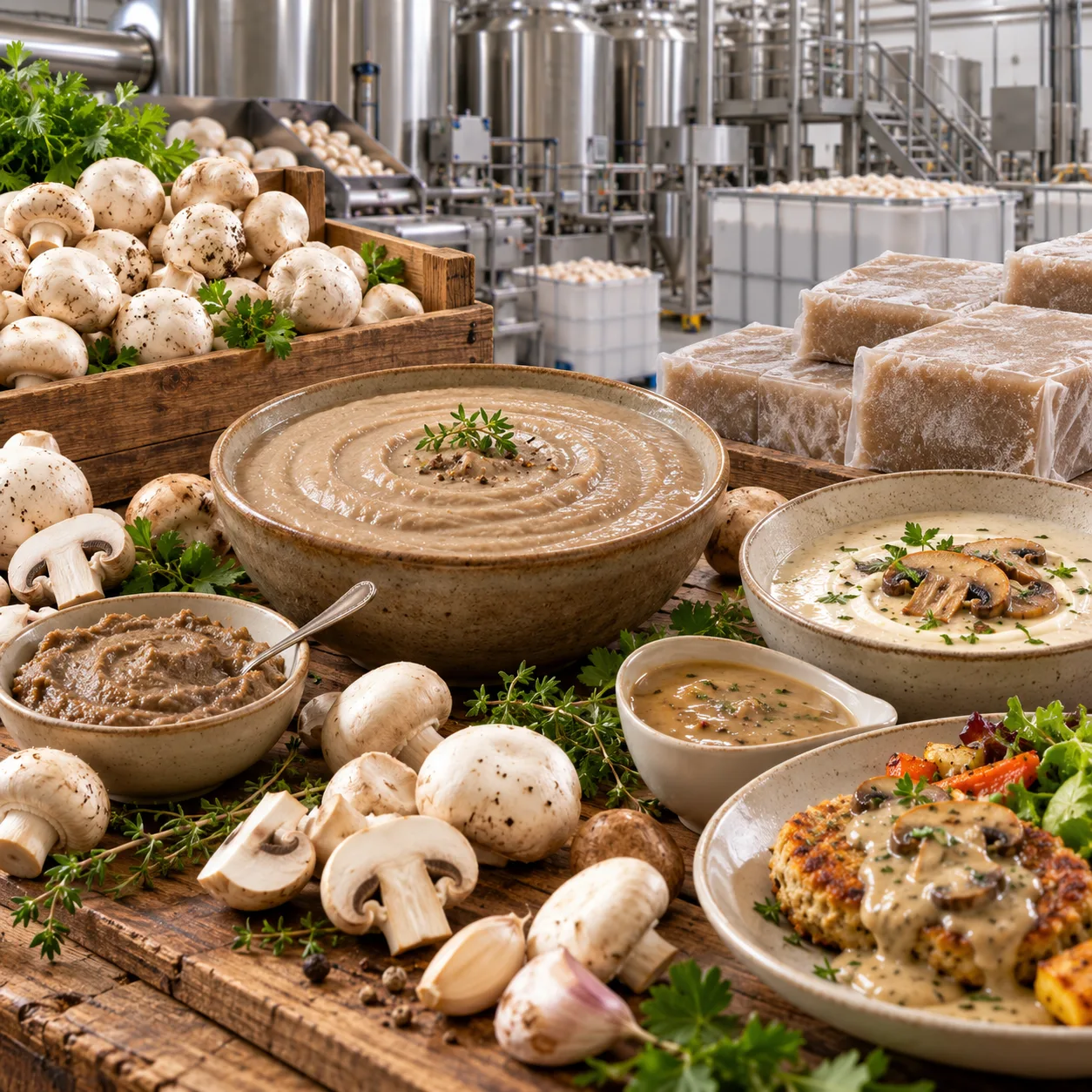
Species and cooking profile determine the finished flavor.
White Button, Cremini & Portobello
White button and brown cremini mushrooms are forms of Agaricus bisporus. Portobello is the more mature stage of the same species and generally develops a stronger flavor and darker appearance.
White button mushrooms are often suitable where a mild flavor and lighter puree are preferred, while brown mushrooms can provide deeper color and a more pronounced cooked profile.
Raw vs. Cooked Flavor
Mushroom flavor changes substantially with thermal processing. Blanching or light cooking produces a relatively mild profile, while stronger cooking can develop deeper roasted, sautéed and savory notes.
Buyers should therefore specify the desired sensory profile rather than assuming all mushroom purees taste the same.
Mushroom species, maturity, raw-material color and thermal treatment can all affect the puree's flavor and appearance. Approve representative production samples where sensory consistency is commercially important.
Mushroom puree requires a savory-ingredient specification.
Unlike fruit puree, Brix is not usually the primary quality measure. Buyers typically place greater emphasis on mushroom species, ingredient declaration, solids, consistency, particle size, color, flavor, microbiology and processing method.
Physical & Chemical Parameters
- Mushroom species and raw-material type
- Total solids or dry matter where required
- °Brix as a secondary process-control parameter
- pH and titratable acidity
- Viscosity or Bostwick consistency
- Screen size and particle distribution
- Color and sensory specification
- Added salt, acid or other ingredients if present
Published Commercial Example
One current commercial mushroom puree program lists approximately 1–4 °Brix and acidity around 0.03–0.10%, with frozen and acidified aseptic formats.
These values are supplier-specific examples rather than universal limits. Different species, solids levels and acidification systems can produce substantially different specifications.
Always approve the current supplier specification and lot-specific Certificate of Analysis. Comparing mushroom puree solely by Brix can be misleading because solids, texture and cooking profile may differ.
Natural mushroom puree is a low-acid savory ingredient.
Frozen Mushroom Puree
Frozen puree can preserve a formulation close to the processor's cooked mushroom profile without relying on acidification for ambient stability.
Manufacturers should define frozen storage, controlled thawing, post-thaw holding time and microbiological handling procedures before routine production.
Acidified Aseptic Puree
Commercial processors may acidify mushroom puree and apply a validated thermal and aseptic process to support a different storage and distribution system.
Acidified puree can differ noticeably in flavor from natural frozen mushroom puree, so acid type, target pH and finished sensory impact should be reviewed during product development.
Natural mushroom puree should generally be treated as a low-acid food. Do not assume ambient shelf stability from the package alone; shelf-stable supply requires an appropriate validated commercial process.
Where mushroom puree is used commercially.
Soups & Broths
Mushroom puree is particularly useful in cream of mushroom soup, mushroom bisques, condensed soups, broths and soup bases.
It distributes mushroom flavor throughout the product while adding body and reducing reliance on separately chopped mushrooms for baseline flavor.
Sauces & Gravies
Applications include mushroom sauce, cream sauce, brown gravy, pasta sauce, steak sauce and other savory systems requiring uniform mushroom character.
Puree can be paired with visible mushroom pieces when both strong flavor distribution and recognizable texture are desired.
Ready Meals & Prepared Foods
Mushroom puree can be incorporated into frozen meals, casseroles, pasta dishes, risotto, grain bowls, meal-kit sauces and other prepared-food systems.
A pumpable puree simplifies dosing and can help maintain more consistent mushroom flavor between production batches.
Plant-Based Meat Alternatives
Mushrooms are used in plant-based burgers, meatless fillings, savory patties and hybrid meat products because their flavor complements roasted and savory seasoning systems.
Puree can also contribute moisture and mouthfeel, although its effect on binding and texture should be validated in the complete formula.
Meat & Poultry Products
Mushroom ingredients can be used in meatballs, patties, sausages, meat sauces and blended meat products to contribute savory flavor, moisture and mushroom identity.
Dosage should be optimized according to desired mushroom intensity and finished-product texture.
Pasta, Ravioli & Savory Fillings
Mushroom puree provides a convenient base for ravioli, tortellini, stuffed pasta, savory pastry and dumpling fillings.
Cheese, breadcrumbs, starches or other solids may be used to adjust moisture and depositability for automated filling equipment.
Dips, Spreads & Condiments
Applications include mushroom spreads, savory dips, sandwich spreads, pâté-style products and condiment bases.
The puree can be blended with herbs, roasted garlic, onion, cream-style ingredients or plant-based fats depending on the concept.
Baby Food
Fine-screened mushroom puree can be incorporated into selected savory infant and toddler meals, vegetable blends and prepared protein dishes.
Baby-food programs may require tighter pesticide-residue, heavy-metal, microbiological and traceability specifications.
Pet Food
Mushroom puree may be used in selected wet pet-food, topper and specialty formulation programs where the approved species and ingredient declaration fit the customer's nutritional and regulatory requirements.
Foodservice & Central Kitchens
Bulk puree can reduce washing, slicing and cooking labor in restaurants, hotels, commissaries and central kitchens producing soups, gravies, sauces and savory fillings.
Smaller pail or bag-in-box formats can be useful where full drums exceed normal production usage.
Control flavor intensity, color and consistency during scale-up.
Umami & Savory Character
Mushroom puree can deepen savory flavor and complement ingredients such as onion, garlic, tomato, yeast extract, herbs and roasted vegetable flavors.
The exact impact depends on mushroom species and the processor's cooking profile.
Color
Puree color can range from light beige to brown depending on the mushroom type and thermal process. Brown mushroom or strongly cooked puree can noticeably darken cream sauces and pale fillings.
Consistency
Solids concentration, screen size and processing temperature affect viscosity and pumpability. A defined consistency range is useful where automated dosing or depositing requires repeatable flow.
Formats for development through industrial production.
Bags, Pails & Bag-in-Box
Smaller commercial formats can support foodservice, product development and lower-volume manufacturing. Published programs include approximately 3–20 kg bags, while other suppliers offer pails and bag-in-box configurations.
Industrial Drums
Bulk mushroom puree can be supplied in lined industrial drums. Published commercial examples include approximately 180–200 kg net weight per drum.
IBC Totes & Large Volume
High-volume programs may use approximately 1,000 kg IBC containers, larger totes or other bulk systems depending on product viscosity, storage requirements and supplier capability.
Pack size does not determine storage condition. Verify whether the quoted puree is frozen, refrigerated, acidified aseptic or supplied under another validated storage system.
Specify mushroom species and process before comparing offers.
Technical Requirements
- Mushroom species and raw-material type
- Natural or acidified formulation
- Total solids and Brix where specified
- pH and acidity
- Screen size and particle specification
- Viscosity or Bostwick consistency
- Color and cooked-flavor profile
- Microbiological acceptance limits
Commercial Requirements
- Conventional or certified organic grade
- Frozen or acidified aseptic preference
- Trial quantity and expected annual volume
- Pail, bag-in-box, drum or tote preference
- Country-of-origin requirements
- Delivery destination in the United States
- Required shipment schedule
- Certification and documentation requirements
Compare offers on equivalent mushroom species, solids level, processing method and ingredient declaration. A natural frozen puree and an acidified aseptic puree can have noticeably different flavor and handling characteristics.
Documents commonly reviewed during supplier approval.
Technical Documentation
- Current product specification
- Lot-specific Certificate of Analysis
- Mushroom species declaration
- Complete ingredient and acidification statement
- Microbiological specification
- Storage and shelf-life information
- Packaging and handling specification
Certification & Supply Documents
- Organic certificate when applicable
- Food-safety certification information
- Baby-food documentation where required
- Kosher or other requested certification
- GMO status where required
- Country-of-origin and traceability information
- Commercial quotation and delivery terms
Explore formulation and sourcing considerations.
Pet Food
Using Purees in Pet Food: Texture & Formulation Considerations
Ingredient SourcingFermentation
Puree Handling & Sourcing: Commercial Process Considerations
Ingredient FormulationSpecialty Applications
Using Purees in Complex Formulations: Texture & Flavor Considerations
Mushroom puree sourcing questions
What is commercial mushroom puree?
Commercial mushroom puree is produced from cleaned edible mushrooms that are cooked or blanched as required, milled and refined into a smooth or controlled-texture savory ingredient.
Which mushroom species is commonly used?
Agaricus bisporus is common and includes white button, brown or cremini, and portobello mushrooms. Other edible mushroom species may also be processed, so species should be specified when it matters to flavor or labeling.
What is the typical Brix of mushroom puree?
One published commercial mushroom puree specification lists approximately 1–4 °Brix. Brix is a secondary parameter for this product; species, solids, consistency, particle size and flavor are generally more informative.
Is mushroom puree a low-acid food?
Natural mushroom puree should generally be treated as a low-acid product unless specifically acidified. Ambient-stable products therefore require an appropriately designed and validated commercial process.
What is bulk mushroom puree used for?
Major applications include soups, broths, sauces, gravies, ready meals, plant-based meat alternatives, blended meat products, ravioli and savory fillings, dips, spreads, baby food, pet food and foodservice preparations.
What is the difference between frozen and acidified aseptic puree?
Frozen puree relies on cold-chain storage, while acidified aseptic puree uses controlled acidification together with a validated thermal and aseptic process. The acidified version can have a different flavor profile, so the formats should be evaluated separately.
Is organic mushroom puree available?
Yes. Certified organic mushroom puree is commercially available from selected suppliers. Request current certification for the exact mushroom species and product being quoted.
How is commercial mushroom puree packaged?
Commercial formats can include smaller bags, pails and bag-in-box, industrial drums around 180–200 kg and larger IBC systems around 1,000 kg. Exact net weights depend on supplier and process format.
What information should I provide for a quote?
Specify the mushroom species, conventional or organic grade, frozen or aseptic format, approximate quantity, packaging preference, destination and delivery timing, together with requirements for solids, pH, acidity, consistency, particle size, color, flavor, microbiology and certification.