
Trisodium Phosphate — E 339(iii)
Trisodium Phosphate, also known as trisodium orthophosphate or tribasic sodium phosphate, is a water-soluble, highly alkaline orthophosphate used in controlled food-manufacturing systems. Depending on the application and applicable regulation, it may support pH adjustment, buffering, mineral-ion control, ionic-strength modification, protein hydration and phosphate-system formulation.
Commercial products may be supplied as anhydrous or hydrated material. The hydration state materially affects active content, bulk density, transport efficiency, dissolution behaviour and required dosage. Procurement documents should therefore specify the exact chemical form, assay basis, application, destination market and required compliance standard rather than requesting only “TSP.”
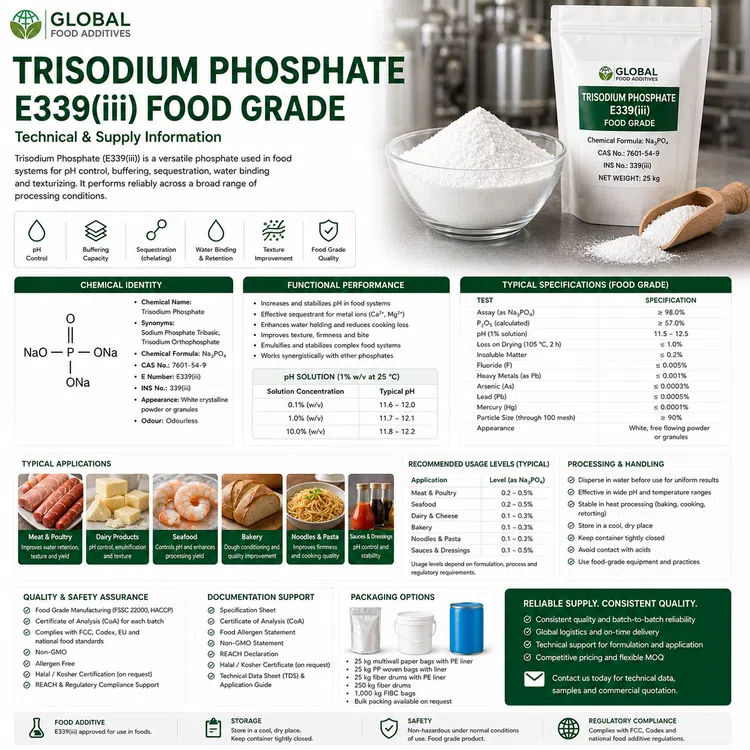
Product identity
| Product name | Trisodium Phosphate |
|---|---|
| Common synonyms | Trisodium orthophosphate, tribasic sodium phosphate, sodium phosphate tribasic |
| Food additive identity | E 339(iii) / INS 339(iii) |
| Chemical family | Inorganic sodium orthophosphate |
| Anhydrous formula | Na3PO4 |
| Hydrated formula | Na3PO4·nH2O |
| Molecular weight | 163.94 g/mol for anhydrous Na3PO4 |
| CAS number — anhydrous | 7601-54-9 |
| CAS number — dodecahydrate | 10101-89-0 |
| EC / EINECS number | 231-509-8 |
| Typical appearance | White, odourless crystals, granules or crystalline powder |
| Water behaviour | Freely soluble in water; forms a strongly alkaline phosphate solution |
| Solubility in ethanol | Insoluble |
| Typical commercial forms | Anhydrous, monohydrate and dodecahydrate; other hydrate forms may be defined by regional or supplier specifications |
Primary technical functions
- Alkalinity and pH adjustment: raises process or formulation pH where a strong alkaline phosphate is technically suitable.
- Buffer-system component: can be combined with mono- or disodium phosphates to establish a selected phosphate-buffer range.
- Mineral-ion management: interacts with calcium, magnesium and other multivalent ions, influencing hardness, precipitation and product stability.
- Protein functionality: may affect protein charge, hydration, extraction and water binding through pH and ionic-strength modification.
- Emulsifying-salt formulation: may be evaluated as one component of a broader phosphate system, particularly where mineral balance and pH must be controlled.
- Process standardisation: can help compensate for controlled variation in raw-material acidity or process-water mineral composition.
Technical specification benchmark
The values below are useful as a regulatory and purchasing reference for E 339(iii), but they are not a substitute for the contracted supplier specification. Every purchase order should identify the required edition of the standard, analytical method, hydrate form and reporting basis.
| Parameter | EU E 339(iii) benchmark | Purchasing interpretation |
|---|---|---|
| Identity | Trisodium monophosphate / Trisodium phosphate / Trisodium orthophosphate | Confirm that the product is orthophosphate and not tripolyphosphate, pyrophosphate or a blended phosphate. |
| Hydration forms | Anhydrous and hydrates containing 1/2, 1, 6, 8 or 12 H2O | State the required hydrate explicitly because water content changes active mass, bulk density and dosage. |
| Assay — anhydrous and most hydrates | Not less than 97.0% Na3PO4, calculated on the dried basis | Confirm whether the supplier reports dry basis, as-is basis or another contractual basis. |
| Assay — dodecahydrate | Not less than 92.0% Na3PO4, calculated on the ignited basis | Do not interpret this value as equal to as-is anhydrous active content without reviewing the test method and COA. |
| P2O5 content | 40.5%–43.5% on the anhydrous basis | Useful for identity, composition control and comparison between phosphate sources. |
| pH | 11.5–12.5 for a 1% solution | Indicates strong alkalinity; the exact preparation method, temperature and water quality should be controlled. |
| Water-insoluble matter | Not more than 0.2% on the anhydrous basis | Relevant to solution clarity, filtration load, deposits, nozzle blockage and visible residue. |
| Loss on ignition — anhydrous | Not more than 2.0% | Supports confirmation of moisture and volatile-content control. |
| Loss on ignition — monohydrate | Not more than 11.0% | Verify the specified hydrate and analytical preparation. |
| Loss on ignition — dodecahydrate | 45.0%–58.0% | Large ignition loss reflects crystallisation water and the defined dodecahydrate composition. |
| Fluoride | Not more than 10 mg/kg, expressed as fluorine | Include on the COA when required by the purchase specification. |
| Arsenic | Not more than 1 mg/kg | Confirm analytical method, reporting limit, accredited-laboratory status and destination-market requirements for elemental impurities. |
| Cadmium | Not more than 1 mg/kg | |
| Lead | Not more than 1 mg/kg | |
| Mercury | Not more than 1 mg/kg |
Selecting anhydrous or hydrated material
Anhydrous grade
- Higher Na3PO4 content per transported kilogram.
- Can reduce freight and storage volume when compared on an equivalent-active basis.
- May exhibit different flow, dusting, dissolution and heat-of-wetting behaviour from hydrated grades.
- Requires effective moisture protection because phosphate products can absorb atmospheric moisture and form lumps.
- Best suited where accurate dry dosing and active-content efficiency are purchasing priorities.
Hydrated grade
- Contains chemically associated crystallisation water.
- Generally requires more product mass to deliver the same amount of anhydrous Na3PO4.
- May provide different handling, dissolution or dust characteristics.
- Bulk density and pallet efficiency can differ substantially from anhydrous material.
- The exact hydrate must appear on the specification, label and COA.
Equivalent-active dosage calculation
When changing supplier or hydrate form, recalculate dosage using the declared lot or contractual active fraction:
Required new product mass = target anhydrous-equivalent mass ÷ new product active fraction
For direct supplier-to-supplier replacement, a practical comparison is:
New product mass = current product mass × current active fraction ÷ new active fraction
Active fractions should be expressed as decimals and taken from comparable analytical bases. A dry-basis assay must not be compared directly with an as-is assay unless moisture or ignition-loss correction has been applied.
Potential food-manufacturing applications
Suitability depends on the exact food category, formulation, legal permission, total phosphate level, sodium target, process conditions and desired finished-product characteristics. The following areas should be treated as technical evaluation pathways rather than universal use claims.
| Application area | Potential technical purpose | Critical validation points |
|---|---|---|
| Processed cheese and cheese preparations | pH adjustment, calcium-ion management and support within a designed emulsifying-salt or phosphate blend. | Melt behaviour, firmness, oil separation, protein hydration, calcium balance, flavour, final pH and applicable additive limits. |
| Meat and poultry systems | Modification of brine pH and ionic conditions that may influence protein extraction, water binding and processing yield. | Total phosphate, sodium, pickup, purge, cook yield, texture, colour, sensory profile, injection uniformity and jurisdictional rules. |
| Fish and seafood processing | Phosphate-system adjustment for moisture management, mineral interactions and process-yield control. | Water pickup, drip loss, thaw loss, cooking loss, texture, surface residue, labelling and market-specific restrictions. |
| Plant-protein processing | pH-shift processing, hydration, extraction support and mineral-interaction control. | Protein solubility, flavour, colour, viscosity, sediment, sodium contribution and downstream neutralisation requirements. |
| Bakery and cereal products | Controlled alkalinity, buffering or mineral management in specialised formulations. | Leavening balance, dough rheology, browning, crumb colour, flavour, mineral interactions and final pH. |
| Beverage bases and concentrates | Neutralisation, buffer preparation or process-water mineral control where strong alkalinity is specifically required. | Haze, precipitation, flavour, carbonation response, acid-addition sequence, heat stability and package compatibility. |
| Sauces, emulsions and prepared foods | pH correction and inclusion in a broader mineral-control or phosphate formulation. | Emulsion stability, viscosity, taste, colour, preservative performance, protein response and final sodium level. |
| Industrial food-process water | Selected pH or hardness-control duties where food-contact and process rules permit the intended use. | Precipitation, scale, equipment compatibility, rinse validation, wastewater phosphorus load and processing-aid status. |
How Trisodium Phosphate affects a formulation
pH and protein charge
Trisodium Phosphate produces an alkaline solution. Increasing pH changes the net electrical charge of many proteins and can move the system away from the protein isoelectric region. Depending on the raw material, this may alter swelling, solubility, extraction, viscosity and water retention.
The response is not linear in every food matrix. Protein source, salt concentration, temperature, shear, residence time and the presence of calcium or magnesium can materially change the result.
Ionic strength and mineral interactions
Sodium and phosphate ions influence ionic strength and interact with multivalent minerals. This can be beneficial in a designed system, but concentrated contact with calcium- or magnesium-rich ingredients can also generate haze, sediment or phosphate precipitation.
Water hardness, ingredient addition order and local concentration should therefore be evaluated during laboratory and pilot trials.
Buffer-system design
Trisodium Phosphate is normally selected for its alkaline contribution, not as a universal stand-alone buffer. Where tighter pH control is required, formulators may evaluate a controlled ratio of mono-, di- and trisodium phosphates.
Buffer selection should consider target pH, buffering capacity, sensory impact, sodium contribution, acid load and the legal status of every phosphate component.
Process-yield versus product quality
Increased water binding or process yield must be evaluated together with texture, flavour, colour, nutritional declaration, purge, cooking loss and consumer expectations. A technically measurable yield increase is not automatically the optimum commercial result.
Process integration and dosing guidance
Recommended development sequence
- Define the target function. Specify whether the objective is pH adjustment, buffering, mineral control, protein functionality, water binding or inclusion in a phosphate blend.
- Confirm regulatory eligibility. Check the food category, maximum level or GMP provision, labelling rules and any cumulative phosphate limit in the destination market.
- Characterise the raw materials. Record starting pH, acidity, calcium, magnesium, protein, salt, moisture, temperature and process-water hardness.
- Select the exact grade. Define anhydrous or hydrate form, active-content basis, particle size, bulk density and required compliance standard.
- Conduct bench trials. Use controlled dose increments and measure pH, appearance, viscosity, solubility, yield, texture and sensory response.
- Verify addition order. Compare direct addition with aqueous premixing and assess local high-pH effects, precipitation and dispersion time.
- Scale to pilot production. Confirm mixing energy, dosing accuracy, hold time, temperature, filtration, equipment compatibility and batch-to-batch repeatability.
- Establish release limits. Set internal control ranges for ingredient dose, finished-product pH, total phosphate, sodium, yield and critical quality attributes.
Premix preparation
- Use potable or otherwise specification-compliant process water.
- Add powder gradually to water under effective agitation rather than creating a high-concentration stationary layer.
- Control dust, splashing and solution temperature during charging.
- Allow sufficient mixing time to obtain a visually uniform solution.
- Check for insoluble matter, haze or mineral precipitate before dosing.
- Use a defined solution concentration and preparation record to improve dosing repeatability.
Addition-order controls
- Avoid uncontrolled direct contact between concentrated phosphate solution and concentrated acid.
- Avoid local overdose onto sensitive proteins or colour systems.
- Evaluate calcium- and magnesium-containing ingredients for precipitation risk.
- Meter the premix into a well-agitated zone whenever possible.
- Monitor pH after adequate equilibration rather than immediately beside the dosing point.
- Validate whether hot or cold addition produces the preferred dissolution and product response.
Incoming quality-control and COA review
Identity and composition
- Exact product and chemical name
- E 339(iii) or relevant destination-market identity
- Anhydrous or declared hydrate form
- CAS and EC identifiers
- Assay with stated analytical basis
- P2O5 or phosphate content
- Loss on drying or loss on ignition
- pH with solution concentration and method
Purity and physical performance
- Water-insoluble matter
- Fluoride
- Lead, arsenic, cadmium and mercury
- Iron or other customer-specified trace elements
- Particle-size distribution
- Bulk and tapped density where dosing equipment requires it
- Colour or whiteness where visually critical
- Flowability, caking or sieve residue where specified
Traceability controls
- Manufacturer name and approved manufacturing site
- Country of origin and country of manufacture
- Batch or lot number
- Manufacturing and retest or expiry date
- COA authorisation and issue date
- Purchase-order and specification revision reference
- Packaging code and net-weight verification
- Upstream lot traceability where contractually required
Food-safety declarations
- Food-grade or food-additive compliance statement
- Allergen statement and cross-contact information
- GMO status
- Irradiation status
- Nanomaterial status where required
- Animal-origin or vegan/vegetarian status
- Halal and Kosher certificates when requested
- Contaminant, pesticide or microbiological statements where relevant
- Food-fraud and supply-chain traceability information
Packaging, storage and logistics
Packaging considerations
Packaging depends on the manufacturer, grade, shipment size and destination. Common commercial options may include lined multiwall bags, woven polypropylene bags with an inner liner, bulk bags or other moisture-resistant industrial formats.
Confirm the following before purchase:
- Net weight per bag or bulk container
- Primary-contact liner material
- Tamper evidence and bag-closing method
- Bags per pallet and net pallet weight
- Pallet material and dimensions
- Stretch wrapping, top sheet and corner protection
- Container loading quantity and maximum stack height
- Private-label, neutral-label or manufacturer-label requirement
- Food-contact compliance for packaging components
Storage controls
- Store in a cool, dry and well-ventilated warehouse.
- Keep bags tightly closed and protected from humidity.
- Store on clean pallets and away from walls or wet floors.
- Protect from rain, condensation and direct water contact.
- Segregate from acids and incompatible chemicals.
- Prevent contamination by dust, pests, odours and foreign material.
- Reseal partly used packaging immediately after dispensing.
- Apply FEFO or the supplier-recommended stock-rotation system.
- Use the shelf life and storage temperature stated by the supplier.
Logistics data to include in a quotation
| Requested quantity | Trial quantity, pallet quantity, full-container load or annual forecast |
|---|---|
| Packaging | Required bag size, liner, palletisation and labelling format |
| Destination | City, port, country and final food market |
| Delivery basis | Requested Incoterm, delivery point and target shipment window |
| Container conditions | Palletised or floor-loaded, moisture protection and loading limits |
| Documents | COA, specification, SDS, origin, health certificate, analysis certificate or other import documents |
Handling and workplace controls
Trisodium Phosphate solutions are strongly alkaline. Workplace handling must follow the current supplier Safety Data Sheet, local occupational regulations and the facility’s chemical-risk assessment.
Typical control measures
- Minimise airborne dust during bag opening and charging.
- Use enclosed transfer or local extraction where practical.
- Wear suitable eye, skin and respiratory protection as defined by the SDS.
- Provide accessible eyewash and emergency washing facilities.
- Train operators on alkaline-material handling and spill response.
- Prevent unauthorised mixing with acids or incompatible materials.
- Use clearly identified, dedicated or validated-clean dispensing tools.
Equipment and material compatibility
- Confirm compatibility of tanks, seals, pumps, hoses and dosing lines with the intended solution concentration and temperature.
- Review compatibility with metals, coatings and elastomers before using concentrated alkaline phosphate solutions.
- Avoid dead legs or stagnant zones where concentrated solution can crystallise or leave deposits.
- Include water-flush or validated cleaning steps where the process permits.
- Inspect dosing nozzles, filters and strainers for mineral deposits.
Regulatory and labelling considerations
European Union
Trisodium Phosphate is identified as E 339(iii). The compositional specification and the permission to use the additive are separate regulatory questions. A product may comply chemically with the E 339(iii) specification while a proposed use is still restricted or not permitted in a particular food category.
Buyers should review the current consolidated versions of:
United States
Under 21 CFR 182.1778, sodium phosphate in mono-, di- and tribasic form is listed as generally recognised as safe when used in accordance with good manufacturing practice. This general provision does not replace product-specific standards of identity, meat or poultry requirements, labelling rules or other conditions that may apply to the finished food.
Reference: 21 CFR 182.1778 — Sodium phosphate
Other destination markets
Codex references, GCC rules, national positive lists, customs classifications and local labelling requirements should be checked separately. Market acceptance must not be assumed from an EU E number, U.S. GRAS status or a supplier’s general food-grade statement.
- Confirm the permitted food category.
- Confirm the maximum level, quantum satis or GMP condition.
- Review total-phosphate calculation requirements.
- Determine whether use is additive, ingredient or processing aid.
- Confirm the required declaration name on the finished-food label.
- Review sodium and nutrition-labelling consequences.
- Check import registration, health-certificate and language requirements.
Process efficiency and environmental control
Phosphate optimisation should consider both product performance and plant-wide phosphorus management. Excess dosage can increase raw-material cost, sodium contribution, cleaning demand and phosphorus loading in wastewater.
Manufacturing-efficiency measures
- Use calibrated loss-in-weight or validated volumetric dosing.
- Track actual ingredient use against standard batch consumption.
- Correct recipes when changing hydrate or supplier assay.
- Reduce bag residue through suitable emptying and handling practices.
- Optimise solution concentration to minimise unnecessary water movement.
- Use pilot data to establish the minimum effective dose.
Wastewater and spill controls
- Prevent dry powder and concentrated solution from entering drains.
- Capture spills using the procedure defined by the SDS and site plan.
- Include phosphate inputs in the facility’s phosphorus mass balance.
- Monitor wastewater phosphorus where discharge permits require it.
- Coordinate formulation changes with wastewater-treatment personnel.
- Dispose of damaged or off-specification material through approved channels.
Documents to request before approval
Core product documents
- Current product specification or Technical Data Sheet
- Representative and lot-specific Certificate of Analysis
- Current Safety Data Sheet
- Product label or label draft
- Packaging and pallet specification
- Shelf-life and storage statement
- Manufacturing-flow summary where qualification requires it
- Country of origin and manufacturing-site statement
Compliance and certification documents
- Food-grade compliance declaration
- Applicable EU, FCC, JECFA or national-standard statement
- Allergen and cross-contact declaration
- GMO, irradiation and nanomaterial statements
- Halal and Kosher certificates where required
- Quality-system or food-safety certification
- Traceability and recall-system declaration
- Heavy-metal and contaminant compliance statement
Additional documents for international trade
- Commercial invoice and packing-list format
- Certificate of origin
- Health, sanitary or free-sale certificate where applicable
- Certificate of analysis legalisation or chamber approval if required
- Transport classification and non-dangerous-goods statement where applicable
- Container loading plan and pallet declaration
- Wood-packaging or ISPM 15 documentation where required
- Importer-specific registration or product-notification documents
Information required for an accurate quotation
| Inquiry field | Information to provide |
|---|---|
| Product identity | Trisodium Phosphate, E 339(iii), with the preferred synonym or existing supplier reference |
| Grade | Anhydrous, monohydrate, dodecahydrate or specification-equivalent option |
| Required standard | EU 231/2012, FCC, JECFA, national standard or attached customer specification |
| Application | Finished-food category and intended technical function |
| Target parameters | Assay, pH, P2O5, particle size, bulk density, insolubles and impurity limits |
| Quantity | Sample, trial order, pallet, container quantity and annual forecast |
| Packaging | Bag size, liner, palletisation, label language and private-label requirement |
| Destination | Delivery city, port, country and final regulatory market |
| Commercial term | Requested Incoterm, currency, payment preference and delivery window |
| Documentation | COA, specification, SDS, origin, certifications and import documents |
| Reference material | Existing COA, specification, label, approved sample or competitor grade |
Frequently asked questions
What is the correct E number for Trisodium Phosphate?
The specific designation is E 339(iii). E 339 is the wider sodium phosphate group, which also includes monosodium phosphate E 339(i) and disodium phosphate E 339(ii).
What is the difference between Trisodium Phosphate and Sodium Tripolyphosphate?
Trisodium Phosphate is an orthophosphate with the formula Na3PO4 and the identity E 339(iii). Sodium Tripolyphosphate is a condensed phosphate with a different structure, additive identity, specification and functional profile. They are not direct one-for-one substitutes.
Are anhydrous and hydrated grades interchangeable?
Not on an equal-weight basis. Hydrated material contains crystallisation water and may differ in assay, bulk density, dissolution behaviour and handling. Dosage must be corrected using comparable active-content data from the supplier specification or COA.
Why is solution pH important?
Trisodium Phosphate is strongly alkaline. Its pH response influences protein charge, water binding, mineral interactions, texture, flavour, colour and the performance of other ingredients. Solution concentration, water quality and temperature should be controlled when comparing results.
Can it be added directly as a dry powder?
Direct dry addition may be possible in some processes, but an aqueous premix often improves dispersion and dosing control. The preferred method depends on mixing energy, batch size, powder handling, local concentration risk and the sensitivity of the food matrix.
Can Trisodium Phosphate cause precipitation?
Yes. Concentrated phosphate can interact with calcium, magnesium and other multivalent ions. Water hardness, ingredient composition, temperature, pH and addition order should be evaluated for haze, sediment or scale formation.
How is the correct dosage determined?
Dosage should be established through laboratory and pilot trials based on the target function, raw-material properties, hydrate form, assay, final pH, total phosphate, sodium contribution and applicable legal limit. Supplier guidance cannot replace application validation.
What is the difference between food grade and technical grade?
Food-grade material should comply with an identified food-additive specification and be manufactured, packed, documented and traceable for food use. Technical grade may have different impurity controls, manufacturing systems, packaging or documentation and should not be substituted without formal food-safety and regulatory approval.
Which COA values should be compared between suppliers?
Compare hydrate form, assay basis, P2O5, pH, ignition loss or moisture, insoluble matter, fluoride, elemental impurities, particle size, bulk density and the analytical methods used. Values reported on different bases should be normalised before comparison.
Is Trisodium Phosphate permitted in every food category?
No. Authorised categories, maximum levels, GMP provisions and labelling rules vary by jurisdiction. Chemical compliance with an E 339(iii) specification does not automatically authorise every proposed use.
What storage conditions are recommended?
Store in sealed, moisture-resistant packaging in a cool, dry and well-ventilated area. Protect from water, condensation, acids, contamination and strong odours. Follow the supplier’s stated shelf life and storage conditions.
Can Global Food Additives review an existing specification?
Yes. Buyers can submit an existing specification, COA, label, approved sample reference or required standard. Supplier options can then be compared on identity, hydrate, active basis, purity, packaging, documentation, origin, quantity and destination.
Tell us the grade, specification and delivery conditions you require.
For an accurate review, include the requested hydrate form, applicable standard, target assay, application, quantity, packaging, destination, Incoterm, shipment timing and required documents. Existing specifications, COAs or product labels can be referenced in the message.
Our team will review the inquiry and respond from orders@foodgradeadditives.com .
Your technical inquiry has been received. You will be redirected to the home page.