
Textured Soy Protein
Textured Soy Protein, commonly abbreviated as TSP and also referred to as Textured Vegetable Protein or TVP, is a shelf-stable, thermomechanically extruded soy ingredient designed to provide protein, water absorption, structural integrity and a meat-like bite in industrial food formulations.
Commercial grades can be manufactured from defatted soy flour, soy protein concentrate or soy protein isolate. Raw-material selection, extrusion conditions, particle geometry and final density influence protein content, hydration rate, flavor, color, chewiness, cooking stability and finished-product yield.
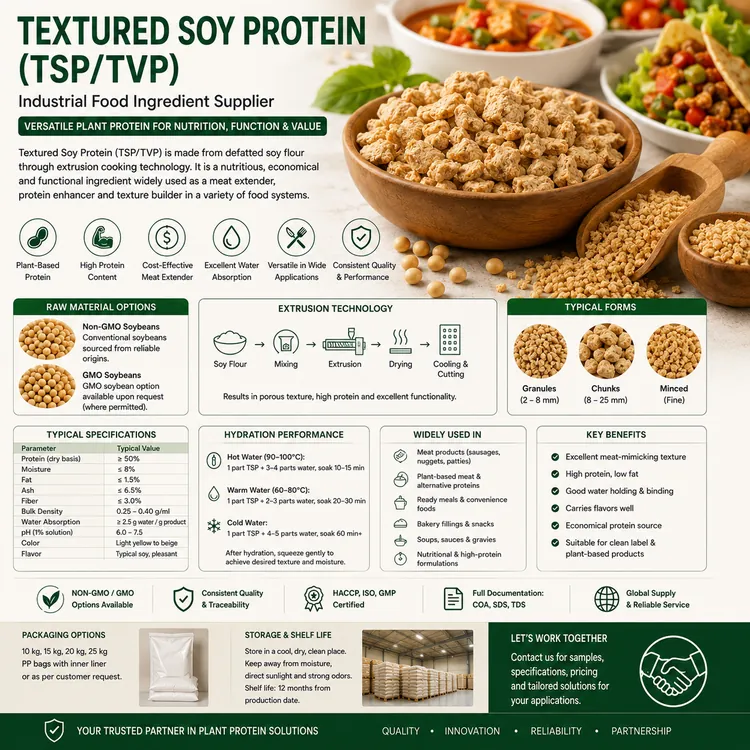
Product identity
| Product name | Textured Soy Protein |
|---|---|
| Common abbreviations | TSP, TVP |
| Product category | Plant protein, texturizer and functional food ingredient |
| Typical raw materials | Defatted soy flour, soy protein concentrate or soy protein isolate |
| Manufacturing principle | High-temperature, short-time extrusion followed by drying, cutting and sizing |
| Typical physical forms | Fine granules, coarse granules, mince, flakes, strips, chips and chunks |
| Appearance | Light cream to tan or brown, depending on grade and formulation |
| Flavor profile | Neutral to characteristic soy flavor; low-flavor grades may be available |
| Allergen declaration | Contains soy; cross-contact declarations depend on the manufacturing facility |
| E / INS number | No single universal number normally applies; confirm destination-market classification |
| CAS / chemical identity | Complex processed food ingredient; identity depends on raw material and supplier specification |
Primary industrial functions
- Protein enrichment and nutritional profile development
- Formation of fibrous, granular or meat-like texture
- Water absorption and moisture retention
- Cooking-yield and finished-product yield support
- Partial replacement or extension of animal protein
- Bulk, bite and particulate definition in fillings
- Fat distribution and emulsion stabilization support
- Cost optimization in formulated protein products
- Structure retention during freezing, reheating or retorting
Typical technical parameters to evaluate
The values below are purchasing and formulation parameters rather than universal product limits. Exact requirements should be agreed in a signed specification and verified against the supplier's current certificate of analysis, test methods and manufacturing standard.
| Parameter | Why it matters | Purchasing guidance |
|---|---|---|
| Protein content | Determines nutritional contribution, formulation value and protein declaration. | Specify the minimum percentage and whether the result is reported as-is or on a dry-matter basis. Commercial values vary considerably according to whether the grade is flour-, concentrate- or isolate-based. |
| Moisture | Affects shelf life, microbiological stability, flow and commercial yield. | Establish a maximum moisture limit and the analytical method used by the supplier. |
| Fat | Influences oxidation risk, flavor stability and nutritional composition. | Review residual-fat requirements, particularly for long shelf-life dry mixes or low-fat finished products. |
| Ash and mineral content | Supports compositional control and can influence flavor or labeling calculations. | Include limits where nutritional declarations or formulation tolerances are sensitive. |
| Crude fiber or dietary fiber | Varies with the starting material and affects water absorption and nutrition. | Define the required test method because crude-fiber and dietary-fiber methods do not produce equivalent results. |
| Particle size and geometry | Controls visual appearance, hydration speed, bite and product distribution. | Specify granule dimensions, screen range, shape, acceptable fines and oversize tolerances. |
| Bulk density | Affects bag volume, conveying, dosing, storage capacity and freight efficiency. | State the test method and whether loose or tapped bulk density is required. |
| Hydration or rehydration ratio | Influences formulation water, cost-in-use, yield and texture. | Agree on water temperature, hydration time, draining procedure and calculation method before comparing suppliers. |
| Water absorption and retention | Indicates how much water is taken up and retained during mixing and cooking. | Test under application-relevant salt, pH, temperature and shear conditions. |
| Texture after hydration | Determines chewiness, firmness, elasticity and resemblance to the target food. | Evaluate sensory texture together with instrumental compression, shear or texture-profile testing where appropriate. |
| Piece integrity | Shows resistance to breaking during hydration, mixing, pumping, freezing and cooking. | Define the process conditions under which structural retention must be demonstrated. |
| Color | Affects finished-product appearance and the amount of coloring or seasoning required. | Use visual standards or instrumental color values where batch-to-batch consistency is critical. |
| Flavor and odor | Characteristic soy, toasted or bitter notes can affect flavor-system requirements. | Request a sensory standard and evaluate the product both dry and after hydration. |
| Dispersibility and dust | Influence production hygiene, operator handling, dosing accuracy and product loss. | Set limits for fines or dust if the material is fed through automated systems. |
How Textured Soy Protein is produced
Textured Soy Protein is normally produced by combining soy protein raw material with controlled moisture and processing it through an extruder. Inside the extruder, heat, pressure, mechanical shear and residence time modify the protein structure. As the material exits the die, pressure reduction and moisture flashing contribute to expansion and the formation of a porous, textured matrix.
The extrudate is then cut, dried and classified into the required particle size. Manufacturers can adjust screw configuration, moisture, barrel temperature, die geometry, feed composition and cutting conditions to influence density, porosity, cell structure, hydration behavior, hardness and finished-piece dimensions.
Extrusion variables affecting performance
- Raw-material protein concentration and carbohydrate content
- Feed moisture and preconditioning conditions
- Extruder screw speed and mechanical energy input
- Barrel temperature profile and residence time
- Die size, die shape and pressure differential
- Expansion ratio and internal pore structure
- Drying temperature and final moisture
- Cutting, screening and fines-removal efficiency
Resulting functional differences
- Fast-hydrating versus slow-hydrating grades
- Soft, tender, elastic, chewy or firm textures
- Low-density porous pieces or high-density compact pieces
- Fine particles for emulsions or large pieces for visible structure
- Different resistance to mixing, pumping and thermal processing
- Different color and flavor absorption characteristics
Common commercial grade families
Defatted soy flour-based TSP
Typically selected for cost-effective protein extension, water absorption and texture development. These grades may have a more noticeable soy flavor and a higher carbohydrate or fiber contribution than concentrate- or isolate-based products.
Soy protein concentrate-based TSP
Commonly selected when higher protein, improved flavor neutrality, firmer texture or lower levels of soluble carbohydrate are required. Performance varies by concentration process and extrusion design.
Soy protein isolate-based systems
May be used in specialized applications requiring high protein contribution, controlled flavor, fine texture or tailored functional performance. Availability and economics are grade and supplier dependent.
Colored or flavored grades
Caramel-colored, red-toned, poultry-colored or pre-seasoned products may be available for specific meat analogues, fillings and convenience foods. Colorants, flavorings and carriers must be declared and verified.
Hydration and production guidance
Hydration conditions should be optimized for each particle size and application. A grade that performs correctly in a dry mix may behave differently in a salted, acidic, high-fat, frozen or retorted system. Supplier instructions should therefore be confirmed through pilot-scale and production-scale trials.
- Determine the target hydration ratio. Start with the supplier's recommendation, then adjust according to required firmness, finished-product yield and free-water control.
- Select the hydration medium. Water, broth, brine, seasoning solution or flavored marinade may be used depending on the application.
- Control water temperature. Warm water may accelerate hydration, while lower temperatures may provide better process control for some particle sizes.
- Allow sufficient contact time. Fine granules normally hydrate faster than dense flakes, strips or chunks.
- Manage mixing intensity. Excessive high-shear mixing can fracture hydrated pieces and increase fines.
- Evaluate free water. Unabsorbed water can weaken emulsions, cause purge, increase syneresis or produce an excessively soft finished texture.
- Control hydrated-product hygiene. Once hydrated, the ingredient is no longer a low-moisture material and must be handled using appropriate time, temperature and sanitation controls.
Industrial application areas
Processed meat and poultry
- Burgers, patties and formed products
- Meatballs, kofta and kebab-style products
- Sausages and emulsified meat products
- Ground-meat preparations
- Canned or retorted meat formulations
- Cooked fillings and meat sauces
Selection should consider particle visibility, hydration level, chopping conditions, fat content, thermal process and target meat identity.
Plant-based meat alternatives
- Plant-based mince and burger formulations
- Nuggets, meatballs and formed analogues
- Dry mixes for hydrated meat substitutes
- Hybrid animal-and-plant protein products
- Ready-to-eat or ready-to-cook fillings
TSP may be combined with binders, oils, flavors, colors, fibers and other plant proteins to build the required bite, juiciness and appearance.
Prepared meals and convenience foods
- Pasta and pie fillings
- Frozen meals
- Soups, stews and sauces
- Stuffed vegetables
- Instant and dehydrated meal systems
- Retorted pouches and canned foods
Piece stability should be validated after pumping, filling, freezing, thawing, reheating or retorting.
Bakery, snacks and nutritional products
- Savory bakery fillings
- Protein-enriched dry blends
- Extruded or formed snacks
- High-protein meal components
- Institutional and foodservice mixes
Fine grades may be considered where visible particulate texture is not required, but flavor, moisture balance and protein labeling must still be evaluated.
Recommended industrial trial measurements
| Trial stage | Measurements to consider |
|---|---|
| Dry ingredient inspection | Particle-size distribution, color, odor, bulk density, fines, foreign-material control and bag condition. |
| Hydration trial | Water uptake, hydration time, drained yield, free water, flavor absorption, piece dimensions and hydrated firmness. |
| Mixing and forming | Piece breakage, distribution uniformity, dough or batter consistency, forming behavior and equipment loading. |
| Cooking | Cooking loss, yield, shrinkage, fat release, moisture retention, internal appearance and structural integrity. |
| Finished texture | Firmness, cohesiveness, chewiness, juiciness, bite, shear force and sensory acceptance. |
| Shelf-life assessment | Flavor stability, color stability, purge, oxidation, microbial compliance and texture after storage or reheating. |
| Frozen-product assessment | Freeze-thaw stability, ice-crystal damage, syneresis, piece breakage and texture after reheating. |
| Retort assessment | Thermal-process survival, softening, fragmentation, sauce interaction and package-to-package consistency. |
Quality-control requirements
Quality requirements should reflect the intended food category, processing conditions, consumer group, shelf life and destination market. A general supplier specification may not be sufficient for high-care, ready-to-eat, infant, medical or export-controlled applications.
Compositional controls
- Protein, moisture, fat, ash and fiber
- Particle size and bulk density
- Hydration performance and texture
- Color, flavor and odor
- Trypsin-inhibitor or urease-related controls when required
- Nutritional values and calculation basis
Microbiological controls
- Total aerobic count
- Yeast and mold
- Coliforms and Escherichia coli
- Salmonella absence in the specified sample size
- Bacillus cereus or other organisms where risk assessment requires
- Environmental-monitoring and hygiene-program information
Chemical and contaminant controls
- Heavy metals according to market requirements
- Pesticide residues where applicable
- Mycotoxins based on raw-material and origin risk
- Residual processing solvents where relevant
- Melamine or other authenticity-related testing when requested
- Foreign-material and metal-detection controls
Identity and claim controls
- Soy allergen declaration
- GMO, non-GMO or identity-preserved status
- Country of origin and manufacturing location
- Halal, kosher, vegan or vegetarian status where required
- Gluten-related declaration and cross-contact assessment
- Organic status only where valid certification is supplied
Documents to request before approval
- Current signed product specification or technical data sheet
- Representative and lot-specific certificate of analysis
- Ingredient statement and processing-aid declaration
- Allergen statement and cross-contact declaration
- GMO, non-GMO or identity-preserved declaration
- Country-of-origin and manufacturing-site statement
- Food-safety certification and audit-scope information
- HACCP or food-safety-plan summary where available
- Microbiological and contaminant limits with test methods
- Nutritional information and calculation basis
- Shelf-life, storage and transport conditions
- Packaging specification and food-contact compliance declaration
- Halal, kosher, organic or other certificates where required
- Vegan or vegetarian suitability statement where relevant
- Safety data sheet when required for handling or transport procedures
- Change-notification and traceability policy
- Recall-contact details and emergency communication procedure
Industrial packing, storage and shipment
| Common packaging | Multiwall paper bags with an inner food-grade liner are commonly used. Exact net weight, liner type and closure method depend on the supplier. |
|---|---|
| Bulk options | Large bags or customized industrial formats may be considered subject to minimum order quantity, product density and manufacturing capability. |
| Palletization | Request bags per pallet, pallet dimensions, net and gross weight, pallet material, stretch wrapping and container-loading configuration. |
| Storage | Store sealed in a cool, dry, clean and well-ventilated area, protected from moisture, direct sunlight, strong odors, pests and chemical contaminants. |
| Shelf life | Grade and packaging dependent. Use the supplier's declared shelf life and verify the minimum remaining shelf life required at shipment and arrival. |
| Transport | Vehicles and containers should be dry, odor-free, pest-free and suitable for food ingredients. Container condensation and water ingress must be prevented. |
| Lot traceability | Each bag and pallet should carry sufficient lot, production-date and best-before information to support receipt control and recall traceability. |
Compare cost-in-use, not price per kilogram alone
Two grades with the same nominal protein content can produce different commercial results because of differences in hydration yield, fines, flavor intensity, bulk density, breakage, process loss and required seasoning or masking systems.
A complete industrial comparison may include:
- Delivered cost per kilogram of dry material
- Hydrated yield under standardized conditions
- Cost per kilogram of usable hydrated ingredient
- Cooking loss and finished-product yield
- Required flavor, color, binder and water adjustments
- Production throughput and hydration-tank capacity
- Dust, fines, breakage and handling losses
- Freight efficiency related to bulk density and bag size
- Batch consistency and rejection risk
- Document quality, lead time and supplier reliability
Information to include in a sourcing request
A technically complete inquiry allows suppliers to select a more suitable grade and reduces delays caused by incomplete specifications.
- Required product form: granule, mince, flake, strip, chunk or other shape
- Target particle dimensions and acceptable fines level
- Minimum protein content and reporting basis
- Preferred raw material: soy flour, concentrate or isolate
- Required color, flavor profile and hydrated texture
- Target hydration ratio or water-absorption performance
- Intended application and approximate usage level
- Process conditions: mixing, freezing, cooking, retorting or drying
- Microbiological and contaminant limits
- Allergen, GMO, halal, kosher, vegan or other declaration requirements
- Packaging format, net bag weight and pallet restrictions
- Trial quantity, annual demand and order frequency
- Destination country, delivery location and preferred Incoterm
- Required shipment date and acceptable lead time
- Documents required before sample, order or shipment approval
Recommended qualification workflow
- Issue a target specification and application description.
- Review supplier documents and identify specification gaps.
- Obtain a representative sample from the proposed commercial grade.
- Run controlled hydration and sensory comparisons.
- Complete laboratory and pilot-plant formulation trials.
- Test the ingredient under actual thermal and mechanical processing conditions.
- Evaluate finished-product shelf life and consumer-relevant texture.
- Approve the product specification, packaging and labeling documents.
- Confirm that the first commercial shipment matches the approved sample and specification.
- Establish ongoing lot verification, change notification and supplier-performance review.
Frequently asked questions
What is Textured Soy Protein used for in food manufacturing?
Textured Soy Protein is used to increase protein, absorb water, create bite and structure, improve yield and partially or completely replace animal-protein particulates in meat products, plant-based foods, fillings, sauces, frozen meals and dry mixes.
Is TSP the same as TVP?
TSP means Textured Soy Protein, while TVP generally means Textured Vegetable Protein. The terms are often used interchangeably when the vegetable-protein source is soy, although TVP can also describe textured proteins produced from other plant materials.
What is the difference between granules, flakes and chunks?
Granules are commonly used where a minced or ground-meat appearance is required. Flakes provide larger visible particulates, while chunks or strips are used for applications requiring a more substantial bite. Particle size also affects hydration time and resistance to breakage.
How much water does Textured Soy Protein absorb?
Water uptake depends on raw material, density, particle size, extrusion conditions and test method. The correct ratio must be confirmed using the supplier's method and validated in the actual formulation, especially where salt, acid, fat, starch or hydrocolloids are present.
Can Textured Soy Protein be added directly without hydration?
Some fine grades can be incorporated directly into formulations containing sufficient available water. Larger or denser pieces are usually prehydrated. Direct addition should be validated to prevent incomplete hydration, excessive firmness or unintended water removal from the surrounding food matrix.
Does Textured Soy Protein contain soy allergen?
Yes. Textured Soy Protein is produced from soy and must be handled as a soy-containing ingredient. Exact label wording and cross-contact declarations should be confirmed for the destination market.
Is Textured Soy Protein available as non-GMO?
Non-GMO and identity-preserved options may be available depending on origin, supplier, certification level, minimum order quantity and required testing. The claim should be supported by current supplier documentation.
Does Textured Soy Protein have an E number?
It is generally marketed as a processed food ingredient rather than a single defined additive with one universal E or INS number. Buyers should verify its regulatory classification and ingredient-list designation in the destination market.
Which documents should be requested?
Buyers commonly request a signed specification, certificate of analysis, ingredient statement, allergen declaration, GMO statement, origin statement, microbiological criteria, nutritional data, shelf-life information, packaging specification and relevant food-safety certifications.
Can Global Food Additives source different TSP specifications?
Global Food Additives can review options for different raw-material bases, protein levels, colors, densities, hydration characteristics, particle sizes and packaging formats according to application, quantity, destination and documentation requirements.
Send your Textured Soy Protein specification.
Include the required shape, particle size, protein content, hydration performance, application, quantity, destination, packaging preference, delivery term and document requirements. Our team will review your inquiry and respond from orders@foodgradeadditives.com.
Your message has been received. You will be redirected to the home page.