
Polysorbate 40
Polysorbate 40 is a food-grade nonionic emulsifier and wetting agent used by food manufacturers for oil-in-water emulsion support, colour and flavour dispersion, powder wetting, fat-water interface control and processing consistency. It is chemically described as polyoxyethylene (20) sorbitan monopalmitate and is typically evaluated where a high-HLB surface-active ingredient with palmitate-based character is required in a legally permitted food category.
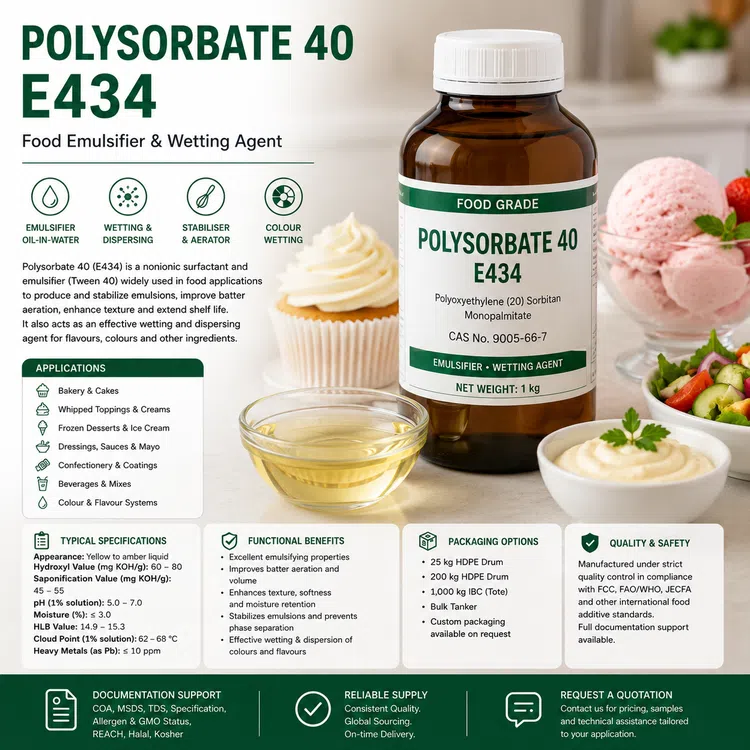
Product identity
| Product | Polysorbate 40 |
|---|---|
| Common names | E434, INS 434, Tween 40, PS 40, polyoxyethylene (20) sorbitan monopalmitate |
| Category | Emulsifiers, wetting agents and surface-active food ingredients |
| Primary function | Emulsification, wetting, dispersion, oil-in-water emulsion support and surface-active processing function |
| E / INS number | E434 / INS 434 |
| CAS / identity | 9005-66-7 |
| Chemical description | Polyoxyethylene (20) sorbitan monopalmitate; ethoxylated sorbitan ester of palmitic acid |
| Surfactant type | Nonionic, high-HLB oil-in-water emulsifier and wetting agent |
| Approximate HLB | Typically discussed around 15.6; confirm supplier specification and application performance |
| Typical form | Light-yellow gel, viscous liquid, paste, flake, bead or blend depending on grade and temperature |
| Typical behaviour | Surface-active, water-dispersible to water-soluble depending on grade, temperature and formulation |
| Technical positioning | Best evaluated for oil-in-water emulsification, wetting and dispersion; not a universal replacement for Polysorbate 60, Polysorbate 65, Polysorbate 80, lecithin, PGPR or mono- and diglycerides |
Application fit
Polysorbate 40 can be considered where the formulation needs surface activity, oil-in-water emulsification, improved wetting of powders or colours, fat or flavour dispersion and better processing uniformity. Suitability depends on food category, permitted use level, pH, oil phase, fat source, stabiliser system, process temperature, sensory expectations and final label requirements.
- Emulsified sauces, dressings and condiments where permitted
- Desserts, dessert mixes and gel systems
- Beverage bases, syrups and flavour dispersion systems where legally suitable
- Colour wetting and pigment dispersion systems
- Dry mixes requiring wetting or reconstitution support
- Bakery fillings, icings and cream-style systems
- Oil-in-water emulsions and clouding or flavour systems
- Confectionery and coating systems where technical and legal fit is confirmed
- Industrial processing applications requiring wetting, dispersion or surface activity
Industrial formulation value
Polysorbate 40 is valuable because it helps manage the interface between water, oil, fat, powders, colours, flavours and air. In aqueous and semi-aqueous systems, it can help reduce surface tension, improve wetting, support dispersion of hydrophobic components and improve emulsion uniformity. In dry mixes, it may help difficult-to-wet ingredients disperse more quickly when properly premixed with a carrier.
Industrial buyers should evaluate Polysorbate 40 by performance and compliance, not only by price per kilogram. Important commercial factors include acid value, hydroxyl value, saponification value, oxyethylene content, palmitic acid source, colour, odour, peroxide value, water content, physical form, handling behaviour, residual ethoxylation impurities, packaging integrity, documentation quality and supplier traceability.
Key technical effects
- Oil-in-water emulsification: Helps distribute oil or fat droplets in aqueous food systems.
- Wetting: Improves wetting of hydrophobic powders, colours, flavours and minor ingredients.
- Dispersion support: Helps reduce spots, streaking, floating particles and uneven distribution when used correctly.
- Flavour and colour delivery: Can support dispersion of selected flavour oils, colour systems and hydrophobic components.
- Surface activity: Reduces interfacial tension and supports interaction between fat, water, protein, starch, gums and air.
- Processing consistency: May improve incorporation, mixing uniformity and batch-to-batch handling in suitable systems.
- Blend compatibility: Can be evaluated with other polysorbates, sorbitan esters, mono- and diglycerides, lecithin, gums or proteins.
Formulation considerations
- Use level: Excessive dosage can create soapy, bitter, waxy or surfactant-like notes and may exceed legal limits.
- Matrix dependence: Performance changes with oil type, fat phase, protein, hydrocolloids, pH, sugar, salt, minerals and heat process.
- HLB matching: Polysorbate 40 is high-HLB and normally stronger in oil-in-water systems than in fat-continuous systems.
- Physical form: Gel, paste, flake or blend grades may require warming, premixing or controlled addition for uniform distribution.
- Oxidation control: Peroxide value, odour and fatty acid source matter in beverage, dessert and flavour systems.
- Label sensitivity: Some brand owners avoid synthetic-sounding emulsifiers; confirm label and marketing requirements early.
- Regulatory limits: Permission and maximum levels vary by market and food category.
Application guidance by industry
Emulsified sauces and dressings
In sauces, dressings, marinades and condiments, Polysorbate 40 may support oil dispersion, wetting of spice particles and emulsion uniformity. Trials should include the actual acid, salt, oil, gum, starch, protein, preservative and heat-treatment system because these factors influence droplet size, viscosity, mouthfeel and separation.
Beverage bases and flavour systems
In beverage bases, syrups, concentrates and flavour systems, Polysorbate 40 may be evaluated for dispersion of selected hydrophobic components. It should be tested against the final pH, acid blend, sweetener system, preservatives, alcohol level, carbonation, pasteurisation, packaging and full shelf-life conditions.
Colour wetting and pigment dispersion
In colour systems, Polysorbate 40 can help wet and disperse certain colourants, lakes or powdered ingredients where legally permitted. The final system should be checked for shade strength, specks, sediment, foam, migration, light stability and interaction with carriers or stabilisers.
Dry mixes and instant products
In dry mixes, instant desserts, powder drinks and seasoning systems, Polysorbate 40 can be used as part of a wetting or dispersion strategy. It should be preblended carefully with a compatible carrier to avoid localised concentration, clumping or uneven reconstitution.
Bakery fillings, icings and creams
In bakery fillings, icings, glazes and cream-style systems, Polysorbate 40 may support fat-water dispersion, colour distribution and texture uniformity. Formulators should evaluate sugar level, fat melting point, water activity, starch or gum system, temperature cycling, storage and packaging interaction.
Desserts and gel systems
In desserts, gel systems and dairy-style products, Polysorbate 40 may support dispersion and surface-active functionality. It should be tested with proteins, stabilisers, acids, flavours, colours, heat treatment and refrigerated or frozen storage where relevant.
Confectionery and coatings
In permitted confectionery or coating systems, Polysorbate 40 may be evaluated for wetting or dispersion rather than as a universal fat-phase viscosity reducer. For chocolate-like or fat-continuous coatings, compare with lecithin, PGPR, sorbitan esters or other fat-phase emulsifiers and confirm legal suitability before use.
Processing and wetting applications
In permitted processing applications, Polysorbate 40 may improve wetting of hydrophobic ingredients, reduce surface defects or help disperse minor components. Validation should include the actual equipment, addition point, temperature, mixing energy and destination-market rules.
Polysorbate 40 versus related emulsifiers
Polysorbate 40 should be selected based on the oil phase, fat phase, water phase, target emulsion type, process, legal market and label requirement. Its palmitate-based profile makes it different from Polysorbate 20, 60, 65 and 80. For many industrial formulations, the best result comes from a blend rather than a single emulsifier.
| Ingredient | Typical technical role | When to evaluate |
|---|---|---|
| Polysorbate 40 | High-HLB emulsifier, wetting agent and palmitate-based dispersion aid | Oil-in-water systems, colour wetting, dry mixes, emulsified foods and surface-active applications where E434 is permitted |
| Polysorbate 20 | High-HLB solubiliser with laurate-based profile | Flavour solubilisation, beverages, colours and light oil-in-water systems where permitted |
| Polysorbate 60 | Stearate-based emulsifier with strong bakery, icing and frozen-dessert positioning | Cakes, icings, whipped toppings, frozen desserts and emulsifier blends |
| Polysorbate 65 | Tristearate-based, more waxy surface-active ingredient | Structured fat-water systems, whipped toppings and selected bakery/frozen dessert blends |
| Polysorbate 80 | Oleate-based liquid emulsifier and flavour-oil solubiliser | Beverages, flavour emulsions, oil-soluble component dispersion and frozen-dessert systems |
| Sorbitan esters | Lower-HLB emulsifiers and fat-phase structuring ingredients | Fat-continuous systems, spreads, coatings and blends where lower-HLB performance is required |
| Lecithin / PGPR | Fat-phase flow, wetting and viscosity control | Chocolate, compound coatings and fat-continuous systems where permitted |
Technical purchasing notes
When reviewing Polysorbate 40, compare the supplier specification against the intended food application, required function, regulatory market, process conditions, sensory profile, packaging needs and customer documentation requirements. The most useful industrial inquiry normally includes target grade, physical form, food category, required specification, packaging size, quantity, destination and approval documents.
| Evaluation point | Why it matters |
|---|---|
| Identity and E / INS status | Confirms the correct food additive identity as Polysorbate 40 / E434 / INS 434. |
| Acid value | Indicates free fatty acid level and supports specification compliance and flavour quality. |
| Saponification value | Helps confirm ester composition and consistency of the emulsifier chemistry. |
| Hydroxyl value | Supports identity and functional consistency of the polyoxyethylene sorbitan ester system. |
| Oxyethylene content | Relevant to surfactant character, water dispersibility and regulatory specification alignment. |
| Palmitic acid profile | Important for functionality, melting behaviour and consistency between lots. |
| Water content | Affects stability, handling, viscosity and some microbiological risk assessments. |
| Peroxide value | Important for odour, oxidation risk and delicate beverage, dessert or flavour applications. |
| Colour and odour | Critical for light-coloured and delicately flavoured products where off-notes are noticeable. |
| Physical form | Gel, paste, flake, bead or blend grades differ in dosing, melting, dusting, pumping and mixing behaviour. |
| Fatty acid source | Relevant for palm, soy, sunflower, halal, kosher, vegan, allergen, sustainability and customer declarations. |
| Residual ethylene oxide / 1,4-dioxane | May be requested by buyers or markets due to ethoxylated ingredient controls. |
| Heavy metals and impurities | Required for food safety, import approval and customer qualification. |
| Microbiological profile | Relevant for sensitive foods, dry blends, liquid blends and products without a later kill step. |
Typical specification items to compare
Specifications vary by producer, grade and regulatory market. Before approving a supplier, request the current technical data sheet and a batch-specific certificate of analysis. The following parameters are commonly reviewed during industrial qualification:
- Product name, synonym list, E / INS number and CAS number
- Chemical description and intended food-grade status
- Appearance, colour, odour and physical form
- Acid value, hydroxyl value, saponification value and oxyethylene content
- Water content or loss on drying
- Peroxide value and oxidation-related limits
- Physical form, viscosity, density, melting range or handling temperature guidance
- Fatty acid composition or source information where available
- pH of aqueous dispersion where specified
- Ash, residue on ignition and inorganic impurity profile
- Residual ethylene oxide, 1,4-dioxane or other process-related impurities where required
- Lead, arsenic, mercury, cadmium and total heavy metals according to buyer requirements
- Total plate count, yeast and mould, coliforms, E. coli and Salmonella where required
- Packaging type, net weight, lot coding, tamper evidence and pallet configuration
- Shelf life, storage conditions and retest policy
Processing and handling guidance
Polysorbate 40 may be handled as a gel, paste, viscous liquid, flake, bead or blend depending on supplier grade and temperature. Some grades may require warming, premixing or controlled addition into a water phase, oil phase or carrier premix before they distribute uniformly. Avoid overheating, prolonged air exposure and contamination during use, because oxidation, odour pickup and process variation can affect sensitive food systems.
Premixing
Premix with part of the water phase, oil phase, emulsifier blend or dry carrier depending on the target function. The best addition point depends on whether the goal is wetting, emulsification or dispersion.
Dry addition
For dry mixes, use a controlled premix with a compatible carrier to avoid localised concentration. Validate homogeneity with the actual mixer, batch size and blending time.
Emulsion formation
Add under good agitation and validate droplet size, separation, creaming, oiling-off, foam and texture over the full shelf life. Homogenisation may be needed for fine emulsions.
Wetting systems
When used for colour or powder wetting, confirm complete dispersion before scale-up. Check for specks, sediment, streaks, delayed hydration and foaming.
Temperature control
Cold storage can change viscosity or make gel/paste grades harder to dose. Confirm unloading, warming, transfer and cleaning procedures before commercial production.
Cleaning control
Surface-active emulsifiers can leave residues on mixers, kettles, hoses and dosing systems. Validate cleaning to avoid carryover, foam, flavour contamination or texture variation.
Regulatory and labelling review
Polysorbate 40 is identified as E434 / INS 434, but permitted use depends on the destination market, food category, technical function, maximum use level and final label declaration. Industrial buyers should not assume one country’s permission applies globally. Export products, private-label projects and foods with standards of identity require especially careful review.
- Confirm whether Polysorbate 40 / E434 / INS 434 is permitted in the target country and food category.
- Check the maximum permitted use level and whether the limit applies to finished food, premix, concentrate, dry basis or consumed portion.
- Confirm whether the legal declaration must be “Polysorbate 40”, “E434”, “emulsifier”, “wetting agent” or another market-specific term.
- Check whether the food standard of identity allows Polysorbate 40 in the intended product.
- Review whether claims such as “clean label”, “no artificial emulsifiers”, “natural”, “plant-based”, “halal”, “kosher”, “non-GMO” or “allergen-free” are compatible with the selected grade and documents.
- Confirm whether the selected grade is suitable for export markets with specific controls on ethoxylated ingredients or process-related impurities.
Food-system approval checklist
A successful Polysorbate 40 approval should combine regulatory review, formulation trials, process validation and documentation review. Before moving from sample to commercial order, buyers should confirm that the grade works in the exact food matrix and production process.
| Project question | Why it should be checked before launch |
|---|---|
| Is the food category permitted? | Some markets allow Polysorbate 40 only in specified categories and at specified limits. |
| Is the use level calculated correctly? | Incorrect basis can cause non-compliant dosage or weak technical performance. |
| Does the grade disperse properly? | Gel, paste or flake grades may need a defined premixing or warming step. |
| Does the product pass sensory testing? | Overuse or poor dispersion can create bitter, soapy, waxy or surfactant-like notes. |
| Does the emulsion survive storage? | Separation, creaming, foaming, flavour ringing and sediment should be checked through shelf life. |
Documents to request
- Product specification or technical data sheet
- Batch-specific certificate of analysis
- Food-grade statement and intended-use declaration
- Safety data sheet
- Allergen statement
- GMO status declaration
- Vegan / vegetarian statement, if required
- Halal and kosher certificates, if required
- Origin statement and manufacturer information, where disclosable
- Fatty acid source and palm / soy / sunflower origin information where required
- Acid value, hydroxyl value, saponification value and oxyethylene content
- Peroxide value, water content, viscosity, density and handling information where applicable
- Residual ethylene oxide, 1,4-dioxane and process impurity declarations where required
- Heavy metal and impurity declarations
- Microbiological limits and test method information where applicable
- Shelf-life, storage and handling information
- Packaging details, label draft and pallet configuration
- Market-specific declarations required by the destination country
Packaging, storage and logistics
Polysorbate 40 may be supplied in food-grade bottles, pails, drums, cartons, lined bags, IBCs or other containers depending on supplier, physical form and order volume. Packaging should protect the material from contamination, moisture, odour pickup, excessive heat and physical damage. Because handling behaviour changes with temperature, winter shipping, hot climates and warehouse conditions should be considered in the logistics plan.
| Commercial detail | Recommended RFQ information |
|---|---|
| Order quantity | State sample, lab trial, first commercial order, monthly demand and annual forecast. |
| Grade | Specify food grade, E434 / INS 434 compliance, required specification and destination-market requirement. |
| Physical form | Specify liquid, gel, paste, flake, bead, blend, premix or other required handling format. |
| Packaging | Specify bottle, pail, drum, IBC, carton, bag, liner requirement, pallet format or container-load preference. |
| Application | Share whether the material will be used in sauce, dressing, beverage, colour wetting, dry mix, dessert, bakery, coating or another system. |
| Destination | Provide country, port, delivery city and consignee requirements if available. |
| Delivery term | Indicate EXW, FCA, FOB, CFR, CIF, DAP or another Incoterms preference if known. |
| Documentation | List all required certificates before quotation to avoid delays after order confirmation. |
Storage recommendations
Store Polysorbate 40 in tightly closed original containers in a clean, dry, well-ventilated warehouse away from direct sunlight, strong odours, incompatible chemicals and excessive heat. Protect from contamination during partial use. If the product becomes too viscous or difficult to handle in cold storage, follow supplier guidance for controlled warming before use. Apply first-in, first-out stock rotation and maintain full lot traceability.
How to request this product
Send the product name, target grade, physical form, reference specification, quantity, destination country, packaging preference, expected shipment date and required documents. If you already purchase Polysorbate 40, attach or describe your existing specification, label, certificate of analysis or approved supplier standard so sourcing options can be compared more accurately.
For formulation-driven projects, include the application type, oil phase, target emulsion type, pH, process temperature, mixing or homogenisation conditions, shelf-life target, packaging format, label requirements and whether the product is for export. This information helps determine whether Polysorbate 40 is suitable or whether Polysorbate 20, Polysorbate 60, Polysorbate 65, Polysorbate 80, sorbitan esters, mono- and diglycerides, lecithin, PGPR, hydrocolloids or a custom emulsifier blend should also be evaluated.
Useful answers
What is Polysorbate 40 used for in food manufacturing?
Polysorbate 40 is used as a nonionic emulsifier, wetting agent, dispersing agent and surface-active processing ingredient. It may be evaluated in emulsified sauces, dressings, beverage systems, dry mixes, colour wetting systems, desserts, bakery applications and selected oil-in-water systems where legally permitted.
Is Polysorbate 40 the same as Tween 40?
Tween 40 is a well-known trade name historically associated with Polysorbate 40. Buyers should still approve the material by food-grade specification, E434 / INS 434 status, supplier documentation and batch COA rather than by trade name alone.
How is Polysorbate 40 different from Polysorbate 60 and Polysorbate 80?
Polysorbate 40 is associated mainly with palmitic acid, Polysorbate 60 with stearic acid and Polysorbate 80 with oleic acid. These differences can affect physical form, solubilising profile, fat compatibility, melting behaviour and application fit.
Can Global Food Additives source Polysorbate 40?
Global Food Additives can review sourcing options for Polysorbate 40 according to target specification, grade, physical form, quantity, destination, packaging preference, delivery term and required documentation.
Which documents should be requested?
Buyers commonly request a technical data sheet, product specification, batch certificate of analysis, food-grade statement, safety data sheet, origin declaration, allergen statement, GMO status, halal or kosher certificate where required, impurity declarations, shelf-life information and packing details.
Can Polysorbate 40 be used for chocolate flow?
Polysorbate 40 is not normally the primary chocolate viscosity reducer. Chocolate and fat-continuous coating systems usually rely on emulsifiers such as lecithin, PGPR, ammonium phosphatides or sorbitan esters depending on standards and market rules. Confirm technical and legal suitability before use.
Is this product permitted in every country?
No. Food additive classification, permitted use, maximum level, labelling and documentation depend on destination-market rules, food category, technical purpose and buyer responsibility. Buyers should verify the final regulatory status before commercial use.
Tell us which food additive or ingredient you need.
Send product names, target specifications, quantity, destination country, packaging preference, delivery term, and document requirements. Our team will review your inquiry and respond from orders@foodgradeadditives.com.
Your message has been received. You will be redirected to the home page.