
Monoammonium Glutamate E624
Monoammonium Glutamate, also known as ammonium glutamate, is a food-grade glutamate flavour enhancer used to build umami, savoury depth, brothiness, meatiness, flavour roundness and overall taste balance in selected savoury food systems. It is part of the glutamate flavour-enhancer family and should be evaluated alongside the full flavour system, label strategy, regulatory position and finished-product performance.
Industrial buyers typically review Monoammonium Glutamate for seasonings, soups, bouillons, sauces, snacks, instant noodles, meat products, seafood systems, meat analogues, ready meals and savoury dry blends. This page is prepared as a structured starting point for sourcing, sensory evaluation, specification review, regulatory document collection, supplier comparison and quotation requests.
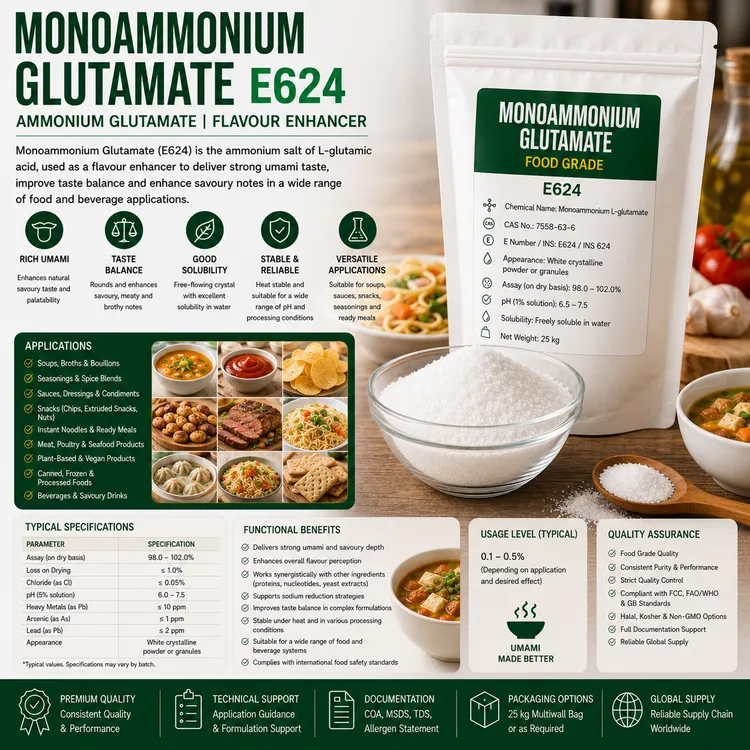
Product identity
| Product | Monoammonium Glutamate |
|---|---|
| Common names | Ammonium glutamate; glutamic acid ammonium salt; monoammonium L-glutamate |
| Common abbreviation | MAG |
| Category | Flavour Enhancers & Taste Modifiers |
| Function | Flavour enhancer / umami ingredient / savoury taste modifier / glutamate-based formulation component |
| E / INS number | E624 / INS 624 |
| CAS / identity | 7558-63-6 as shown in the current product data; confirm exact CAS, hydrated form and identity by supplier documentation |
| Ingredient family | Ammonium salt of glutamic acid |
| Typical form | Powder, crystal, granule, fine grade or application-specific blend |
| Key purchasing variables | Assay, purity, particle size, solubility, moisture, pH, ammonium and glutamate identity, heavy metals, microbiology, origin, certifications and packaging |
Application fit
Potential industrial use areas may include:
- Seasonings, spice blends and savoury premixes
- Soups, bouillons, stocks and instant noodles
- Sauces, gravies, marinades and condiments
- Snacks, chips, crackers and coated nuts
- Meat products, poultry, seafood and processed foods
- Plant-based meat analogues and hybrid meat systems
- Ready meals, frozen meals and savoury dry mixes
Technical overview for food manufacturers
Monoammonium Glutamate provides glutamate-driven umami through an ammonium salt form. For formulators, it should be reviewed as part of a complete savoury taste architecture rather than as a simple one-to-one replacement for MSG, salt, yeast extract, hydrolyzed vegetable protein or nucleotide systems. The correct use level depends on the food matrix, pH, salt level, sweetness, acidity, fat, protein system, spice intensity, heating process, storage condition and consumer preparation method.
In practical industrial development, E624 may be evaluated with sodium chloride, potassium chloride, yeast extract, hydrolyzed vegetable protein, ribonucleotides, onion powder, garlic powder, mushroom notes, meat flavours, smoke flavours, organic acids, sugars, spices and thermal-process flavours. The objective is not only stronger umami, but also better roundness, reduced flatness, longer flavour continuity and a more balanced savoury profile.
Umami performance and taste-system design
The main functional value of Monoammonium Glutamate is its contribution to umami and savoury flavour perception. In a finished food, its effect is influenced by free glutamate level, salt balance, amino acid profile, ribonucleotide synergy, thermal flavours, protein notes and the overall flavour-release system.
- Umami enhancement: supports savoury fullness, brothiness, meatiness and flavour depth in liquid, dry and semi-solid foods.
- Flavour roundness: helps reduce thin, watery or flat taste in soups, sauces, snacks and ready meals.
- Flavour continuity: improves persistence of savoury notes after dilution, cooking, reheating or extended storage.
- Salt-perception support: may help maintain savoury impact in systems where salt balance is being optimized.
- Bitterness balancing: can help round harsh notes from plant proteins, minerals, spices, yeast-derived ingredients or hydrolyzed proteins.
- Synergy with nucleotides: can be evaluated with inosinate, guanylate or yeast-derived ribonucleotides where permitted and technically suitable.
- Cost-in-use control: may reduce the need for higher levels of expensive savoury flavours in some formulas, subject to sensory validation.
Application guidance by food category
Monoammonium Glutamate should be selected according to finished-product taste target, additive declaration, ammonium-glutamate identity, process conditions and market permission. It may not match monosodium glutamate or monopotassium glutamate exactly in taste balance because the counter-ion and total mineral system can affect perception.
Seasonings and dry blends
In dry seasoning systems, Monoammonium Glutamate can contribute savoury lift, umami impact and flavour continuity. It may be reviewed in snack seasonings, spice blends, noodle sachets, soup powders, bouillons and savoury premixes.
- Match particle size with salt, sugar, spices, yeast extract and carrier powders to reduce segregation.
- Check flowability, caking, dusting and blend uniformity during storage and filling.
- Validate taste after the seasoning is applied, diluted, cooked or consumed.
- Review compatibility with anti-caking agents and moisture barrier packaging.
- Confirm label declaration and permitted use before commercial launch.
Soups, bouillons and instant noodles
In soups and noodle seasoning systems, E624 can support brothiness, meatiness, vegetable depth and taste persistence after dilution in hot water. It may be paired with MSG, yeast extract, hydrolyzed protein, ribonucleotides or mineral salts depending on taste and label strategy.
- Measure final taste after the intended dilution ratio.
- Check solubility, clarity and sediment in broth systems.
- Evaluate aftertaste, salt perception and total umami balance.
- Confirm compatibility with acids, colours, flavours and dehydrated vegetables.
- Validate sodium, potassium, ammonium and overall nutrition data if required by the destination market.
Sauces, marinades and condiments
In sauces, marinades and condiments, Monoammonium Glutamate can help round tomato, soy, meat, mushroom, roasted, fermented, garlic, onion and spice notes. It should be evaluated at the target pH, salt level, sugar level and heat process.
- Validate performance in acidic, salty, sweet or high-solids systems.
- Check taste after pasteurization, hot fill, retort or chilled storage.
- Evaluate compatibility with gums, starches, acids, preservatives and flavour emulsions.
- Review aftertaste and savoury persistence after shelf-life storage.
- Confirm label declaration and permitted use in the destination market.
Meat, poultry and seafood systems
In meat and seafood applications, E624 may support savoury intensity, cooked flavour perception and marinade flavour balance. It should be assessed together with salt, phosphates, proteins, spices, smoke notes, brines and cooking process.
- Measure flavour before and after cooking or reheating.
- Check compatibility with brines, tumbling, injection, dry seasoning and coating systems.
- Review phosphate, salt, protein and flavour interactions.
- Validate chilled, frozen and cooked shelf-life taste stability.
- Confirm finished-product additive declaration and market-specific limits.
Plant-based and hybrid meat systems
Plant-based proteins often require support for umami, masking and flavour continuity. Monoammonium Glutamate can be reviewed in plant-based burgers, sausages, nuggets, kebab-style products, mince, seafood analogues and hybrid meat products.
- Evaluate masking of beany, pea, cereal, fungal, bitter or mineral notes.
- Test synergy with yeast extract, mushroom, soy sauce powder, smoke, Maillard flavours and fat systems.
- Confirm vegan, vegetarian, halal or kosher suitability from supplier documents.
- Validate taste after frying, grilling, baking, freezing and thawing.
- Check consumer-facing claims such as “no added MSG,” “clean label” or “natural flavour.”
Ready meals and frozen foods
In ready meals and frozen foods, Monoammonium Glutamate can support savoury consistency after distribution, reheating and shelf life. It may be reviewed in rice dishes, noodles, sauces, stews, frozen meals, savoury fillings and meal kits.
- Test sensory performance after the declared shelf life.
- Evaluate microwave, oven, steam or pan-heating instructions.
- Check water migration, flavour dilution and sauce balance after freeze-thaw.
- Confirm additive declaration and finished-product nutrition data.
- Monitor flavour drift and aftertaste during storage.
Formulation and process-control notes
Monoammonium Glutamate is generally incorporated as a dry or dissolved ingredient, but industrial performance depends on particle size, blend uniformity, dissolution, dosage accuracy, sensory threshold and the overall savoury system. Because it is less common than MSG in some purchasing channels, grade verification and regulatory documentation should be checked early.
- Dry blending: match particle size with salt, sugar, spices, yeast extract and carriers to reduce segregation.
- Liquid systems: dissolve fully before final taste adjustment and check clarity or sediment where a clear solution is required.
- Heat processing: evaluate flavour after pasteurization, retort, baking, frying or hot filling because the complete flavour system can shift.
- pH sensitivity: test at the actual product pH because acid balance can change perceived umami, saltiness and aftertaste.
- Synergy systems: assess interaction with yeast extract, HVP, nucleotides, smoke flavours, onion, garlic, mushroom, tomato and spice extracts.
- Sensory limits: excessive glutamate contribution may create lingering, heavy or unbalanced taste.
- Blend stability: monitor caking, dusting and flow in humid environments and long storage.
- Claim review: verify whether “no added MSG,” “MSG free,” “clean label,” “natural” or “reduced sodium” claims are compatible with the formula and local law.
Specification checkpoints before purchasing
For industrial purchasing, buyers should compare the supplier’s specification against the intended application, sensory target, regulatory requirements and destination market. Monoammonium Glutamate may require more careful identity confirmation than commodity MSG because registry number, hydrated form and market acceptance can vary by supplier documentation.
Core quality parameters
- Assay or purity of Monoammonium Glutamate
- Identification and E624 / INS 624 confirmation where applicable
- CAS, hydrated form and exact chemical identity statement
- Appearance, colour, odour and taste
- Particle size, mesh size or crystal distribution
- Moisture or loss on drying
- pH of aqueous solution
- Ammonium content or nitrogen-related data where specified
- Specific rotation or optical purity where specified
- Chloride, sulphate or other inorganic impurities where specified
- Clarity and colour of solution where required
- Heavy metals, arsenic and lead limits
- Microbiological limits for food-grade supply
Commercial and compliance checks
- Food-grade and intended-use statement
- Origin and manufacturing-site information
- Fermentation substrate or manufacturing-process information where available
- Allergen, GMO, irradiation and BSE/TSE declarations
- Halal, kosher or other certification if required
- Destination-market regulatory declaration
- Packaging size, liner type and pallet configuration
- Minimum order quantity, lead time and available shelf life
Regulatory and labelling considerations
Monoammonium Glutamate is commonly identified as E624 / INS 624, but permission, use level, food-category restrictions and label declaration depend on the destination market. Buyers should confirm whether the additive must be declared as monoammonium glutamate, ammonium glutamate, flavour enhancer E624, INS 624 or another market-specific label term.
Special care is needed for claims involving “no added MSG,” “MSG free,” “no artificial additives,” “natural flavour,” “clean label” or sodium-related positioning. These claims can be sensitive when the formula contains glutamate-rich ingredients such as yeast extract, hydrolyzed vegetable protein, soy sauce powder, fermented sauces, tomato powder, cheese powders, mushroom extracts or added ribonucleotides.
Quality assurance and validation plan
A structured approval process helps avoid problems in flavour balance, aftertaste, label approval, blend uniformity, supplier documentation and commercial production. For large-volume savoury products, sensory validation should be treated as a quality-control requirement, not only a development activity.
- Document screening: review TDS, specification, COA, food-grade statement, regulatory declaration, allergen status, GMO status, origin and certifications.
- Identity verification: confirm CAS, hydrated form, E624 / INS 624 identity, assay basis and supplier manufacturing route.
- Bench formulation: test multiple E624 levels against the current formula and target savoury profile.
- Synergy trial: evaluate E624 with salt, yeast extract, hydrolyzed proteins, ribonucleotides, flavours, acids, sugars and spices.
- Process trial: run through real blending, heating, filling, coating, cooking, drying or freezing conditions.
- Sensory panel: assess umami intensity, saltiness, bitterness, aftertaste, harshness, balance and consumer preference.
- Analytical review: confirm additive status, label declaration and finished-product nutrition data where required.
- Shelf-life check: monitor flavour stability, aroma drift, caking, moisture pickup and overall product quality during storage.
- Commercial approval: finalize grade, supplier, specification, use level, packaging, MOQ, lead time and release criteria.
Storage, handling and logistics
Food-grade Monoammonium Glutamate is typically supplied as a dry powder, crystal or granule. It should be stored in clean, dry, odour-free warehouse conditions, protected from moisture, pests, contamination and damaged packaging. Opened bags should be resealed or transferred into controlled containers to prevent contamination and moisture pickup.
Packaging options to confirm
- Net weight per bag, carton, drum or big bag
- Inner liner and moisture barrier
- Particle size or mesh grade on label
- Batch code, production date and expiry format
- Pallet configuration and container loading data
- Export label language and country-specific marking
Purchasing information to provide
- Target application and finished product type
- Required grade, assay, particle size or benchmark sample
- Target flavour profile and current umami system
- First-order quantity and annual volume estimate
- Destination country and delivery term
- Preferred packaging size
- Required certificates and declarations
- Target shipment date and destination port
Documents to request
The document package should be agreed before purchase, especially for regulated markets, multinational food manufacturers, private-label products, flavour-system approvals and export shipments.
- Product specification or technical data sheet
- Certificate of analysis for available batch or lot
- Safety data sheet where applicable
- Food-grade, intended-use and regulatory compliance statement
- E624 / INS 624 statement where applicable
- CAS, hydrated form and identity confirmation
- Origin, manufacturer and manufacturing-site information
- Assay, pH, moisture, particle size and impurity profile
- Ammonium or nitrogen-related data where specified
- Allergen, GMO, irradiation and BSE/TSE declarations where required
- Halal, kosher or other certification if required
- Heavy metal, arsenic, lead and microbiological specifications
- Shelf-life, storage and handling information
- Label draft, packaging details and pallet configuration
- Market-specific declarations required by the destination country
How to request this product
Send the product name, E number, target grade or reference specification, particle size preference, intended application, quantity, destination country, packaging preference, delivery term, expected shipment date and required documents. If you already purchase Monoammonium Glutamate, attach or describe your current specification, supplier label, certificate of analysis, flavour benchmark or existing additive declaration so supplier options can be compared more accurately.
Useful answers
What is Monoammonium Glutamate used for in food manufacturing?
Monoammonium Glutamate is used for umami, savoury depth, meatiness, brothiness, salt-perception support, sweetness modulation and overall taste balance. It is commonly reviewed for seasonings, soups, sauces, snacks, meat products, meat analogues, ready meals, noodles and savoury dry mixes.
What is the E number for Monoammonium Glutamate?
Monoammonium Glutamate is commonly identified as E624 or INS 624. Buyers should confirm the correct label declaration and permitted use according to the destination market and finished food category.
Is Monoammonium Glutamate the same as MSG?
No. MSG is monosodium glutamate, while Monoammonium Glutamate is an ammonium salt of glutamic acid. Both are glutamate-based flavour enhancers, but their counter-ion, specification profile, taste balance and label declaration differ.
Is Monoammonium Glutamate a preservative?
No. Monoammonium Glutamate is normally used as a flavour enhancer and taste modifier. It should not be used as the main shelf-life or microbial-control system. Food safety must be managed through validated formulation, processing, packaging and storage controls.
Which specification parameters should be checked?
Buyers should check assay, purity, identity, CAS confirmation, hydrated form, appearance, particle size, moisture, pH, solubility, ammonium-related data where specified, chloride, sulphate, heavy metals, arsenic, lead, microbiological limits, origin, allergen status, GMO status, shelf life and storage conditions.
Can Global Food Additives source Monoammonium Glutamate?
Global Food Additives can review sourcing options for Monoammonium Glutamate according to target specification, particle size, application, quantity, destination, packaging and required documentation.
Which documents should be requested?
Buyers commonly request a technical data sheet or specification, certificate of analysis, safety data sheet where applicable, food-grade statement, origin statement, allergen and GMO declarations, halal or kosher certificate where required, shelf-life information, label and packaging details.
Is Monoammonium Glutamate permitted in every country?
No. Food additive use depends on destination-market rules, food category, use level, label requirements and buyer responsibility. Regulatory status should be verified before commercial use.
Tell us which food additive or ingredient you need.
Send product names, target specifications, quantity, destination country, packaging preference, delivery term, and document requirements. Our team will review your inquiry and respond from orders@foodgradeadditives.com.
Your message has been received. You will be redirected to the home page.