
Malt Extract
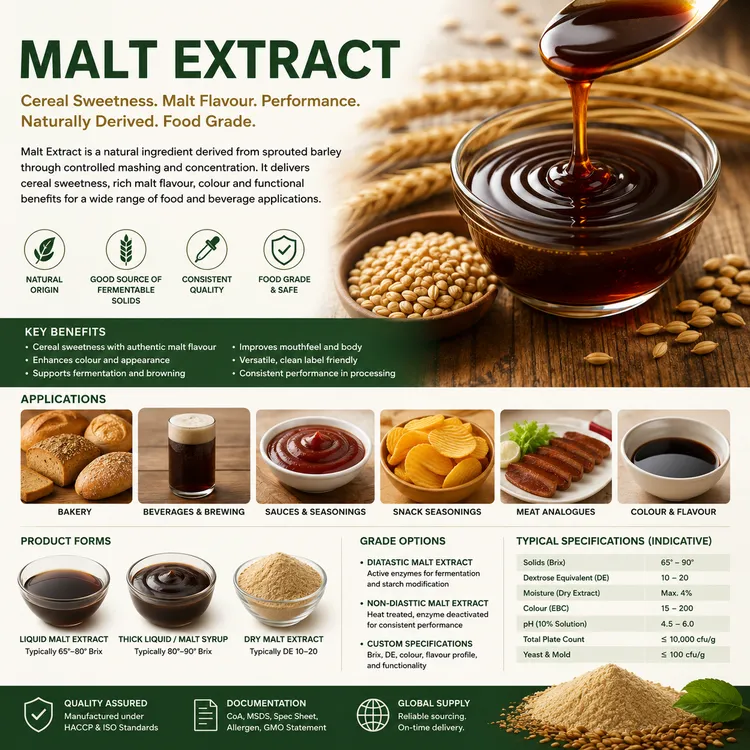
Malt Extract is a food-grade cereal-derived ingredient used by food manufacturers for malt flavour, cereal sweetness, brown colour development, flavour rounding, body, fermentation solids and taste modification. It is commonly evaluated in bakery, beverages, malted drinks, brewing, seasonings, soups, sauces, snacks, breakfast cereals, confectionery, dairy systems, meat analogues and savoury flavour systems.
For industrial sourcing, Malt Extract should be selected by source grain, liquid or dry form, diastatic or non-diastatic status, Brix or dry solids, colour, flavour profile, carbohydrate profile, maltose level, enzyme activity, solubility, microbiological quality, allergen status, gluten status, label requirements and destination-market regulations. The term “malt extract” can cover very different grades, so buyers should compare supplier documents and application performance, not only the product name.
Product identity
| Product | Malt Extract |
|---|---|
| Other names | Barley malt extract, liquid malt extract, dry malt extract, malt syrup, malt powder, extract of malt |
| Category | Flavour Enhancers & Taste Modifiers |
| Function | Flavour enhancer / taste modifier / savoury system ingredient |
| CAS / identity | 8002-48-0 |
| E / INS number | Confirm by destination market and supplier documentation |
| Typical source | Malted barley is common; wheat, rice or other cereal sources may be offered depending on supplier |
| Typical form | Liquid syrup, viscous extract, paste, powder, granule, spray-dried grade or agglomerated powder |
| Technical grade types | Diastatic, non-diastatic, light, amber, dark, roasted, liquid extract, dry extract or application-specific blend |
| Key technical focus | Source grain, Brix, dry solids, colour, flavour profile, maltose, carbohydrate profile, enzyme activity, allergen and gluten status |
Application fit
Potential use areas may include:
- Seasonings, snack coatings, savoury powders and taste-modifier systems
- Soups, sauces, gravies, marinades, glazes and ready-meal bases
- Bakery, bread, bagels, crackers, biscuits, cereal bars and malted dough systems
- Malted beverages, cocoa drinks, dairy beverages, non-dairy drinks and powdered drink mixes
- Brewing, fermentation substrates, yeast-support systems and wort-based applications
- Breakfast cereals, granola, extruded cereals and toasted grain systems
- Confectionery, fillings, chocolate systems, caramel-style products and malted sweets
- Meat analogues, savoury protein systems and roasted cereal flavour platforms
Technical overview
Malt Extract is produced from malted cereal grain. During malting, grain is steeped, germinated and kilned to develop cereal flavour, colour precursors and natural enzymes. During mashing, the malted grain is mixed with water under controlled conditions so that starch and other grain components are extracted and converted into a sweet wort. This wort is then concentrated into liquid malt extract or dried into dry malt extract.
The finished ingredient contains a mixture of carbohydrates, including maltose and higher saccharides, along with cereal-derived flavour compounds, proteins, minerals, colour compounds and, in some grades, residual enzyme activity. Light grades are selected for mild cereal sweetness and fermentable extract. Dark or roasted grades are selected for stronger colour, toasted notes, caramel-like character and more intense malt flavour.
Malt Extract can function as a flavour ingredient, sweetening contributor, colour contributor, fermentation substrate, bakery improver, browning support ingredient and carrier of cereal identity. Its industrial behaviour is strongly influenced by source grain, mashing profile, evaporation or drying conditions, enzyme retention, colour target and storage conditions.
Functional benefits in food systems
Malt flavour and cereal sweetness
Provides characteristic malt, cereal, toasted, caramel, honey-like or roasted notes depending on grade, colour and kilning profile.
Flavour rounding
Can soften harsh notes, improve taste balance and add depth in savoury seasonings, soups, sauces, snacks and meat analogue systems.
Bakery browning and aroma
Contributes fermentable sugars and Maillard browning precursors that can support crust colour, baked aroma and cereal character.
Fermentation solids
Liquid and dry malt extracts can supply soluble solids and fermentable carbohydrates for brewing, yeast-raised bakery and selected fermentation systems.
Liquid, dry, diastatic and non-diastatic grades
Grade selection depends on how Malt Extract will be used. Liquid grades are convenient for syrup systems, brewing, bakery dosing and flavour blending. Dry grades are preferred for dry mixes, seasonings, snack powders, bakery premixes and applications requiring long storage stability or easy weighing. Diastatic grades contain active enzymes, while non-diastatic grades are used mainly for flavour, colour and sweetness.
| Grade type | Typical function | Industrial review points |
|---|---|---|
| Liquid Malt Extract | Viscous syrup for malt flavour, soluble solids, sweetness, brewing extract and bakery systems. | Review Brix, dry solids, viscosity, colour, microbial limits, pumpability, storage temperature and crystallization risk. |
| Dry Malt Extract | Powder or granule for dry blends, seasonings, bakery premixes, beverage powders and brewing applications. | Review moisture, solubility, particle size, bulk density, caking, colour, flavour and packaging barrier. |
| Diastatic Malt Extract | Provides malt flavour plus active amylase enzymes for starch conversion in suitable systems. | Confirm diastatic power, enzyme activity, process temperature, flour compatibility and risk of excessive starch breakdown. |
| Non-diastatic Malt Extract | Used mainly for flavour, colour, sweetness, solids and taste balance without meaningful enzyme activity. | Useful in bakery, confectionery, seasonings, beverages and sauces where enzyme activity is not desired. |
| Light Malt Extract | Mild colour and cereal sweetness. | Used when flavour must remain gentle and colour impact should be limited. |
| Dark or roasted Malt Extract | Stronger roasted, caramel and toasted notes with deeper colour. | Useful for savoury systems, dark bakery, malt beverages, sauces and roasted flavour platforms. |
Application engineering guidance
| Application | Typical technical objective | Key formulation review points |
|---|---|---|
| Seasonings and snack coatings | Add toasted cereal character, savoury depth, sweetness balance and powder carrier functionality. | Review powder flow, hygroscopicity, salt level, spice load, colour, flavour intensity, allergen declaration and gluten status. |
| Soups, sauces and gravies | Round flavour, add malt sweetness, support brown colour and improve cooked cereal notes. | Validate heat stability, pH, salt, starch system, colour target, flavour balance and interaction with yeast extract, HVP or savoury flavours. |
| Bakery and bread | Improve malt aroma, crust colour, yeast fermentation support and cereal sweetness. | Check diastatic activity, flour enzyme balance, sugar level, dough fermentation, crust colour, crumb texture, stickiness and shelf life. |
| Bagels, crackers and biscuits | Develop toasted colour, cereal notes, surface browning and flavour depth. | Review baking temperature, surface application, reducing sugar level, colour uniformity, crispness and flavour carry-through. |
| Malted beverages and cocoa drinks | Provide malt identity, sweetness, cereal body and roasted notes. | Evaluate solubility, sediment, dairy or plant-protein compatibility, cocoa interaction, spray-dried powder performance and label declaration. |
| Brewing and fermentation | Supply fermentable extract, malt character and wort solids. | Review extract yield, fermentability, colour, bitterness impact, diastatic status, microbial quality and compatibility with yeast process. |
| Breakfast cereals and granola | Support cereal flavour, toasted aroma, binding, gloss and browning. | Validate coating viscosity, bake profile, stickiness, moisture migration, cluster formation, colour and storage crispness. |
| Confectionery and fillings | Add malt sweetness, caramel-like notes, colour and cereal flavour identity. | Check water activity, fat compatibility, crystallization, viscosity, flavour release, allergen status and colour stability. |
| Meat analogues and savoury proteins | Add roasted cereal depth, brown notes, sweetness balance and savoury flavour rounding. | Review protein source, salt, yeast extract, smoke flavour, caramel colour, Maillard reaction, allergen labeling and vegan suitability. |
Flavour and colour design
Malt Extract contributes more than sweetness. Its flavour can range from mild cereal and biscuit-like notes to stronger toasted, caramel, roasted or slightly bitter dark malt notes. This makes it useful in savoury systems where a rounded cooked background is needed, and in sweet systems where malted, caramel-like or cereal notes improve depth.
Colour is an important purchasing parameter. Light extracts may be used in beverages, bakery and cereals where colour should remain controlled. Dark extracts may be used in sauces, meat analogues, malt drinks and brown bakery products where stronger colour is desired. Colour should be specified using supplier method, such as EBC, Lovibond, absorbance or internal colour scale, and compared in the finished product.
Diastatic activity and bakery control
Diastatic Malt Extract contains active starch-converting enzymes, mainly amylase activity. In bakery, this can support fermentation by increasing fermentable sugars and can improve crust colour. However, excess enzyme activity can cause sticky dough, gummy crumb, weak structure, excessive browning or processing instability. Non-diastatic Malt Extract is safer when only flavour, colour and sweetness are required.
| Control point | Why it matters | Industrial review |
|---|---|---|
| Diastatic power | Indicates enzyme potential for starch conversion. | Request activity method and validate in the actual flour or starch system. |
| Dough stickiness | Too much enzyme activity can weaken dough handling. | Run line trials with target flour, fermentation time and process temperature. |
| Crust colour | Malt sugars and enzyme activity can increase browning. | Measure baked colour and adjust dose, sugar system or bake profile. |
| Crumb texture | Excessive starch breakdown can create gummy or weak crumb. | Evaluate crumb firmness, slicing, resilience and eating quality over shelf life. |
| Enzyme inactivation | Heat process may reduce enzyme activity, but timing affects function. | Confirm process temperature and internal product temperature during baking or cooking. |
Specification and quality-control parameters
For industrial purchasing, Malt Extract should be compared by grade, source grain, form, solids, colour, flavour and documentation. A supplier specification should provide enough information for R&D, QA, regulatory review and production scale-up.
Identity and source
- Product name: Malt Extract
- CAS number: 8002-48-0
- Source grain, such as barley, wheat, rice or other cereal
- Liquid, dry, diastatic, non-diastatic, light or dark grade
- Country of origin and production site
- Processing method, including extract, syrup, spray-dried or agglomerated form
Functional properties
- Brix or dry solids for liquid grades
- Moisture for dry grades
- Colour value and test method
- Flavour profile or sensory standard
- Carbohydrate profile, maltose content or reducing sugars where specified
- Diastatic activity or enzyme activity where applicable
Physical properties
- Appearance, colour and odour
- Viscosity and density for liquid grades
- Particle size and bulk density for dry grades
- Solubility, dispersibility and sediment behavior
- Caking tendency and hygroscopicity
- Crystallization or phase separation risk
Food safety controls
- Total plate count, yeast and mould
- Coliforms, E. coli, Salmonella and specified pathogens where required
- Heavy metals and elemental impurities
- Allergen declaration, especially barley, wheat and gluten-containing cereals
- GMO, irradiation and nanomaterial statements where required
- Halal, kosher, vegan or vegetarian suitability where commercially required
Quality effects to validate
| Quality factor | Possible Malt Extract effect | Validation method |
|---|---|---|
| Flavour depth | Adds malt, cereal, biscuit, caramel, toasted or roasted notes. | Sensory panel in final product and comparison against approved reference standard. |
| Sweetness and taste balance | Contributes maltose-rich sweetness and can round savoury or acidic systems. | Sweetness balance test, salt perception review and flavour-release evaluation. |
| Colour | Can increase golden, amber or brown colour depending on grade. | Colour measurement, visual standard and accelerated storage comparison. |
| Browning | Can support Maillard browning in bakery and heated savoury systems. | Bake test, cook test, colour measurement and flavour development review. |
| Fermentation performance | Can provide fermentable extract for yeast systems where applicable. | Fermentation curve, sugar utilization, final gravity, pH and sensory review. |
| Powder handling | Dry Malt Extract may cake or absorb moisture if packaging is weak. | Humidity chamber test, flowability test, caking test and package trial. |
| Microbial stability | Liquid grades and low-heat applications require careful microbial review. | COA review, water activity, preservative system where applicable and shelf-life testing. |
Compatibility with ingredients and processing
Malt Extract can be combined with many flavour-building ingredients, including yeast extract, hydrolyzed vegetable protein, caramel colour, smoke flavours, cocoa, coffee, vanilla, dairy powders, cereal flours, roasted grains, spices, savoury flavours and sweeteners. It can improve background depth but may also add cereal allergen considerations and colour impact.
| System | Potential effect | Industrial review |
|---|---|---|
| Malt Extract + yeast extract | Can create stronger savoury depth and roasted cereal background. | Balance umami, salt perception, bitterness and allergen declarations. |
| Malt Extract + caramel colour | Can intensify brown appearance and cooked notes. | Check colour standard, label declaration and flavour impact. |
| Malt Extract + cocoa or coffee | Can support roasted, malty, chocolate or beverage depth. | Validate bitterness, sweetness, solubility and sediment. |
| Malt Extract + dairy powders | Can create malted milk or creamy cereal beverage profiles. | Check solubility, heat stability, protein interaction, allergen labeling and flavour balance. |
| Malt Extract + bakery enzymes | Can affect fermentation and browning when diastatic activity is present. | Coordinate with amylase, maltogenic amylase and flour improver system. |
| Malt Extract + high-protein meat analogues | Can add roasted cereal depth and balance beany notes. | Evaluate protein source, salt, fat, heat process, colour and vegan label expectations. |
Processing and handling notes
Liquid Malt Extract is viscous and may require warmed storage, heated transfer lines or positive-displacement pumps depending on solids and temperature. Dry Malt Extract should be protected from moisture because it can cake or become sticky under humid conditions. Both forms should be stored away from strong odours because malt flavour can be affected by warehouse conditions.
In dry blending, particle size and hygroscopicity are important for flow, segregation and sachet filling. In liquid processing, viscosity, Brix, microbial quality and pumpability are important. In high-heat applications, Malt Extract can darken and develop stronger roasted notes, so process temperature and residence time should be validated.
Regulatory and labeling review
Malt Extract is often reviewed as a cereal-derived food ingredient, flavouring ingredient, sweetening contributor or processing ingredient depending on destination market and application. It may not have a universal E number. Buyers should verify ingredient status, label wording, source grain declaration, allergen declaration, gluten declaration and whether the ingredient is allowed in the intended food category.
Because Malt Extract is commonly made from barley, it should normally be treated as a gluten-containing cereal ingredient unless the supplier provides specific validated documentation accepted by the destination market. Products making gluten-free, allergen-free, clean-label, natural, vegan, non-GMO, organic, malted, no-added-sugar or nutrition claims should be reviewed carefully.
Label declarations may include “malt extract,” “barley malt extract,” “malt syrup,” “dried malt extract,” “malted barley extract,” “malt flavour,” or another locally accepted wording depending on grade and market. Final label suitability remains the buyer's responsibility.
Industrial purchasing notes
When reviewing Malt Extract, compare the supplier specification against the intended food application, process conditions, flavour target, colour target, enzyme requirement, label expectations and local rules. For industrial purchasing, the most useful inquiry normally includes source grain, liquid or dry form, diastatic or non-diastatic requirement, colour, Brix or moisture, packaging size, quantity, destination and required documents.
| Purchasing factor | Why it matters |
|---|---|
| Source grain | Determines flavour, allergen status, gluten declaration, customer acceptance and label wording. |
| Liquid vs dry form | Controls handling, storage, dosing, moisture contribution and process convenience. |
| Diastatic status | Active enzyme grades can affect dough, starch conversion, fermentation and texture. |
| Colour and flavour grade | Light, amber, dark and roasted grades create different product colour and taste effects. |
| Brix, dry solids or moisture | Important for formulation water balance, sweetness, viscosity and shelf life. |
| Carbohydrate profile | Maltose and reducing sugar content influence sweetness, fermentation, browning and label calculation. |
| Microbiological quality | Critical for ready-to-eat, low-heat, beverage, dairy and dry powder applications. |
| Documentation package | Complete specification, COA, allergen, gluten, GMO, origin, heavy metal, microbiology, halal, kosher and regulatory documents reduce approval delays. |
Documents to request
- Product specification or technical data sheet with CAS number and identity statement
- Certificate of analysis for available batch or lot
- Source grain declaration, such as barley, wheat, rice or other cereal
- Liquid, dry, diastatic, non-diastatic, light, dark or roasted grade declaration
- Brix, dry solids, moisture or loss-on-drying information
- Colour specification and test method
- Flavour profile, sensory standard or reference sample where available
- Carbohydrate profile, maltose content and reducing sugar data where specified
- Diastatic power or enzyme activity data for diastatic grades
- pH, ash, protein and solubility data where specified
- Food-grade statement and destination-market regulatory declaration
- Allergen, gluten, GMO, irradiation and nanomaterial statements where required
- Halal, kosher, vegan or vegetarian suitability documents where commercially required
- Microbiological limits and pathogen absence statement
- Heavy metals and elemental impurity limits
- Origin, manufacturer, production site and change-control information
- Shelf-life, storage condition and humidity or temperature protection guidance
- Packaging details, net weight, drum, pail, bag, IBC or pallet configuration and batch coding
- Label declaration guidance and market-specific compliance statement
- Traceability and supplier quality-system information where required
How to request this product
Send the product name, source grain preference, liquid or dry form, diastatic or non-diastatic requirement, colour target, flavour target, Brix or moisture requirement, quantity, destination country, packaging preference, expected shipment date and required documents. If you already purchase Malt Extract, attach or describe your existing specification, label, certificate of analysis, supplier grade, colour value, Brix, moisture level or application so supplier options can be compared more accurately.
For faster technical review, include the final product type, target function, desired malt flavour intensity, colour limitation, process temperature, pH, sweetness target, allergen and gluten requirements, GMO preference, required certifications, annual consumption estimate and whether you need a laboratory sample, pilot quantity or commercial shipment.
Useful answers
What is Malt Extract used for in food manufacturing?
Malt Extract is used for malt flavour, cereal sweetness, taste balance, colour development, bakery browning, fermentation solids and flavour rounding. Typical applications include bakery, beverages, malted drinks, brewing, seasonings, soups, sauces, snacks, breakfast cereals, confectionery, dairy systems and meat analogues.
What is Malt Extract made from?
Malt Extract is made from malted cereal grain, commonly barley. Other cereal sources may be available depending on supplier. The exact source grain should be confirmed because it affects flavour, allergen status, gluten declaration and label wording.
What is the difference between liquid and dry Malt Extract?
Liquid Malt Extract is a viscous syrup or paste used for liquid dosing, brewing, bakery and flavour systems. Dry Malt Extract is a powder or granule used for dry blends, seasonings, bakery premixes and powdered beverages. They differ in water content, handling, storage, solubility and dosing.
What is diastatic Malt Extract?
Diastatic Malt Extract contains active starch-converting enzymes. It may be useful in bakery or starch systems where enzyme activity is desired. Non-diastatic Malt Extract is used mainly for flavour, colour and sweetness when enzyme activity is not required.
Does Malt Extract contain gluten?
Barley Malt Extract should be treated as a gluten-containing cereal ingredient unless the supplier provides specific validated gluten-free documentation accepted by the destination market. Always verify allergen and gluten status before commercial use.
Can Global Food Additives source Malt Extract?
Global Food Additives can review sourcing options for Malt Extract according to source grain, liquid or dry form, diastatic status, colour, flavour profile, Brix or moisture, application, quantity, destination, packaging and required documentation.
Which documents should be requested?
Buyers commonly request a technical data sheet, product specification, certificate of analysis, source grain declaration, colour value, Brix or moisture data, allergen and gluten statement, GMO declaration, microbiological limits, shelf-life information and packing details.
Is Malt Extract permitted in every country?
No. Use depends on destination-market rules, ingredient status, food category, source grain, allergen rules, gluten labeling, label wording, claims and buyer responsibility. Final regulatory suitability should be verified before commercial use.
Tell us which food additive or ingredient you need.
Send product names, target specifications, quantity, destination country, packaging preference, delivery term and document requirements. For Malt Extract, please also include the source grain, liquid or dry form, diastatic requirement, colour target, flavour target, Brix or moisture requirement, allergen or gluten requirements and required certificates. Our team will review your inquiry and respond from orders@foodgradeadditives.com.
Your message has been received. You will be redirected to the home page.