
Koji Culture
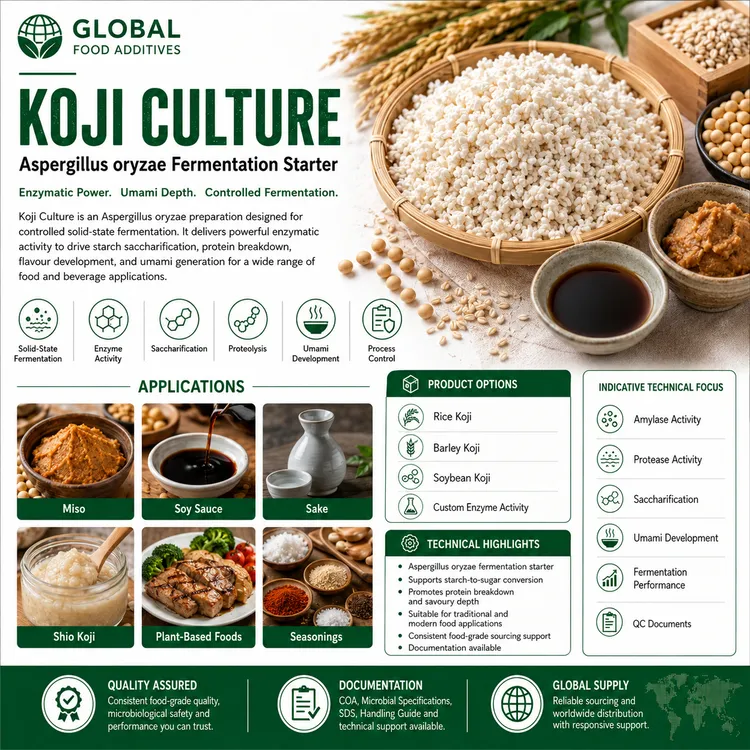
Koji Culture is a food-grade fungal fermentation starter, commonly based on Aspergillus oryzae preparation, used for solid-state fermentation of grains, legumes and protein-rich substrates. It is evaluated by food manufacturers for controlled enzyme production, starch saccharification, protein hydrolysis, flavour development, umami generation, aroma formation and starter-culture performance in miso, soy sauce, sake, amazake, shio koji, fermented seasonings, plant-based foods and savoury fermentation bases.
For industrial use, Koji Culture should be reviewed as both a microbial culture and an enzyme-generating process tool. Performance depends on strain identity, spore viability, substrate preparation, moisture, temperature, oxygen, incubation time, enzyme profile, contamination control, downstream salting or fermentation, regulatory status and documentation quality.
Product identity
| Product | Koji Culture |
|---|---|
| Common names | Koji starter, koji-kin, tane-koji, Aspergillus oryzae culture |
| Category | Fermentation, Cultures & Bio-Protective Ingredients |
| Function | Fermentation, starter culture or bio-protective ingredient |
| E / INS number | Confirm by destination market and supplier documentation |
| CAS / identity | Aspergillus oryzae preparation; not a single chemical substance |
| Typical organisms | Selected Aspergillus oryzae strains or other approved koji molds depending on application and supplier |
| Typical form | Koji spores, inoculated grain, rice koji, barley koji, soybean koji, freeze-dried culture, powder or application-specific blend |
| Typical substrates | Steamed rice, barley, wheat, soybean, pea, chickpea, fava bean, cereal bran or selected plant-protein substrates |
| Key process focus | Spore germination, mycelial growth, enzyme production, substrate conversion, contamination control and sensory profile |
Application fit
Potential use areas may include:
- Miso, soybean paste, legume pastes and fermented seasoning bases
- Soy sauce, shoyu, tamari-style systems and high-salt moromi fermentation
- Sake, amazake, mirin-style bases and rice saccharification systems
- Shio koji, koji marinades and enzyme-active culinary fermentation ingredients
- Plant-based meat, seafood analogues and fermented protein systems
- Bakery flavour bases, sourdough-style koji ferments and cereal fermentation
- Vegetable fermentation, pickling bases and savoury fermented condiments
- Enzyme-rich fermentation ingredients for flavour houses and food manufacturers
Technical overview
Koji Culture is used to grow a controlled mold culture on a prepared substrate, usually under warm, humid and aerobic solid-state conditions. During growth, the culture secretes enzymes into the substrate. These enzymes can convert starches into sugars, proteins into peptides and amino acids, and selected lipids into flavour-active compounds. This enzymatic activity is the technical basis for many koji-driven foods, including miso, soy sauce, sake, amazake and shio koji.
The value of a Koji Culture depends on the strain and its enzyme profile. A high-amylase culture may be preferred for rice saccharification and sweet fermented bases, while stronger protease or peptidase activity may be more valuable for soybean, legume, meat analogue and umami-focused applications. Some strains are selected for aroma profile, colour control, salt tolerance, fast growth, low sporulation colour, low off-flavour formation or compatibility with specific grain and protein substrates.
Because koji is a living culture system, industrial approval should include supplier documentation, strain review, laboratory trials, pilot-scale fermentation and finished-product testing. A culture that performs well on polished rice may not perform the same way on whole grains, soybeans, barley, peas, chickpeas, fava beans or high-moisture plant-protein matrices.
Functional benefits in food manufacturing
Saccharification
Koji enzymes such as alpha-amylase and glucoamylase can convert starches in rice, barley, wheat or other grains into fermentable sugars, supporting sweetness and downstream yeast fermentation.
Proteolysis and umami
Proteases and peptidases can break proteins into peptides and amino acids, supporting savoury depth, glutamate release, umami development and improved flavour complexity.
Aroma and flavour formation
Koji fermentation can generate nutty, cereal, mushroom, fruity, malty, roasted, fermented and savoury notes depending on strain, substrate and incubation conditions.
Texture modification
Enzymatic breakdown of starches, proteins and cell structures can soften substrates, improve marinade penetration, modify plant-protein texture and support controlled fermentation bases.
Application engineering guidance
| Application | Technical objective | Critical review points |
|---|---|---|
| Miso and legume pastes | Generate enzymes for protein hydrolysis, starch conversion, flavour development and long fermentation maturation. | Review soybean or legume cooking, koji substrate, salt level, water activity, maturation time, inoculation rate, enzyme balance, colour target and microbial controls. |
| Soy sauce and shoyu systems | Create koji with strong proteolytic and carbohydrate-converting activity before brine fermentation. | Validate wheat-soy ratio, substrate steaming or roasting, koji incubation, brine strength, moromi fermentation, press yield, nitrogen release and aroma profile. |
| Sake and rice saccharification | Produce rice koji capable of converting starch into fermentable sugars for alcoholic fermentation. | Check rice polishing, steaming moisture, koji room temperature, humidity, amylase activity, glucose release, yeast compatibility and flavour impact. |
| Amazake and sweet rice bases | Convert rice starch into sugars for naturally sweet non-alcoholic or low-alcohol fermented bases. | Review amylase activity, sweetness target, temperature holding, microbial stability, pasteurization, viscosity and shelf-life plan. |
| Shio koji and marinades | Create enzyme-active salty seasoning systems for flavour enhancement, tenderization and moisture retention. | Validate salt level, enzyme activity, meat or vegetable application, microbial stability, label status, allergen risk and shelf-life conditions. |
| Plant-based meats | Improve savoury profile, reduce beany notes, support protein softening and create fermented complexity. | Review protein source, extrusion history, moisture, fat system, salt, pH, enzyme exposure, texture change and sensory profile. |
| Fermented grains and cereals | Develop sweetness, malty notes, digestibility and enzymatic flavour complexity. | Validate wholegrain bran effect, water absorption, surface moisture, mold penetration, enzyme production and contamination risk. |
| Alternative legume ferments | Develop miso-like, soy-free or allergen-conscious fermented bases. | Check pea, chickpea, fava, lentil or bean composition, anti-nutritional factors, cooking process, koji growth, proteolysis and allergen labeling. |
| Flavour bases and reaction ingredients | Create amino acid, peptide and sugar-rich bases for savoury systems or controlled thermal flavour development. | Monitor free amino nitrogen, reducing sugars, salt, pH, microbial load, Maillard reaction behaviour and regulatory classification. |
Culture selection and strain performance
Industrial Koji Culture selection should begin with the intended application. Rice koji for sake or amazake usually requires strong starch-converting activity. Soy sauce and miso koji may require stronger proteolysis, peptidase activity and salt-tolerant downstream performance. Plant-based meat and novel legume applications may require lower off-note generation, controlled proteolysis and sensory compatibility with pea, soy, wheat, chickpea or fava proteins.
Commercial culture suppliers may offer different strains or blends for rice, barley, soybean, miso, shoyu, sake, shio koji or experimental plant-based fermentation. The buyer should ask whether the culture has been validated on the intended substrate and whether application protocols are available for the target process.
| Selection factor | Why it matters | Buyer questions |
|---|---|---|
| Strain identity | Determines enzyme profile, growth speed, aroma, colour and regulatory review. | Can the supplier confirm genus, species, strain or internal culture code? |
| Spore count or viable count | Affects inoculation reliability and fermentation start. | What is the declared count, method and shelf-life retention? |
| Amylase activity | Important for rice, barley, cereal, amazake, sake and sweet-fermentation systems. | Is activity measured under conditions relevant to the target substrate? |
| Protease and peptidase activity | Important for miso, soy sauce, legumes, plant proteins and umami generation. | Does the supplier provide protease or amino nitrogen development data? |
| Aroma profile | Koji strain and substrate can create different cereal, mushroom, fruity or savoury notes. | Has the culture been sensory-tested in the same product category? |
| Safety status | Fungal cultures require careful review of identity, purity and toxin-control documentation. | Are mycotoxin, aflatoxin, pathogen and production-purity statements available? |
| Handling format | Spores, inoculated grain and freeze-dried formats differ in dosage and storage. | What is the recommended inoculation rate, storage temperature and reactivation method? |
Solid-state fermentation control
Koji production is typically a solid-state fermentation process. The substrate must be cooked or steamed to the correct moisture, cooled, inoculated, aerated and incubated under controlled temperature and humidity. Unlike submerged fermentation, the mold grows on the surface and through the substrate, so water activity, surface moisture, airflow, bed depth and heat removal are critical.
Industrial controls should include raw material preparation, thermal treatment, cooling, inoculation uniformity, incubation temperature, humidity, oxygen availability, turning schedule, bed depth, fermentation time, contamination monitoring and endpoint criteria. Enzyme production and flavour quality can change quickly if the koji overheats, dries out, becomes too wet, lacks oxygen or is contaminated.
Substrate preparation and process design
| Substrate or process factor | Technical impact | Industrial review |
|---|---|---|
| Rice polishing and steaming | Affects water absorption, mold penetration, enzyme production and final aroma. | Validate soaking time, steaming time, moisture gradient, cooling and inoculation uniformity. |
| Soybean cooking | Protein availability and texture influence protease action and fermentation quality. | Review soak time, pressure cooking, thermal kill step, cooling and crushing or mixing method. |
| Wheat or barley treatment | Roasting, cracking or steaming changes flavour, enzyme access and sugar release. | Control particle size, roasting colour, moisture and mixing ratio with legume substrate. |
| Alternative legumes | Pea, chickpea, fava or lentil substrates vary in protein, starch and off-note profile. | Validate cooking, dehulling, moisture, anti-nutritional factors and allergen declarations. |
| Moisture content | Too low slows growth; too high increases clumping and contamination risk. | Set substrate-specific moisture target and measure after cooking, cooling and incubation. |
| Oxygen and airflow | Koji mold is aerobic and requires oxygen for healthy growth and enzyme production. | Control tray depth, airflow, turning schedule, chamber ventilation and CO2 accumulation. |
| Temperature control | Temperature affects growth speed, enzyme profile, aroma and safety. | Monitor product-core temperature, not only room temperature, and define corrective action limits. |
| Fermentation endpoint | Endpoint determines enzyme level, aroma, colour, moisture and downstream performance. | Use time, visual growth, aroma, temperature, enzyme activity and analytical markers together. |
Specification and quality-control parameters
For industrial purchasing, Koji Culture should be evaluated by identity, activity, purity, safety and process performance. A supplier specification should define what the culture is, how it is measured, how it should be stored, and what performance can be expected in the intended application.
Identity and culture data
- Product name and culture format
- Genus, species and strain or internal culture code where available
- Aspergillus oryzae preparation statement where applicable
- Single-strain or blended culture description
- Carrier, grain base or medium components
- Traceability of master culture and production batch
Activity and performance
- Spore count, viable count or activity unit
- Recommended inoculation rate
- Amylase activity where applicable
- Protease or peptidase activity where applicable
- Saccharification or amino nitrogen development data
- Application-specific protocol for rice, soy, barley or legume substrates
Safety and purity controls
- Food-grade statement
- Mycotoxin and aflatoxin statement where applicable
- Pathogen absence statement according to supplier scope
- Limits for coliforms, E. coli, Salmonella, yeast and mould where applicable
- Allergen and cross-contact declaration
- GMO, irradiation and nanomaterial statements where required
Handling and logistics
- Storage temperature and humidity requirement
- Shelf life unopened and after opening
- Moisture protection and oxygen protection for dry formats
- Package size, dose format and batch coding
- Transport temperature and permitted excursions
- Customs documentation for microbial cultures where required
Food safety and contamination control
Koji production requires strict hygiene because the process intentionally supports fungal growth on nutrient-rich substrates. The selected koji culture should dominate the substrate quickly and predictably. Poor sanitation, incorrect moisture, slow cooling, uneven inoculation or excessive incubation time can allow unwanted bacteria, yeasts or molds to develop.
Industrial operations should define raw material acceptance criteria, heat-treatment parameters, cooling times, inoculation hygiene, chamber sanitation, airflow filtration where needed, foreign-matter controls, employee hygiene, environmental monitoring and finished-koji release criteria. Mycotoxin and strain-safety documentation should be part of supplier approval, especially when using fungal cultures in new substrates or novel product categories.
Analytical and validation approach
Industrial validation should measure both microbial performance and food quality. Useful indicators may include spore count, microbial purity, substrate moisture, product-core temperature, pH where relevant, water activity, enzyme activity, reducing sugar development, free amino nitrogen, amino acid profile, organic acid profile, salt concentration in downstream fermentation, colour, aroma and sensory profile.
Finished-product validation depends on the application. Miso and soy sauce require long maturation and salt-tolerant fermentation studies. Sake and amazake require sugar-release and yeast-compatibility data. Plant-based meat and alternative protein systems require sensory, texture, protein hydrolysis and off-note reduction testing. For all applications, repeat trials are recommended before supplier approval.
Compatibility with ingredients and process conditions
| Factor | Possible effect | Practical review |
|---|---|---|
| Salt | High salt suppresses mold growth but supports downstream miso or moromi stability. | Grow koji before high-salt addition unless supplier protocol says otherwise. |
| Preservatives | Can inhibit culture growth and enzyme production. | Avoid antimicrobial preservatives during the culture-growth stage unless validated. |
| Acidic ingredients | Low pH may inhibit mold growth or change enzyme expression. | Confirm pH window for the culture and add acids after the appropriate process stage. |
| Whole grains and bran | Can change water absorption, mold penetration, aroma and enzyme access. | Validate soaking, steaming and particle size for each grain type. |
| Legume proteins | Support proteolysis and umami development but may carry beany or bitter notes. | Run sensory and amino nitrogen trials with the selected culture. |
| Heat treatment | Can inactivate spores and enzymes if applied after culture growth. | Define whether live culture, active enzyme or inactivated flavour base is required. |
| Oxygen availability | Koji growth is aerobic and can be limited by compacted substrate or excessive bed depth. | Control tray depth, turning, airflow and substrate looseness. |
| Downstream fermentation | Yeast, lactic acid bacteria or salt-tolerant organisms may interact with koji enzymes. | Validate complete process, not only koji growth stage. |
Regulatory and labeling review
Koji Culture is generally reviewed as a microbial food culture, fermentation starter, enzyme-producing culture or processing aid, depending on the destination market and final product. Regulatory treatment depends on strain identity, production method, substrate, whether the culture remains viable, whether enzymes remain active, food category, label wording and any claims related to fermentation, digestion, natural processing, protein transformation or flavour enhancement.
Label declarations may vary. Depending on the final food and jurisdiction, wording may refer to koji, cultured rice, fermented soybean, Aspergillus oryzae culture, enzyme-treated ingredient, fermented grain, fermentation starter or another locally accepted term. Claims such as “live culture,” “natural enzymes,” “improved digestibility,” “clean label,” “umami-enhanced,” or “traditional fermentation” should be substantiated and reviewed by the buyer's regulatory team.
Industrial purchasing notes
When reviewing Koji Culture, compare the supplier specification against the intended application, substrate, process conditions, target enzyme profile, sensory target, label expectations and local rules. Price should be assessed together with culture reliability, spore count, enzyme activity, safety documentation, storage stability and supplier technical support.
| Purchasing factor | Why it matters |
|---|---|
| Culture format | Spores, tane-koji, inoculated grain, freeze-dried culture and blends differ in dosing, storage and process repeatability. |
| Strain and enzyme profile | Determines starch conversion, protein hydrolysis, flavour profile, aroma, colour and downstream fermentation performance. |
| Substrate compatibility | A rice-focused culture may not perform the same on soybeans, barley, peas, chickpeas or plant-protein concentrates. |
| Spore count and shelf life | Low viability can cause slow or uneven growth, contamination risk and inconsistent enzyme production. |
| Food safety documentation | Fungal cultures require careful review of mycotoxin, aflatoxin, pathogen, allergen and GMO statements. |
| Storage and humidity control | Culture activity can decline if exposed to heat, moisture or extended storage beyond supplier guidance. |
| Technical support | Supplier protocols can reduce trial time for inoculation rate, moisture, incubation, enzyme targets and scale-up. |
| Documentation package | Complete specifications, COA, identity, food-grade, allergen, GMO, halal, kosher and regulatory documents reduce approval delays. |
Documents to request
- Product specification or technical data sheet with culture identity and intended application
- Certificate of analysis for available batch or lot
- Genus, species, strain or supplier culture-code statement where available
- Spore count, viable count or activity statement
- Amylase, glucoamylase, protease, peptidase or other enzyme activity data where applicable
- Recommended inoculation rate and application protocol
- Substrate compatibility data for rice, barley, soybean, wheat or target alternative substrate
- Food-grade statement and destination-market regulatory declaration
- Mycotoxin, aflatoxin and unwanted metabolite statements where required
- Pathogen absence, microbiological purity and contamination-control statements
- Safety data sheet where applicable
- Allergen, gluten, GMO, irradiation and nanomaterial statements where required
- Origin, manufacturer, production site and change-control information
- Storage condition, shelf life, humidity protection and permitted temperature-excursion information
- Halal, kosher, vegan or vegetarian suitability statement where commercially required
- Packaging details, dose format, net weight, pallet configuration and batch coding
- Label declaration guidance and market-specific compliance statement
- Application protocol, troubleshooting guide and scale-up recommendations where available
How to request this product
Send the product name, target application, substrate type, desired enzyme profile, culture format, batch size, annual quantity, destination country, storage capability, packaging preference, expected shipment date and required documents. If you already use a Koji Culture, attach or describe your existing specification, strain code, spore count, enzyme activity, inoculation rate, incubation protocol, substrate and certificate of analysis so supplier options can be compared more accurately.
For faster technical review, include the final product type, grain or legume substrate, cooking or steaming method, target moisture, incubation temperature, fermentation time, desired aroma profile, downstream salt level, pH target, regulatory market, required certifications and whether you need a laboratory sample, pilot quantity or commercial production supply.
Useful answers
What is Koji Culture used for in food manufacturing?
Koji Culture is used for controlled solid-state fermentation, enzyme generation, saccharification, proteolysis, flavour development, umami formation and fermentation process control. Typical applications include miso, soy sauce, sake, amazake, shio koji, fermented grain and legume bases, plant-based foods and savoury fermentation systems.
What organism is commonly used in Koji Culture?
Koji Culture is commonly based on Aspergillus oryzae preparation, although other approved koji strains may be used for specific applications. The exact genus, species and strain should be confirmed on supplier documentation.
Why are amylase and protease activities important?
Amylase activity converts starches into sugars, which is important for rice, sake, amazake and sweet fermented bases. Protease and peptidase activities break proteins into peptides and amino acids, supporting umami and savoury flavour in miso, soy sauce, legumes and plant-based foods.
Can Global Food Additives source Koji Culture?
Global Food Additives can review sourcing options for Koji Culture according to target application, strain requirement, substrate type, enzyme profile, culture format, quantity, destination, packaging, storage conditions and required documentation.
Which documents should be requested?
Buyers commonly request a technical data sheet, product specification, certificate of analysis, strain identity statement, spore count or activity statement, enzyme activity data, food-grade statement, mycotoxin or aflatoxin statement where applicable, safety data sheet where applicable, origin statement, allergen declaration, GMO declaration, shelf-life information and storage instructions.
Is Koji Culture permitted in every country?
No. Use depends on destination-market rules, strain identity, production method, substrate, food category, processing-aid interpretation, live culture status, label requirements and buyer responsibility. Final regulatory suitability should be verified before commercial use.
Can Koji Culture be used for plant-based meat alternatives?
Yes, selected koji cultures may be evaluated for plant-based meat and seafood alternatives to support savoury flavour, protein modification, off-note reduction and texture development. Validation is required because each plant protein substrate behaves differently.
What should be checked before switching Koji Culture suppliers?
Check strain identity, spore count, enzyme activity, substrate compatibility, aroma profile, growth speed, safety statements, mycotoxin controls, allergen status, GMO status, storage conditions, shelf life, regulatory documents and performance in the finished product.
Tell us which food additive or ingredient you need.
Send product names, target specifications, quantity, destination country, packaging preference, delivery term and document requirements. For Koji Culture, please also include the application, target substrate, desired enzyme profile, culture format, incubation process, batch size, storage conditions and required certificates. Our team will review your inquiry and respond from orders@foodgradeadditives.com.
Your message has been received. You will be redirected to the home page.