Enzymes & Processing Aids
Ficin
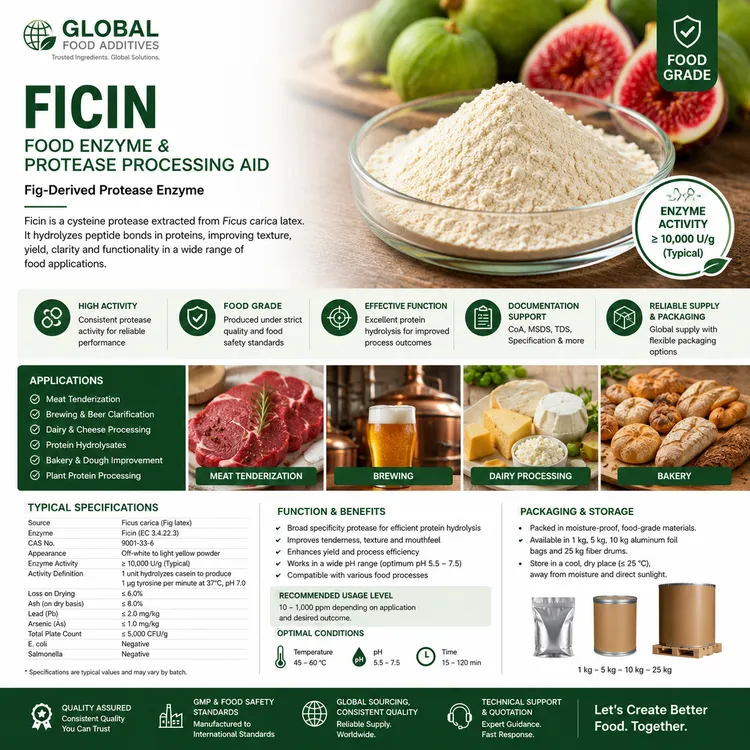
Ficin, also known as ficain in enzyme nomenclature, is a proteolytic enzyme preparation traditionally associated with fig latex-derived protease activity. In food manufacturing it is evaluated as a processing aid for protein modification, meat tenderising, brewing stability, casing treatment, selected dairy applications and controlled texture development. For industrial purchasing, the key requirements are enzyme activity, activity method, carrier declaration, dosage guidance, process compatibility, inactivation behaviour, documentation quality and destination-market regulatory review.
CAS 9001-33-6
EC 3.4.22.3
Protease enzyme
Processing aid
Activity-based sourcing
Product identity
| Product | Ficin |
|---|
| Synonyms | Ficain, fig protease, Ficus protease, cysteine protease preparation |
|---|
| Category | Enzymes & Processing Aids |
|---|
| Function | Food enzyme / protease / processing aid for protein modification |
|---|
| EC number | 3.4.22.3 |
|---|
| E / INS number | Confirm by destination market and supplier documentation |
|---|
| CAS / identity | 9001-33-6 |
|---|
| Typical source | Ficus species latex-derived enzyme preparation, depending on supplier |
|---|
| Typical form | Enzyme powder, granulate, tablet, liquid preparation or formulated enzyme blend |
|---|
Application fit
Potential use areas may include:
- Meat tenderising and protein texture modification
- Brewing, beer stability and protein haze reduction concepts
- Protein hydrolysis for savoury, nutritional or process applications
- Casing treatment for sausage, cheese or collagen-related processing
- Selected dairy, gelatin and protein-rich systems where permitted
- Bakery or dough systems requiring controlled protein weakening
Industrial value for food manufacturers
Ficin is considered when a manufacturer needs targeted proteolysis rather than a simple additive effect. The enzyme acts on protein structures, so performance depends on substrate type, pH, temperature, water activity, salt level, contact time, dosage and whether the process includes an inactivation step. Because enzyme preparations are purchased by declared activity rather than only by weight, buyers should compare cost-in-use, enzyme units, test method and process results instead of evaluating only price per kilogram.
Protein modification
Ficin can be evaluated for controlled hydrolysis of protein matrices, helping modify tenderness, viscosity, solubility, digestibility perception or processing performance. Over-treatment may create excessive softening or bitter peptides, so trials are essential.
Process efficiency
In suitable processes, a protease can reduce mechanical treatment, shorten maturation time, improve extraction or modify texture under controlled conditions. Actual benefits must be confirmed by pilot-scale validation.
Alternative enzyme system
Ficin may be compared with papain, bromelain, bacterial proteases or fungal proteases when the buyer needs a different source, activity profile, sensory result or label strategy.
Processing-aid positioning
In many applications, food enzymes are evaluated as processing aids. Labelling and residual activity treatment depend on the destination market, enzyme source, application and final product category.
Commercial grade options
Ficin may be supplied as a concentrated enzyme, diluted preparation, powder blend, liquid preparation or application-specific formulation. The correct grade should be selected based on dosing accuracy, worker safety, dust control, dispersion, storage stability and compatibility with the production line.
| Grade type |
Typical purchasing interest |
Technical points to verify |
| Powder enzyme preparation |
Dry blending, meat seasonings, powder premixes, laboratory trials and applications requiring flexible dosing. |
Activity units, carrier, particle size, dusting risk, flowability, moisture, microbiology, allergen status and storage temperature. |
| Granulated enzyme |
Lower dust handling, improved flow and easier dispersion in selected dry applications. |
Granule strength, dissolution rate, activity retention, anti-dusting treatment and compatibility with the processing matrix. |
| Liquid enzyme preparation |
Spraying, injection, marinade systems, automated dosing and processes where liquid distribution is preferred. |
Activity per millilitre, preservatives, stabilisers, pH, viscosity, microbial control, cold-chain needs and shelf-life after opening. |
| Application-specific blend |
Meat tenderising, brewing, protein hydrolysis or process-aid systems requiring more than one enzyme activity. |
Complete enzyme profile, carrier declaration, blend ratio, enzyme interactions, inactivation conditions and regulatory status. |
Technical specification checkpoints
For enzyme purchasing, the specification must be evaluated differently from standard chemical additives. Activity method, unit definition, substrate used in the assay and temperature/pH of the test can significantly change how one supplier's product compares with another.
- Declared enzyme activity
- Confirm activity value, unit definition, assay substrate, test pH, test temperature and acceptance range. Do not compare enzyme offers unless activity methods are understood.
- Activity profile
- Request practical guidance for operating pH, temperature range, optimum conditions and inactivation conditions. Actual process performance should be validated in the customer's food matrix.
- Source and identity
- Clarify botanical source, enzyme nomenclature, CAS number, EC number, manufacturing route and whether the material is a purified enzyme or broader plant-derived enzyme preparation.
- Carrier system
- For formulated grades, confirm carrier ingredients, salts, sugars, starches, maltodextrin, anti-caking agents, preservatives or stabilisers because they may affect labelling, allergens and dietary certifications.
- Physical form
- Check powder, granule, tablet or liquid form. Particle size, dusting, bulk density, viscosity and dispersion behaviour influence dosing accuracy and workplace handling.
- Moisture and stability
- Moisture content and storage temperature can affect activity retention. Ask for shelf-life data and recommended storage conditions for unopened and opened packs.
- Microbiological quality
- Review total plate count, yeast and mould, coliforms, E. coli, Salmonella and any application-specific microbiological limits required by the buyer's HACCP plan.
- Contaminants
- Request heavy metals and other contaminant declarations according to destination-market requirements and internal food safety standards.
- Residual activity
- Where the enzyme is used as a processing aid, determine whether the final process includes heat, pH or other steps that inactivate the enzyme before packaging.
- Regulatory documentation
- Confirm food-enzyme status, processing-aid status, source acceptability, market-specific declarations and any label implications before approving commercial use.
Application guidance by food sector
Ficin should be tested under the actual production conditions because protease action can continue until the enzyme is inactivated or the substrate becomes unavailable. Trial design should include dosage curve, contact time, temperature, pH, salt level, water activity, sensory result, texture measurement and final product safety review.
Meat tenderising
Ficin can be evaluated for tenderising beef, poultry, pork or processed meat systems by partially hydrolysing muscle proteins and connective structures. Key controls include dosage, injection or tumbling distribution, dwell time, temperature and prevention of over-softening.
Brewing and beverage stability
Proteases may be evaluated for protein haze control or process stability in brewing and fermented beverages. The brewer should validate foam impact, flavour stability, residual activity and compliance with local brewing regulations.
Protein hydrolysis
Ficin may be used in selected protein hydrolysis concepts for savoury bases, nutritional ingredients or process streams. Hydrolysis degree, bitterness, peptide profile, filtration behaviour and microbial control should be tested.
Dairy and gelatin systems
In protein-rich systems, ficin can alter gel strength, viscosity, coagulation behaviour or texture. Pilot trials should check reaction control, enzyme inactivation, flavour development and finished-product stability.
Casing and collagen-related processing
Protease activity may be evaluated for cleaning, softening or treatment of proteinaceous casings and collagen-containing materials. Process control is important to avoid excessive weakening or inconsistent mechanical strength.
Bakery and dough systems
In selected bakery applications, proteases can modify gluten strength, dough extensibility and machinability. Ficin should be trialled carefully because excessive proteolysis can reduce structure and finished-product volume.
Processing and formulation considerations
| Technical factor |
Why it matters |
Practical buyer / R&D action |
| Dosage curve |
Protease response is not always linear; small dosage changes can strongly affect texture or hydrolysis level. |
Run low, medium and high dosage trials and measure texture, viscosity, soluble nitrogen or other relevant process indicators. |
| Contact time |
Ficin continues acting while conditions remain favourable, which may cause over-tenderising or excessive protein breakdown. |
Define controlled residence time and include an inactivation or chilling step where required. |
| pH and temperature |
Enzyme activity depends strongly on pH and temperature, and supplier grades may behave differently. |
Validate performance at the actual process pH and temperature, not only at the supplier's standard assay conditions. |
| Matrix composition |
Salt, sugar, fat, polyphenols, minerals, preservatives and water activity can influence enzyme activity and distribution. |
Test in the complete formula, including marinades, brines, seasoning carriers or fermentation media. |
| Inactivation control |
Residual protease may keep modifying texture during storage if not controlled. |
Confirm heat, pH, water activity or other inactivation conditions and verify final product stability through shelf life. |
| Sensory impact |
Proteolysis can improve tenderness but may also create bitterness, soft texture or flavour changes. |
Include sensory panel review and application-specific quality criteria before commercial approval. |
Comparison with related protease enzymes
Ficin should be compared by application performance, enzyme activity method and cost-in-use. It should not be substituted directly for papain, bromelain or microbial proteases without validating the final product result.
| Protease |
Typical industrial reason to evaluate |
Key difference to check |
| Ficin |
Fig-derived protease preparation for meat tenderising, protein modification, brewing stability and selected process-aid applications. |
Activity method, source declaration, pH/temperature profile, residual activity and regulatory status vary by supplier. |
| Papain |
Papaya-derived protease widely evaluated for tenderising, protein hydrolysis and processing applications. |
Different substrate preference, activity profile, source, allergen considerations and market familiarity. |
| Bromelain |
Pineapple-derived protease used in meat, hydrolysate, beverage and specialty applications. |
Different botanical source, activity behaviour, flavour impact and cost-in-use. |
| Microbial proteases |
Fermentation-derived enzymes for bakery, brewing, protein hydrolysis and general processing. |
Check production organism, enzyme class, GMO status, halal/kosher status and permitted food-enzyme use. |
| Rennet / chymosin |
Specific dairy coagulation, especially cheese making. |
Not a general tenderising enzyme; function, specificity and regulatory treatment are different. |
Quality assurance and supplier approval
Food enzyme procurement requires supplier qualification, batch activity review and application-specific validation. The buyer should keep an approved specification, COA history, safety data sheet, source statement, allergen declaration, activity method and change-control agreement on file.
COA review
Check lot number, manufacturing date, expiry or retest date, enzyme activity, physical appearance, moisture, microbiology, heavy metals and carrier information before releasing material to production.
Activity verification
For critical processes, buyers may verify activity internally or through third-party testing. The test method should match the approved supplier method or an agreed application-relevant assay.
Food safety system
Ask whether the production site operates under recognised food safety or quality systems such as HACCP, ISO 22000, FSSC 22000, BRCGS, IFS, GMP or another customer-accepted programme.
Change control
For repeat supply, confirm notification expectations for changes in source material, enzyme activity method, production site, carrier system, preservatives, packaging or regulatory documentation.
Worker handling and plant safety
Enzyme powders can create occupational exposure concerns because airborne enzyme dust may irritate or sensitise susceptible workers. Industrial handling should follow the supplier SDS and the site's hygiene, ventilation and personal protective equipment procedures. Liquid or granulated preparations may reduce dust exposure but still require controlled handling.
Handling note: Enzyme products should be handled by trained personnel. Avoid dust generation, use closed transfer where practical, keep containers sealed, prevent cross-contamination and follow the supplier's SDS for respiratory, eye and skin protection.
Regulatory and labelling notes
Ficin may be treated as a food enzyme, processing aid or ingredient depending on destination market, production source, application and whether active enzyme remains in the final food. Some countries require food-enzyme authorisation, source disclosure, allergen review or special labelling. Buyers should confirm compliance before commercial use, especially for meat, beverage, dairy, infant, medical or export products.
Important: product availability, permitted use, claims, processing-aid status, residual activity and labelling depend on supplier, enzyme source, destination market, food category and customer responsibility. The buyer should verify regulatory status and final suitability for the intended application.
Packaging, storage and logistics
Ficin enzyme preparations are typically packed to protect activity from moisture, heat and contamination. Storage requirements may differ between powder, granulated and liquid grades. Buyers should confirm shelf life, recommended temperature, humidity limits, cold-chain needs for liquids and remaining shelf life at dispatch.
Powder packing
Common options may include foil bags, fibre drums, cartons or lined bags depending on activity level and quantity. Confirm net weight, inner liner, tamper evidence and pallet configuration.
Liquid packing
Liquid enzyme preparations may be supplied in bottles, jerrycans, drums or IBCs. Confirm preservatives, pH, microbial control, storage temperature, viscosity and shelf life after opening.
Storage control
Store in a cool, dry, clean area away from direct sunlight, high humidity, strong odours and incompatible chemicals. Keep packs sealed and follow first-in-first-out stock rotation.
Export preparation
For international shipments, align product description, HS code guidance, certificate of origin, food-enzyme declaration, halal or kosher status, SDS, shelf-life remaining and destination import requirements.
Documents to request
- Product specification or technical data sheet
- Lot-specific certificate of analysis
- Enzyme activity declaration and assay method
- Safety data sheet
- Food-grade or food-enzyme suitability statement
- Source and manufacturing origin statement
- Carrier, stabiliser, preservative and anti-caking declaration
- Allergen, gluten, GMO, vegan, halal or kosher statement if required
- Microbiological specification
- Heavy metals and contaminant declaration where required
- Shelf-life, expiry or retest-date statement
- Recommended storage and handling conditions
- Packaging specification and pallet configuration
- Change-control or notification policy for repeat supply
- Market-specific food enzyme or processing-aid declarations
How to request this product
Send the product name, target enzyme activity, activity method if known, application, physical form, quantity, destination country, preferred packaging, expected shipment date, Incoterms and required documents. If you already purchase Ficin, attach your current specification, COA, activity unit definition, dosage range or process conditions so supplier options can be compared accurately.
Recommended inquiry format
Example: “We need food-grade Ficin / Ficain protease, CAS 9001-33-6, EC 3.4.22.3, powder or liquid enzyme preparation, target activity required, application: meat tenderising / brewing / protein hydrolysis / casing treatment, quantity: 25 kg trial or annual contract, destination: EU / GCC / USA / Africa, required documents: TDS, COA, activity method, SDS, allergen statement, GMO statement, halal certificate, origin certificate, microbiological specification and shelf-life declaration. Please quote FOB / CIF / CFR with lead time.”