
Calcium Alginate
Calcium Alginate, commonly referenced as E404 / INS 404, is a calcium salt of alginic acid used as a food-grade hydrocolloid for gelling, stabilization, water binding, texture design, encapsulation support and structured-food applications. For industrial food manufacturers, the real purchasing value depends on confirmed food-grade status, calcium content, particle size, gel behavior, hydration strategy, regulatory fit, documentation quality and batch-to-batch consistency.
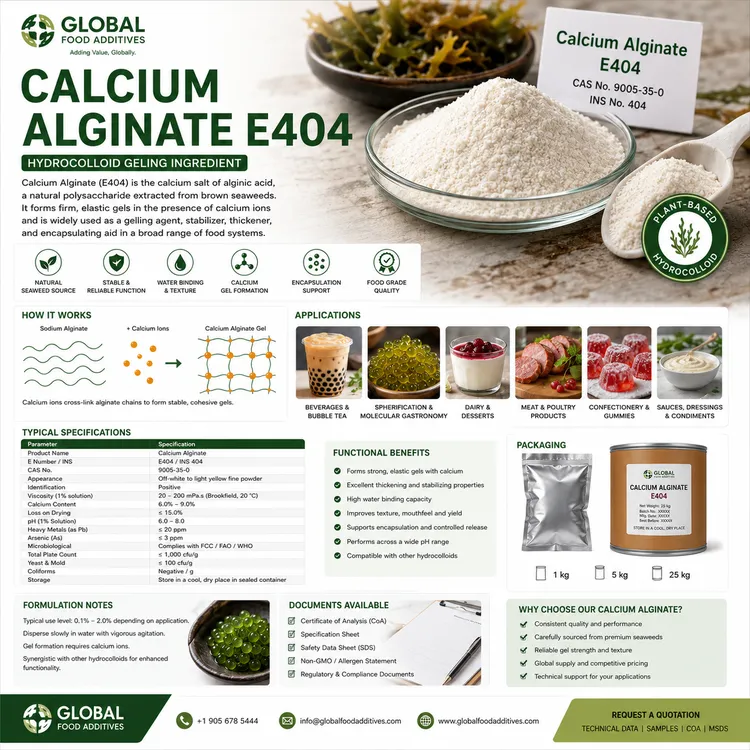
Hydrocolloid performance depends on grade, particle size, calcium balance, pH, shear, temperature, process sequence and finished-product rules.
Product identity
| Product | Calcium Alginate |
|---|---|
| Alternative names | Calcium salt of alginic acid; calcium alginate hydrocolloid; calcium-crosslinked alginate |
| Category | Hydrocolloids, Gums & Gelling Agents |
| Function | Thickener / stabilizer / gelling ingredient |
| E / INS number | E404 / INS 404 |
| CAS / identity | 9005-35-0 |
| Chemical family | Calcium salt of alginic acid, a polysaccharide family associated with brown seaweed-derived alginates |
| Typical form | Fine powder, granule, fibre-like material, bead-grade or application-specific hydrocolloid grade depending on supplier specification |
| Typical appearance | White to cream or pale yellowish powder or granular material, subject to grade and origin |
| Solubility behavior | Calcium Alginate is generally much less soluble than sodium alginate and is typically associated with calcium-crosslinked gel structures |
| Main technical value | Provides controlled gel texture, water binding, structure, bead formation, encapsulation support and stability in suitable food systems |
| Key buying point | Do not compare only by product name; compare calcium level, viscosity reference, gel strength, particle size, microbiology, heavy metals and regulatory documentation |
Industrial buying value
Calcium Alginate is typically evaluated when a manufacturer needs a calcium-linked alginate structure rather than a simple soluble thickener. It can be useful in products requiring firm gels, soft gels, beads, fibres, coatings, encapsulated phases, moisture control or textural stability under processing and storage. Because alginate behavior is highly grade-dependent, successful sourcing requires both documentation review and application trials.
- Supports calcium-crosslinked gel formation and structured texture design
- Can contribute water binding, shape retention and controlled release in selected systems
- Useful in bead, fibre, filling, dessert, analogue and encapsulation applications where permitted
- May improve freeze-thaw, heat-process or storage stability when correctly formulated
- Requires close review of calcium availability, pH, shear, hydration sequence and target texture
Technical overview
Calcium Alginate is part of the alginate hydrocolloid family. Alginates are polysaccharides built from mannuronic acid and guluronic acid blocks. In practical food technology, the ratio and arrangement of these blocks influence gel strength, elasticity, brittleness, water binding and process tolerance. Calcium ions can crosslink alginate chains, creating the well-known calcium alginate network used in gels, beads, films, fibres and structured products.
Compared with sodium alginate, which is often selected for direct hydration and viscosity building, Calcium Alginate is generally associated with an already calcium-linked, less soluble material. This makes grade selection important. Some buyers need a fine powder for dry blending, others need controlled particle size for gel particles or bead systems, and others need a supplier specification designed for texture, encapsulation or structured-food manufacturing.
Calcium-crosslinking logic
Alginate gelation is strongly influenced by calcium availability. When calcium ions interact with alginate chains, a three-dimensional network can form. The strength and texture of that network depend on alginate grade, calcium source, calcium release rate, pH, solids, shear, temperature, sequestrants and the timing of addition.
- Fast calcium release can create surface gelation, lumps or uneven texture
- Controlled calcium release can support more uniform gel development
- High-guluronic alginate systems often produce firmer, more brittle gels
- High-mannuronic alginate systems generally support softer, more elastic gel character
- Sequestrants and acidity regulators can delay or control gelation timing
Performance variables
The same Calcium Alginate grade may perform differently across factories. Performance depends on raw-material quality, process order, water quality, calcium balance, pH, shear, temperature and final storage conditions. Buyers should evaluate the material in the real formulation, not only in water.
- Particle size and hydration or dispersion behavior
- Available calcium and interaction with other calcium sources
- pH, acid type, buffer capacity and soluble solids
- Heat treatment, freezing, thawing and mechanical shear
- Interaction with proteins, sugars, salts, phosphates, fibres and other hydrocolloids
Application fit
Potential use areas may include the applications below, subject to destination-market rules, food-category permission, maximum permitted level, label declaration and customer policy. These examples are technical formulation contexts, not a universal approval list.
| Application area | Technical reason to evaluate | Buyer / R&D checks |
|---|---|---|
| Dairy desserts and gelled dairy systems | Supports texture, water binding, shape retention and gel structure in selected formulations | Milk minerals, protein interaction, pH, heat process, calcium balance, syneresis and spoonable texture |
| Fruit preparations, dessert gels and fillings | Helps build gel texture, suspension and moisture control where calcium-linked networks are desired | Fruit acidity, Brix, calcium source, pH, shear during filling, freeze-thaw stability and cut texture |
| Sauces, toppings and structured inclusions | Can support viscosity, suspension, controlled texture and particulate stability in selected systems | pH, salt, oil phase, emulsifier system, shear tolerance, pumpability and final mouthfeel |
| Beverage beads and spherification systems | Useful for calcium alginate bead structures, liquid-core concepts and textural inclusions where permitted | Shell thickness, calcium bath, alginate grade, pH, Brix, storage stability, sedimentation and beverage clarity |
| Meat alternatives and plant-based structures | Supports binding, fibre-like texture, water retention and gel network design in selected analogue products | Protein type, oil level, calcium source, extrusion or forming process, cooking loss and bite profile |
| Bakery fillings and heat-stable preparations | Can help maintain structure and reduce water migration in fillings or fruit systems | Bake stability, pH, sugar level, freeze-thaw cycles, water activity and starch/hydrocolloid interaction |
| Encapsulation and controlled-release systems | Can form gel beads or matrices for flavours, acids, enzymes, colours or sensitive ingredients | Loading capacity, bead strength, release profile, particle size, carrier compatibility and regulatory status |
| Edible films, coatings and structured gels | Can support film or gel network formation in specialized applications | Film strength, water vapour behavior, sensory impact, drying process, calcium treatment and label acceptance |
Quality and specification parameters
For industrial purchasing, Calcium Alginate should be compared by measurable specification, performance in the target application and the documentation package. A technically suitable grade should deliver the required texture or stability without causing hydration defects, sediment, graininess, syneresis, off-colour, off-odour or regulatory issues.
| Specification area | What to request | Why it matters |
|---|---|---|
| Identity and grade | Product name, E/INS number, CAS number, food-grade statement, alginate type and supplier grade code | Confirms that the offered material matches the intended hydrocolloid and avoids non-food or unsuitable grades |
| Calcium content | Calcium percentage, test method and basis of calculation | Influences gel behavior, formulation calcium balance and comparison between grades |
| Viscosity reference | Viscosity method, concentration, temperature, spindle, speed and solvent or conversion method where applicable | Hydrocolloid viscosity data is only useful when test conditions are clearly stated |
| Gel strength | Gel strength or texture profile method where available | Critical for structured gels, beads, fillings, desserts and plant-based applications |
| Particle size | Mesh size, D10/D50/D90 where available, sieve residue and dust level | Affects dispersion, hydration, lumping, mouthfeel, sediment and dry-blend uniformity |
| Moisture / loss on drying | Moisture content, loss on drying and drying method | Influences flowability, microbial stability, shelf life, caking and cost comparison |
| Ash and mineral profile | Total ash, acid-insoluble ash and mineral composition where relevant | Supports identity, purity and supplier comparison for seaweed-derived materials |
| pH behavior | pH of suspension or extract under defined test conditions | Important for dairy, beverage, fruit and gelled systems where pH controls texture and stability |
| Insoluble matter | Insoluble matter, clarity, sediment or filtration information where relevant | Critical for beverages, fine gels, coatings and applications where sediment is unacceptable |
| Heavy metals | Lead, arsenic, cadmium, mercury and total heavy metals according to buyer standard | Important for seaweed-derived hydrocolloids, export compliance and customer audits |
| Microbiology | Total plate count, yeast and mould, coliforms, E. coli, Salmonella and other limits when required | Important for dairy, dessert, beverage, nutritional and high-care applications |
| Compliance | Food-grade declaration, allergen statement, GMO statement, vegan/vegetarian statement, halal/kosher if required | Reduces regulatory, customer and label-approval delays |
| Traceability | Manufacturer, country of origin, raw-material origin, batch number, production date, retest date and shelf life | Enables supplier qualification, recall readiness and audit-trail control |
Formulation and plant-trial checklist
- Target texture: define whether the product needs viscosity, firm gel, elastic gel, bead shell, water binding, suspension, coating or fibre-like structure.
- Hydration sequence: determine whether the ingredient should be dry-blended, dispersed into high-shear water, pre-slurried, added with sugar or converted through a calcium-controlled system.
- Calcium control: review existing calcium from milk, salts, water hardness, mineral blends and added calcium salts before selecting dosage.
- pH and buffer capacity: test final pH because alginate texture and calcium release can change with acidity and buffering ingredients.
- Shear tolerance: evaluate mixing, pumping, filling, homogenisation and post-gel handling to avoid breaking weak structures.
- Thermal process: check heat treatment, cooling profile and gel-setting stage because temperature sequence can change final texture.
- Freeze-thaw stability: assess syneresis, ice-crystal damage, water release and texture recovery if the product is frozen or chilled.
- Sensory review: confirm mouthfeel, bite, graininess, film formation, flavour release and visual appearance at the intended dosage.
- Storage testing: monitor gel strength, water separation, sediment, microbial stability and package appearance through shelf life.
- Cost-in-use: calculate cost per tonne of finished product based on dosage, process yield, reduced waste, texture stability and rejection reduction.
Comparison with related hydrocolloid options
Calcium Alginate is part of a wider group of hydrocolloids. The correct choice depends on solubility, gelation mechanism, pH, calcium sensitivity, heat process, freeze-thaw requirement, mouthfeel, label plan and cost-in-use.
| Option | Typical reason to compare | Industrial note |
|---|---|---|
| Calcium Alginate / E404 | Calcium-linked gel structures, beads, fibres, water binding and structured systems | Generally less soluble than sodium alginate; requires careful texture and process validation |
| Sodium Alginate / E401 | Rapid hydration, viscosity building and calcium-triggered gelation systems | Often selected when the formulator wants to control gelation by adding calcium separately |
| Potassium Alginate / E402 | Alginate functionality with potassium counter-ion | May be reviewed where sodium contribution is a formulation or label concern |
| Pectin / E440 | Fruit gels, dairy gels, fillings and acidic systems | Requires pH, sugar, calcium and degree-of-esterification review |
| Carrageenan / E407 | Dairy stabilization, gels and water binding | Strong interaction with dairy proteins; regulatory and customer policies should be checked |
| Xanthan gum / E415 | Cold-process viscosity, suspension and shear-thinning flow | Usually selected for viscosity and suspension rather than calcium-set gel networks |
| Gellan gum / E418 | Clear gels, suspension beverages and heat-stable gel systems | Requires ion balance and hydration control for predictable texture |
| Starch systems | Cost-effective thickening, body and process viscosity | May be better for bulk viscosity but less precise for calcium-linked gel structures |
Process integration guidance
Calcium Alginate should be introduced through a controlled process. The best method depends on whether the buyer is using the material as a powder ingredient, gel particle, bead, fibre, encapsulation matrix or part of a broader alginate-calcium system. Incorrect sequencing can cause fisheyes, clumps, uneven gelation, excessive firmness, weak gels or sediment.
Hydration and dispersion points
- Dry-blend with sugar, starch or carrier powders to reduce lumping where appropriate
- Use sufficient mixing energy and controlled addition rate for uniform dispersion
- Confirm whether the grade is intended to dissolve, disperse, swell or remain as a structured particle
- Control calcium availability before and during hydration to avoid premature gelation
- Validate particle-size impact on sediment, texture and mouthfeel
Production risk controls
- Define mixer type, shear level, water temperature and addition sequence
- Monitor pH, soluble solids, calcium source and sequestrant level
- Check pumpability and filling consistency after gel development
- Prevent over-processing that can break weak gel networks
- Record batch number, dosage, process conditions and QC release result for traceability
Handling, storage and warehouse control
Calcium Alginate should be handled according to the supplier safety data sheet, food-safety plan and local workplace rules. Hydrocolloid powders can be sensitive to moisture and can create dust during handling, so storage and weighing procedures should protect both product quality and operator safety.
| Control point | Recommended buyer action |
|---|---|
| Storage environment | Store in a clean, dry, well-ventilated area according to supplier recommendations |
| Moisture protection | Keep bags sealed until use and protect opened packaging from humidity and condensation |
| Dust management | Use suitable handling controls, local extraction and PPE according to SDS and site policy |
| Cross-contact | Store away from odorous, wet, allergenic or incompatible materials |
| Lot traceability | Record lot number, supplier COA, internal release status and expiry/retest date before use |
| Opened packaging | Define resealing, relabelling, retest and maximum-open-time procedures |
Packaging and logistics options
Packaging depends on supplier standard, grade and order volume. Common industrial requests include sample packs, trial quantities, 10-25 kg bags, multiwall paper bags with inner PE liners, fibre drums, lined cartons, palletised export packaging and full-container supply. For export projects, buyers should request pallet dimensions, net and gross weight, bag dimensions, liner type, batch coding system, shelf life, storage conditions, HS code guidance, document language and shipping marks before confirming the order.
Regulatory and label diligence
Calcium Alginate should be managed as a regulated food additive. The buyer is responsible for verifying whether E404 / INS 404 is permitted in the destination market, whether it is allowed in the finished food category, the maximum permitted level, the calculation basis, carry-over rules, label declaration and any customer-specific policy for hydrocolloids or seaweed-derived ingredients.
Some product categories allow hydrocolloids broadly, while others have specific limits or function-based rules. A material may be technically effective but commercially unsuitable if the retailer, brand owner, importer or destination-market authority does not accept the additive in the final product. Regulatory confirmation should be completed before commercial purchase and before full-scale production.
Documents to request
- Product specification or technical data sheet with grade, E/INS number and identity information
- Certificate of analysis for available batch or representative lot
- Safety data sheet where applicable
- Food-grade declaration and additive identity confirmation
- CAS, alginate type, calcium content and regulatory-identity clarification where required by buyer specification
- Origin statement, manufacturer information and traceability declaration
- Raw-material origin statement, including seaweed or alginate source where relevant
- Shelf-life, retest date and recommended storage conditions
- Particle size, viscosity reference, gel strength, moisture, ash and pH/suspension data
- Heavy metals, lead, arsenic, cadmium, mercury and impurity statements aligned with buyer requirements
- Microbiological specification for dairy, dessert, beverage, nutritional or high-care applications
- Allergen, GMO, vegan/vegetarian, BSE/TSE and irradiation statements where required
- Halal and kosher certificates when required by customer or destination market
- Label draft, packaging details, pallet configuration and net/gross weight
- Market-specific declarations required by the importing country
How to request this product
Send the product name, target grade or reference specification, quantity, destination country, packaging preference, expected shipment date, delivery term and required documents. If you already purchase Calcium Alginate, attach or describe your current specification, label, certificate of analysis or supplier grade so alternative options can be compared accurately.
For faster technical review, include the intended application, target function, pH, process temperature, calcium source, desired texture, gel strength target, particle-size preference, packaging format, destination-market rules, customer compliance requirements and whether trial samples are needed before bulk quotation.
Useful answers
What is Calcium Alginate used for in food manufacturing?
Calcium Alginate is typically reviewed for gel texture, water binding, suspension, structured foods, edible beads, encapsulation, freeze-thaw stability and mouthfeel. Exact suitability depends on grade, application, process, regulations and supplier documents.
How is Calcium Alginate different from Sodium Alginate?
Sodium Alginate is commonly used when hydration and viscosity build are required, while Calcium Alginate is generally associated with calcium-crosslinked gel structures. The right choice depends on whether the manufacturer needs viscosity, controlled gelation, beads, fibres, films, coatings or structured texture.
Which applications commonly evaluate this additive?
Potential applications include dairy desserts, fruit preparations, dessert gels, sauces, beverage beads, meat alternatives, bakery fillings, encapsulated ingredients and edible structured systems, depending on local regulations and customer approval.
What causes Calcium Alginate gel defects?
Common causes include poor dispersion, premature calcium release, excessive shear, unsuitable pH, wrong particle size, incompatible minerals, insufficient hydration, uncontrolled acidification and poor process sequencing.
Which technical parameters should be compared between suppliers?
Buyers should compare food-grade status, identity, calcium content, viscosity reference, gel strength, particle size, moisture, ash, pH, heavy metals, microbiology, origin, shelf life, packaging and compliance documents.
Can Global Food Additives source Calcium Alginate?
Global Food Additives can review sourcing options for Calcium Alginate according to target specification, quantity, destination, packaging, shipment timing and required documentation.
Which documents should be requested?
Buyers commonly request a technical data sheet or specification, certificate of analysis, safety data sheet where applicable, food-grade declaration, origin statement, allergen/GMO statements, heavy-metal information, microbiology data, shelf-life information, label details and packing details.
Is this product permitted in every country?
No. Food additive use depends on destination-market rules, food category, use level, label requirements and buyer responsibility. Always verify regulatory status before commercial use.
Tell us which food additive or ingredient you need.
Send product names, target specifications, quantity, destination country, packaging preference, delivery term, and document requirements. Our team will review your inquiry and respond from orders@foodgradeadditives.com.
Your message has been received. You will be redirected to the home page.