
Butterfly Pea Flower Extract
Butterfly Pea Flower Extract is a botanical colour ingredient derived from Clitoria ternatea flowers and used for blue, purple, violet and pH-responsive shade development in selected food and beverage systems. For industrial manufacturers, the real purchasing value depends on colour strength, pH behaviour, extract standardisation, carrier system, heat and light stability, botanical origin, regulatory classification, documentation quality and batch-to-batch shade consistency.
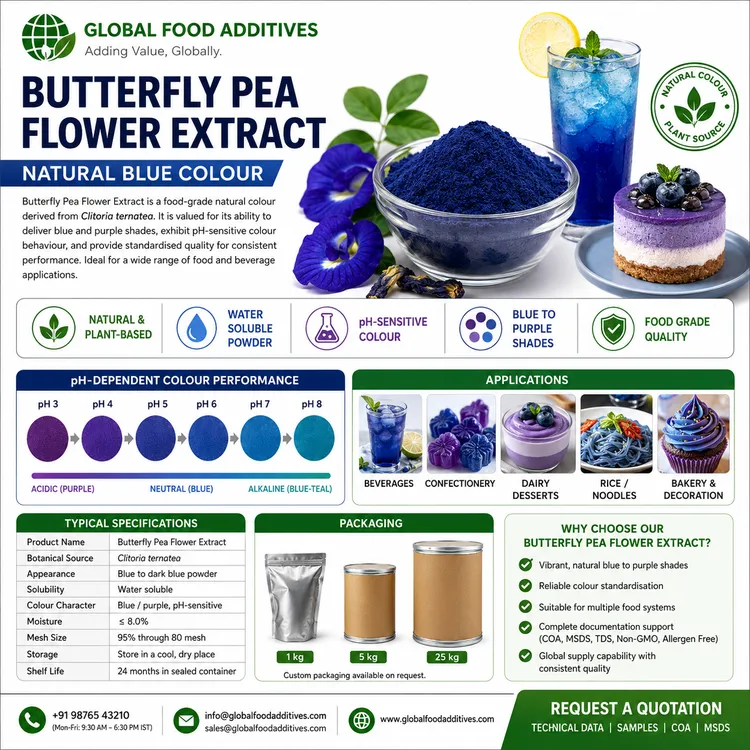
Colour performance depends on pH, acidity system, heat process, light exposure, oxygen, packaging, carrier and destination-market rules.
Product identity
| Product | Butterfly Pea Flower Extract |
|---|---|
| Botanical source | Clitoria ternatea L. flower petals, typically dried before extraction |
| Alternative names | Butterfly pea extract; blue pea flower extract; Clitoria ternatea extract; ternatin-rich botanical colour |
| Category | Colours & Colouring Foods |
| Function | Food colour / colouring food / colour standardisation ingredient |
| E / INS number | Confirm by destination market, supplier documentation and regulatory classification |
| CAS / identity | Clitoria ternatea flower extract; botanical extract identity depends on raw material, extraction route and standardisation |
| Colour family | Anthocyanin / ternatin-type botanical colour system |
| Typical shade range | Blue, violet, purple, pinkish-purple or greenish-blue depending on pH, formulation and blending system |
| Typical form | Powder, spray-dried extract, liquid concentrate, water-soluble colour, dispersion, blend or customer-specific preparation |
| Main technical value | Supports natural-positioned blue and purple shade development, colour standardisation and pH-responsive visual effects |
| Key buying point | Do not compare only by price per kilogram; compare colour value, dosage, carrier, stability, approved use, extract standardisation and landed cost-in-use |
Industrial buying value
Butterfly Pea Flower Extract is normally evaluated when a brand needs a botanical blue or purple shade and wants to reduce reliance on synthetic colour systems. It can be attractive for beverages, confectionery, frozen desserts, dairy desserts, snacks and novelty products, but the colour is formulation-sensitive. Shade can shift with pH, acidulants, minerals, heat, light and packaging, so sourcing must be linked to finished-product trials.
- Provides rare plant-derived blue and violet shade options for selected applications
- Supports pH-responsive colour change concepts in beverages, desserts and novelty foods
- Can be supplied as powder, liquid, dry extract, dispersion or formulated colour preparation
- Useful for natural, clean-label or colouring-food projects where permitted by local rules
- Requires careful review of shade stability, dosage, process conditions and final label status
Technical overview
Butterfly Pea Flower Extract is a botanical colour system rich in blue anthocyanin-type compounds often associated with ternatin pigments. Unlike many simple synthetic colours, the final shade is strongly influenced by the finished-product environment. In low-acid to neutral systems the colour can appear blue to blue-violet, while more acidic systems can shift the shade toward violet, purple or pinkish tones. This makes the ingredient useful for visual storytelling, but it also means that the colour must be validated in the actual food matrix.
For procurement and R&D teams, a colour offer should be evaluated by cost-in-use rather than simple kilogram price. A concentrated extract may cost more per kilogram but require less dosage. A low-cost extract may create higher total cost if it fades faster, needs higher dosage, carries sediment, has weak documentation, gives poor shade repeatability or is not approved for the destination market.
pH-responsive colour logic
The colour behaviour of Butterfly Pea Flower Extract is one of its main industrial advantages and one of its main formulation risks. The same extract can deliver different shade outcomes depending on acidity, buffer capacity and mineral composition.
- Neutral or mildly acidic systems often support blue to blue-violet shades
- Stronger acidity can shift colour toward purple, violet or pinkish-purple
- pH drift during shelf life can change the visible colour
- Citric, malic, lactic, phosphoric and acetic acid systems may produce different final hues
- Buffer salts, minerals and proteins can affect colour tone and stability
Stability variables
Botanical colours need application-specific stability testing. Butterfly Pea Flower Extract may be affected by heat, light, oxygen, pH, dissolved minerals, oxidants, reducing agents and packaging transparency. The strongest laboratory shade is not always the best commercial grade if shelf-life stability is weak.
- Heat process, hot-fill, pasteurisation or retort exposure
- Light exposure from clear bottles, glass jars, display cabinets or retail shelves
- Oxygen pickup during mixing, filling and headspace storage
- Interaction with ascorbic acid, sulphites, oxidants, minerals and preservatives
- Carrier system, water activity, Brix, fat phase and emulsifier system
Application fit
Potential use areas may include the applications below, subject to destination-market rules, approved food categories, use level, final label declaration and customer policy. These examples are technical formulation contexts, not a universal approval list.
| Application area | Technical reason to evaluate | Buyer / R&D checks |
|---|---|---|
| Ready-to-drink beverages and beverage bases | Blue, violet or colour-changing effect in teas, soft drinks, functional drinks and beverage concentrates | pH, buffer capacity, dissolved oxygen, pasteurisation, light exposure, bottle colour, sediment and approved use |
| Confectionery and gummies | Botanical blue or purple shade in gummies, chews, hard candy, fillings and novelty products | Cook temperature, acid sanding, gel system, water activity, pH after cooling, colour bleeding and shelf-life shade |
| Dairy desserts, yogurts and milk drinks | Pastel blue, violet or purple shade development in dairy or dairy-style applications | Protein interaction, pH, heat treatment, culture activity, calcium salts, fat content and colour stability |
| Frozen desserts and ice products | Blue or violet shade in ice cream, water ice, frozen novelties and sherbet-type products | Freeze-thaw cycles, overrun, fat phase, stabilizers, pH, light exposure and colour distribution |
| Snack seasonings and coated snacks | Colour-standardised seasoning blends or novelty blue/purple coating effects where permitted | Carrier, oil load, water activity, surface adhesion, heat exposure, dusting, shade uniformity and label status |
| Bakery icings, fillings and decorations | Botanical blue or purple shade in icings, glazes, fillings, frostings and decorative systems | pH, sugar level, fat content, water activity, bake exposure, colour migration and packaging light protection |
| Sauces, toppings and syrups | Visual identity and colour standardisation in sweet or acidic liquid systems | Acid type, Brix, viscosity, heat process, oxygen, preservative system, clarity and sediment |
| Powdered beverages and dry mixes | Dry botanical colour for instant drink powders, smoothie mixes, dessert powders and premixes | Particle size, carrier compatibility, humidity, flowability, reconstitution shade, pH after dilution and packaging barrier |
| Alcoholic beverages and cocktail bases | Blue, violet or pH-responsive colour effects in selected beverage systems where legally permitted | Alcohol content, acidity, clarity, light exposure, regulatory category, flavour system and colour change positioning |
Quality and specification parameters
For industrial purchasing, Butterfly Pea Flower Extract should be compared by measurable colour performance, botanical authenticity, purity, microbiology and regulatory documentation. A technically suitable grade should deliver the desired shade at the target dosage without causing sediment, haze, off-flavour, instability, weak compliance support or inconsistent colour between batches.
| Specification area | What to request | Why it matters |
|---|---|---|
| Botanical identity | Latin name, plant part, country of origin, extraction process and identity test | Confirms raw-material authenticity and reduces adulteration or mislabelling risk |
| Colour strength | Colour value, absorbance method, dilution factor, wavelength, pH of test medium and reference standard | Allows cost-in-use comparison and avoids misleading price-per-kilogram decisions |
| Hue and shade data | Colour coordinates, hue angle, visual shade panels or application-specific colour match data | Supports shade matching between batches, suppliers and finished products |
| Marker compounds | Total anthocyanins, ternatin marker profile or supplier-defined active marker where available | Helps standardise extract quality and supports technical comparison |
| pH response | Colour response curve across relevant pH range and application matrix | Critical for products where acidity changes the target shade |
| Solubility and clarity | Water solubility, dispersibility, turbidity, sediment and filtration behaviour | Important for beverages, syrups, clear desserts and reconstituted powders |
| Carrier system | Maltodextrin, gum, starch, sugar, glycerol, water, oil dispersion or other carrier declaration | Affects label, allergen status, solubility, dosage, stability, flow and customer approval |
| Extraction and solvents | Extraction medium, residual solvent statement and processing aid declaration where applicable | Required for regulatory review, customer audits and label-positioning decisions |
| Moisture and water activity | Moisture, water activity and loss on drying for powder grades | Influences caking, microbial stability, shelf life and warehouse performance |
| Particle size and bulk density | Mesh size, particle-size distribution, loose/tapped density and flowability | Important for dry blending, dosing accuracy, sachet filling and reconstitution |
| Stability data | Heat, light, pH, oxygen and shelf-life stability data in relevant model systems | Reduces launch risk and supports correct packaging and process decisions |
| Contaminants | Heavy metals, lead, arsenic, cadmium, mercury, pesticide residues, mycotoxins and foreign matter | Important for botanical materials, export compliance and retailer specifications |
| Microbiology | Total plate count, yeast and mould, coliforms, E. coli, Salmonella and other limits when required | Critical for beverages, dairy desserts, dry mixes, confectionery and high-care applications |
| Compliance | Food-grade declaration, allergen statement, GMO statement, vegan/vegetarian statement, halal/kosher if required | Reduces regulatory, customer and label-approval delays |
| Traceability | Manufacturer, extractor, raw-material origin, batch number, production date, retest date and shelf life | Enables supplier qualification, recall readiness and audit-trail control |
Formulation and plant-trial checklist
- Target shade: define whether the finished product needs blue, blue-violet, purple, pinkish-purple, greenish-blue or a colour-change effect.
- pH mapping: measure colour at actual finished-product pH and after expected shelf-life pH drift.
- Acid system: test citric, malic, lactic, phosphoric, acetic or blended acid systems because each may shift hue differently.
- Heat exposure: evaluate colour loss during hot-fill, pasteurisation, baking, cooking, extrusion or candy cooking.
- Light exposure: test final packaging under realistic retail lighting, especially for clear bottles or transparent wrappers.
- Oxygen control: review dissolved oxygen, headspace oxygen, mixing aeration and oxygen barrier packaging.
- Ingredient interactions: check ascorbic acid, minerals, proteins, sulphites, preservatives, hydrocolloids, emulsifiers and flavour compounds.
- Carrier compatibility: confirm that maltodextrin, gum, sugar, glycerol or other carriers meet the label and allergen requirements.
- Sensory review: assess taste, aroma, astringency, botanical notes and mouthfeel at the intended use level.
- Cost-in-use: compare colour cost per tonne or per 1,000 finished units, not only price per kilogram of colour.
Comparison with related blue, purple and botanical colour options
Butterfly Pea Flower Extract is part of a wider colour toolbox. The right choice depends on desired shade, pH, process severity, label plan, regulatory status, cost-in-use and shelf-life requirement.
| Colour option | Typical reason to compare | Industrial note |
|---|---|---|
| Butterfly Pea Flower Extract | Botanical blue, violet and pH-responsive shade development | Highly pH-sensitive; strong technical fit for novelty, beverage and natural-positioned colour systems where permitted |
| Spirulina extract / phycocyanin | Bright natural blue in selected low-heat applications | Often heat- and acid-sensitive; compare pH, process temperature and light stability |
| Galdieria extract blue | Blue colour option from algae-based source in permitted markets | Review current market approval, cost-in-use, shade and application category |
| Gardenia blue | Stable blue colour in selected jurisdictions and applications | Regulatory status varies strongly by country; verify before formulation approval |
| Anthocyanins from grape, black carrot or elderberry | Red, purple and violet shades in acidic systems | Often stronger in acidic pH; may not provide the same blue effect as butterfly pea |
| Beetroot red | Pink to red colour in selected applications | Different shade family; heat and light stability must be checked |
| FD&C synthetic colours | High strength, consistent shade and broad process tolerance where permitted | May conflict with natural-positioned labels or customer policies in some markets |
Process integration guidance
Butterfly Pea Flower Extract should be added through a controlled colour-standardisation process. The best addition point depends on product type, colour form, heat process, pH adjustment and packaging. For beverages and liquid systems, the colour is often tested after pH adjustment because post-colour acid addition can shift hue. For dry mixes, particle size, carrier, humidity and reconstitution pH are usually the main control points.
Liquid-system handling points
- Pre-dilute liquid or powder colour according to supplier guidance for uniform distribution
- Measure colour after final pH adjustment and after thermal process when applicable
- Check clarity, sediment, ring formation, turbidity and bottle-wall staining
- Evaluate light protection through amber bottles, sleeves, cartons or UV-barrier packaging
- Record dosage, batch shade, pH and production lot for colour traceability
Dry-system handling points
- Match particle size with the host powder to reduce segregation
- Control humidity during weighing, blending and packing
- Validate reconstitution shade in the intended water quality and serving pH
- Check carrier compatibility with sweeteners, acids, minerals, flavours and vitamins
- Use moisture- and light-protective packaging where required by stability testing
Shade development and colour matching workflow
Industrial buyers should request application samples and develop a colour-matching workflow before approving bulk orders. Natural colours can vary between crop seasons, extract lots and suppliers, so the purchasing specification should include both analytical and visual acceptance criteria.
| Step | Recommended action |
|---|---|
| 1. Define shade target | Set a visual reference, colour coordinates or approved market sample for the finished product |
| 2. Map pH response | Test the extract at the product's expected pH range and after shelf-life pH drift |
| 3. Run process trials | Apply the real heat, shear, filling, freezing, drying or cooking process used in production |
| 4. Evaluate packaging | Compare clear, opaque, UV-barrier, metallised or carton packaging under real retail exposure |
| 5. Confirm label status | Verify whether the material is declared as colour additive, colouring food, extract or another market-specific term |
| 6. Lock specification | Approve colour value, carrier, origin, dosage range, documents and batch-to-batch shade tolerance |
Handling, storage and warehouse control
Butterfly Pea Flower Extract should be handled according to the supplier safety data sheet, food-safety plan and local workplace rules. Botanical colours may be sensitive to heat, humidity, oxygen and light, so storage conditions should protect both analytical strength and visible shade quality.
| Control point | Recommended buyer action |
|---|---|
| Storage environment | Store in a clean, cool, dry and well-ventilated area according to supplier recommendations |
| Light protection | Keep containers closed and protected from direct sunlight or strong warehouse lighting |
| Moisture protection | Protect powders from humidity and condensation; reseal opened packs immediately |
| Oxygen exposure | Minimise repeated opening of containers and consider nitrogen-flushed packaging where supplied |
| Odour and cross-contact | Store away from odorous, allergenic, volatile or incompatible materials |
| Lot traceability | Record lot number, supplier COA, internal release status and expiry/retest date before use |
| Opened packaging | Define resealing, relabelling, retest and maximum-open-time procedures for each colour grade |
Packaging and logistics options
Packaging depends on supplier standard, extract concentration, form and order volume. Common industrial requests include sample vials, laboratory trial packs, 1-5 kg colour packs, 10-25 kg cartons or drums for powder, HDPE drums or jerrycans for liquid extract, foil-lined bags, light-protective containers, nitrogen-flushed packaging, palletised export packaging and full-batch supply. For export projects, buyers should request pallet dimensions, net and gross weight, container type, liner type, batch coding system, shelf life, storage temperature, HS code guidance, document language and shipping marks before confirming the order.
Regulatory and label diligence
Butterfly Pea Flower Extract should be managed as a regulated colour ingredient. The buyer is responsible for verifying whether it is permitted in the destination market, whether the intended food category is covered, the maximum use level, the approved manufacturing process, purity criteria, label declaration, natural-colour claim rules and customer-specific restrictions. The same material may be classified differently as a colour additive, colouring food, botanical extract or ingredient depending on jurisdiction and use.
For international projects, regulatory review should be completed before commercial purchase. A formulation that is acceptable in one country may require a different label name, documentation package or colour source in another. Buyers should also check whether the product is intended for retail foods, foodservice, alcoholic beverages, supplements, confectionery, dairy, snacks or export-only production because approval can differ by category.
Documents to request
- Product specification or technical data sheet with grade, botanical source and colour-strength method
- Certificate of analysis for available batch or representative lot
- Safety data sheet where applicable
- Food-grade declaration and market-specific colour-use declaration
- Botanical identity statement, including Clitoria ternatea and plant-part confirmation
- Origin statement, manufacturer or extractor information and traceability declaration
- Extraction process, solvent statement, carrier declaration and processing-aid information where required
- Colour value, absorbance method, hue data, pH response and stability information where available
- Shelf-life, retest date and recommended storage conditions
- Pesticide-residue statement or test results aligned with buyer and destination-market requirements
- Heavy metals, lead, arsenic, cadmium, mercury and impurity statements aligned with buyer requirements
- Microbiological specification for beverages, dairy, confectionery, dry mixes or high-care applications
- Allergen, GMO, vegan/vegetarian, BSE/TSE and irradiation statements where required
- Halal and kosher certificates when required by customer or destination market
- Label draft, packaging details, pallet configuration and net/gross weight
- Market-specific declarations required by the importing country
How to request this product
Send the product name, target shade, reference sample or colour coordinates, intended application, quantity, destination country, packaging preference, expected shipment date, delivery term and required documents. If you already purchase Butterfly Pea Flower Extract, attach or describe your current specification, label, certificate of analysis, colour value, carrier system and dosage so supplier options can be compared accurately.
For faster technical review, include the finished-product pH, heat process, packaging type, light exposure, target shelf life, flavour system, carrier restrictions, allergen requirements, natural-claim expectations, destination-market rules, customer compliance requirements and whether trial samples are needed before bulk quotation.
Useful answers
What is Butterfly Pea Flower Extract used for in food manufacturing?
Butterfly Pea Flower Extract is typically reviewed for blue, violet and purple shade development, pH-responsive colour effects, visual identity, colour standardisation and natural-positioned colour programs. Exact suitability depends on grade, application, process, regulations and supplier documents.
Why does the colour change with pH?
The extract contains anthocyanin-type colour compounds that respond to acidity. A product may appear blue, violet, purple or pinkish depending on pH, acid system, buffer capacity, minerals and storage conditions.
Which applications commonly evaluate this extract?
Potential applications include beverages, ready-to-drink teas, confectionery, gummies, dairy desserts, frozen desserts, snack seasonings, bakery decorations, syrups, dry mixes and selected alcoholic beverage systems, depending on local regulations and customer approval.
What causes colour instability?
Common causes include unsuitable pH, excessive heat, strong light exposure, oxygen, ascorbic acid, sulphites, minerals, incompatible preservatives, transparent packaging, high storage temperature and weak colour concentration.
Which technical parameters should be compared between suppliers?
Buyers should compare colour value, hue, pH response, marker content, botanical identity, carrier system, extraction route, solubility, sediment, heat stability, light stability, microbiology, heavy metals, pesticide residues, origin, shelf life, packaging and compliance documents.
Can Global Food Additives source Butterfly Pea Flower Extract?
Global Food Additives can review sourcing options for Butterfly Pea Flower Extract according to target shade, specification, quantity, destination, packaging, shipment timing and required documentation.
Which documents should be requested?
Buyers commonly request a technical data sheet or specification, certificate of analysis, safety data sheet where applicable, botanical origin statement, carrier declaration, allergen/GMO statements, pesticide-residue information, heavy-metal information, microbiology data, shelf-life information, label details and packing details.
Is this product permitted in every country?
No. Food colour use depends on destination-market rules, food category, approved use, use level, manufacturing process, label requirements and buyer responsibility. Always verify regulatory status before commercial use.
Tell us which food additive or ingredient you need.
Send product names, target specifications, quantity, destination country, packaging preference, delivery term, and document requirements. Our team will review your inquiry and respond from orders@foodgradeadditives.com.
Your message has been received. You will be redirected to the home page.