
Ascorbyl Palmitate E304
Ascorbyl Palmitate is a food-grade, oil-dispersible antioxidant used to help protect fats, oils, flavour systems, fat-soluble vitamins, colours and oxidation-sensitive finished products. Because it combines the antioxidant functionality of ascorbic acid with a lipophilic palmitate structure, it is especially relevant where oxidation control is needed in fat-containing matrices rather than purely water-based systems. This page is prepared for industrial sourcing, technical specification review, supplier qualification, document collection and quotation requests.
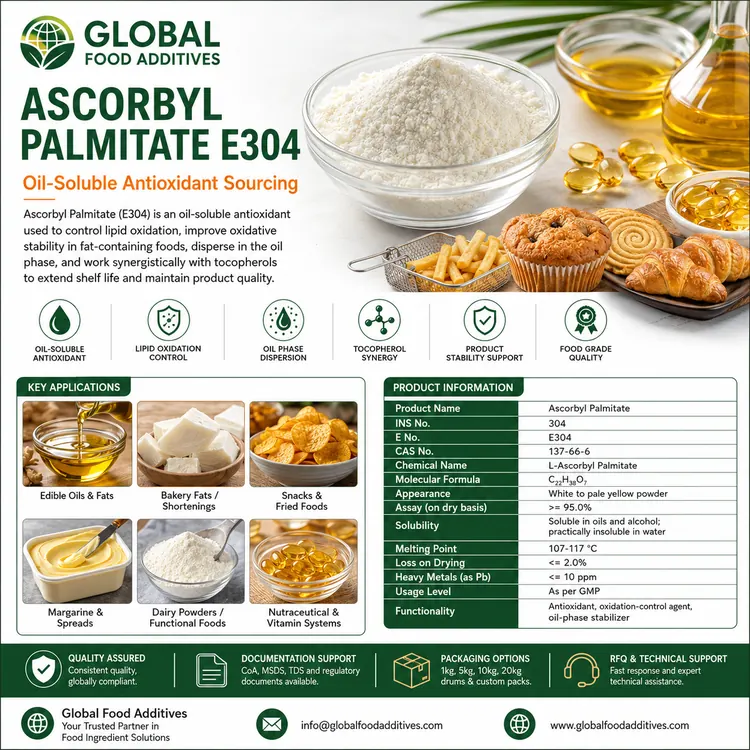
Product identity
| Product | Ascorbyl Palmitate |
|---|---|
| Common names | L-Ascorbic Acid 6-Palmitate, 6-O-Palmitoyl-L-Ascorbic Acid, Vitamin C Palmitate |
| Category | Antioxidants & Oxidation Control |
| Function | Fat-phase antioxidant / oxidation-control ingredient |
| E / INS number | E304 |
| CAS / identity | 137-66-6 |
| Chemical identity | Ester of L-ascorbic acid and palmitic acid |
| Molecular formula | C22H38O7 |
| Molecular weight | Approximately 414.53 g/mol |
| Typical appearance | White to yellowish-white powder or crystalline powder, depending on grade |
| Solubility profile | Very low water solubility; oil-dispersible or soluble in suitable carriers depending on processing conditions |
| Typical form | Powder, fine powder, crystalline grade, oil-dispersible grade or antioxidant premix |
Application fit
Ascorbyl Palmitate is usually selected where oxidation affects flavour, colour, aroma, vitamin retention, oil quality or shelf-life performance in fat-containing systems.
- Edible oils, frying oils, vegetable oils and specialty fats
- Snack seasonings, extruded snacks and oil-coated products
- Bakery fats, shortenings, margarines and fat-based fillings
- Flavour oils, oleoresins, essential oils and encapsulated flavours
- Fat-soluble colours, carotenoids, vitamin premixes and nutrient blends
- Meat systems, emulsions, sauces, mayonnaise-type products and dressings
- Powdered fats, spray-dried emulsions, dry mixes and fortified foods
- Specialty beverage emulsions and oil-phase beverage components
Technical purchasing notes
When reviewing Ascorbyl Palmitate, compare the supplier specification against the intended oil phase, fat type, application temperature, process oxygen exposure, packaging format, target shelf life, label expectations and local rules. The most useful inquiry normally includes target grade, assay, particle size, solubility or dispersibility requirement, carrier system if any, packaging size, annual quantity, destination country and required documentation.
Ascorbyl Palmitate is not a direct one-for-one replacement for water-soluble ascorbic acid. In industrial formulations, the decision should be based on where oxidation occurs: water phase, oil phase, interface, dry powder surface or dispersed emulsion droplets. For fat-rich and low-moisture systems, oil-phase dispersion and early incorporation are often more important than total antioxidant dosage alone.
Functional role in oxidation control
Lipid oxidation can cause rancidity, cardboard notes, colour fading, loss of aroma quality, vitamin degradation and reduced shelf life. Ascorbyl Palmitate is used to help slow oxidation in fat-containing food systems by acting as an antioxidant in or near the lipid phase. It is particularly useful where the antioxidant must be compatible with oils, fats, flavour oils, carotenoids or fat-soluble vitamins.
In many formulations, Ascorbyl Palmitate is evaluated as part of a broader antioxidant system. It may be combined with tocopherols, rosemary extract, citric acid, phosphates, chelators or oxygen-control packaging strategies, subject to local regulations and customer label requirements. The best system depends on oil type, unsaturation level, metals, processing heat, oxygen exposure, packaging headspace, light exposure and distribution temperature.
Industrial formulation guidance
Oil and fat systems
- Evaluate in vegetable oils, frying oils, bakery fats, shortening, margarine and specialty fat blends.
- Add at a process point that allows proper dispersion before final packaging or use.
- Check whether gentle warming, pre-dissolution or premixing is needed for uniform distribution.
- Monitor peroxide value, anisidine value, induction time, flavour stability and colour retention.
- Consider interaction with tocopherols, metal contaminants, citric acid and packaging oxygen barrier.
Flavours, colours and vitamin premixes
- Useful in flavour oils, oleoresins, carotenoids, vitamin A, vitamin D, vitamin E and other fat-soluble systems.
- Can help protect sensitive oil-phase components during storage and distribution.
- Assess compatibility with carriers, emulsifiers, encapsulation materials and spray-drying conditions.
- For dry premixes, check particle size, blend uniformity, anti-caking needs and oxidation of exposed surfaces.
- Validate sensory stability and active retention over the finished product shelf life.
Application-specific considerations
Ascorbyl Palmitate performance depends on product composition and process design. The same dosage may perform differently in bulk oil, oil-coated snacks, emulsions, meat fat, powdered flavour systems or vitamin premixes. Industrial users should therefore approve the ingredient through application-specific trials rather than only through the supplier specification.
- Edible oils: check oxidative induction time, peroxide value, anisidine value and sensory rancidity during storage.
- Frying systems: evaluate thermal exposure carefully because antioxidant activity may decline under severe frying conditions.
- Snack applications: test oil-coated products under realistic light, oxygen, humidity and packaging conditions.
- Emulsions: confirm whether oxidation occurs mainly in oil droplets, at the oil-water interface or through metal-catalysed pathways.
- Meat and fat systems: monitor colour, warmed-over flavour, rancidity, purge and interaction with nitrite, phosphates or spices where relevant.
- Powdered systems: control moisture pickup, surface oil, oxygen exposure and packaging barrier properties.
- Fortified foods: verify retention of sensitive vitamins and colours throughout the declared shelf life.
Specification checklist for buyers
A professional Ascorbyl Palmitate specification should support both chemical identity and manufacturing performance. Because the ingredient is often used to protect high-value oils, colours, flavours or nutrients, supplier consistency and packaging integrity are important qualification factors.
- Assay or active content, including analytical method and accepted range
- Identity confirmation and CAS / E-number alignment
- Appearance, colour, odour and sensory neutrality
- Free ascorbic acid and free palmitic acid limits where specified
- Moisture or loss on drying
- Melting range and physical-form description
- Particle size distribution and bulk density for dry blending
- Solubility, dispersibility or recommended premix method for oil systems
- Purity profile, related substances and residual solvents where relevant
- Heavy metals, arsenic, lead and other elemental impurities where required
- Microbiological limits where applicable to the grade and intended use
- Food-grade statement, allergen declaration, GMO declaration and origin statement
- Halal, kosher, vegan or vegetarian declarations where required by customer or market
- Packaging, shelf life, storage conditions and batch traceability
Synergistic antioxidant systems
Ascorbyl Palmitate is often evaluated together with other antioxidants because oxidation is rarely controlled by one mechanism alone. Tocopherols may protect the lipid phase, citric acid or other chelating systems may reduce metal-catalysed oxidation, rosemary extract may contribute plant-based antioxidant activity, and oxygen-barrier packaging may reduce oxygen ingress. A well-designed antioxidant system considers raw-material quality, processing exposure and distribution conditions together.
- Compare Ascorbyl Palmitate alone against blends with tocopherols or other permitted antioxidants.
- Evaluate chelation needs if trace metals accelerate oxidation.
- Check label strategy before combining synthetic, nature-derived or extract-based antioxidants.
- Use accelerated testing only as a screening tool; confirm results with real-time shelf-life testing where possible.
- Measure both analytical oxidation markers and sensory quality, because low peroxide values do not always guarantee acceptable flavour.
- Review additive carry-over rules when Ascorbyl Palmitate is used in premixes, colours, flavours or vitamin preparations.
Quality control and performance testing
Industrial approval should include both incoming-material checks and finished-product validation. The correct performance test depends on the application. Bulk oils may be evaluated by peroxide value, anisidine value, TOTOX, Rancimat induction time or sensory testing. Flavours and vitamin premixes may require active retention, aroma profile, colour stability or oxygen headspace evaluation.
- Approve supplier lots against the COA before release to production.
- Retain reference samples to monitor colour, odour and physical condition over time.
- Confirm dispersion in the actual carrier or oil phase used in production.
- Run dosage trials at realistic production conditions and legal limits.
- Monitor oxidative markers across the intended shelf life and packaging format.
- Check whether heat, light, oxygen, metals or moisture reduce the antioxidant benefit.
- Document the final validated addition point, dosage and mixing procedure in the production SOP.
Regulatory and labelling review
Ascorbyl Palmitate is identified as E304 in many additive systems, but the correct declaration, permitted food categories, maximum use levels and carry-over treatment depend on the destination market. Buyers should confirm whether the ingredient should be declared by name, E number, functional class such as antioxidant, or as part of a premix or compound ingredient declaration.
Nutrition or vitamin-related claims should not be assumed simply because the molecule is an ascorbic-acid ester. Finished-product claims such as “source of vitamin C”, “natural antioxidant”, “clean label”, “no artificial preservatives”, “non-GMO”, “vegan”, “halal” or “kosher” should be reviewed against the full formulation, supplier declarations and destination-market rules.
Packaging, storage and logistics
Ascorbyl Palmitate is normally supplied in moisture-protective bags, cartons, drums or other sealed packaging depending on supplier and order size. Because antioxidant performance can be affected by heat, moisture, light and oxygen exposure, buyers should confirm storage requirements, remaining shelf life and packaging integrity before shipment.
- Request net weight, gross weight, pallet configuration and container loading quantity before confirming freight.
- Store in a cool, dry area away from direct sunlight, strong odours and oxidizing materials.
- Keep containers tightly closed after opening to reduce moisture pickup and quality loss.
- Confirm production date, expiry date, batch number and remaining shelf life before shipment.
- Ask for packing photos, label draft and pre-shipment COA when import clearance or customer approval requires them.
- For export orders, confirm HS code guidance, document legalization needs and destination import requirements.
Documents to request
- Product specification or technical data sheet
- Certificate of analysis for the offered batch or lot
- Safety data sheet where applicable
- Food-grade statement and intended-use declaration
- Origin, manufacturer, shelf-life and storage information
- Allergen, GMO, halal, kosher, vegan or vegetarian declarations where required
- Heavy metal, impurity, residual-solvent and microbiological information where relevant
- Regulatory compliance statement for the destination country where available
- Recommended application guidance, solubility notes and handling instructions
- Label draft, packaging details, pallet configuration and lot-coding format
- Sample COA or historical COA for supplier comparison
- Market-specific declarations required by the buyer, retailer or importing country
How to request this product
Send the product name, target grade or reference specification, application, oil or fat system, expected use level, quantity, destination country, packaging preference, delivery term, expected shipment date and required documents. If you already purchase Ascorbyl Palmitate, attach or describe your existing specification, label, certificate of analysis, approved supplier reference or antioxidant-system target so available supplier options can be compared more accurately.
Useful answers
What is Ascorbyl Palmitate used for in food manufacturing?
Ascorbyl Palmitate is used as an antioxidant and oxidation-control ingredient for food systems containing oils, fats, fat-soluble vitamins, colours, flavours or other oxidation-sensitive components. It is commonly evaluated in edible oils, snacks, bakery fats, meat systems, emulsions, flavour oils, fortified foods and dry premixes.
Is Ascorbyl Palmitate the same as ascorbic acid?
No. Ascorbyl Palmitate is an ester made from ascorbic acid and palmitic acid. It is more lipophilic than ascorbic acid, making it useful in fat-containing systems where water-soluble ascorbic acid may not provide the desired oil-phase protection.
Is Ascorbyl Palmitate water soluble?
It has very low water solubility and is generally selected for oil-dispersed or fat-containing systems. For water-phase antioxidant protection, manufacturers often evaluate ascorbic acid, sodium ascorbate or other water-soluble antioxidants instead.
Can Ascorbyl Palmitate be used with tocopherols?
Yes. Ascorbyl Palmitate is often evaluated in antioxidant systems with tocopherols, rosemary extract, citric acid or other permitted antioxidants. The best combination depends on oil type, food category, label strategy, regulatory limits and shelf-life target.
Which documents should be requested?
Buyers commonly request a technical data sheet, product specification, certificate of analysis, safety data sheet where applicable, food-grade statement, origin statement, shelf-life and storage information, allergen and GMO declarations, regulatory statement, label guidance and packaging details.
Can Global Food Additives source Ascorbyl Palmitate?
Global Food Additives can review sourcing options for Ascorbyl Palmitate according to target specification, application, quantity, destination, packaging preference, delivery term and required documentation.
Is this product permitted in every country?
No. Food additive use depends on destination-market rules, food category, use level, labelling requirements, claims and buyer responsibility. The buyer should verify regulatory status and final suitability before commercial use.
What should be checked during supplier qualification?
Supplier qualification should include assay, identity, purity, free ascorbic acid, free palmitic acid, particle size, solubility or dispersibility, colour, odour, heavy metals, batch traceability, food-grade documentation, regulatory declarations, packaging integrity, lead time, remaining shelf life and export-document support.
Tell us which food additive or ingredient you need.
Send product names, target specifications, quantity, destination country, packaging preference, delivery term, and document requirements. Our team will review your inquiry and respond from orders@foodgradeadditives.com.
Your message has been received. You will be redirected to the home page.