
Ammonium Bicarbonate
Ammonium Bicarbonate is a food-grade thermal leavening agent used by industrial bakeries and food manufacturers for controlled gas release, dough aeration, product spread, surface opening, crisp bite and uniform bakery texture. It is especially valuable in low-moisture baked goods where ammonia can volatilize during baking and where sodium-based leavening systems may not deliver the same expansion profile or crisp structure.
This page is prepared for purchasing teams, R&D technologists, QA departments and import managers who need a practical sourcing overview before requesting price, specification, batch documentation or regulatory confirmation.
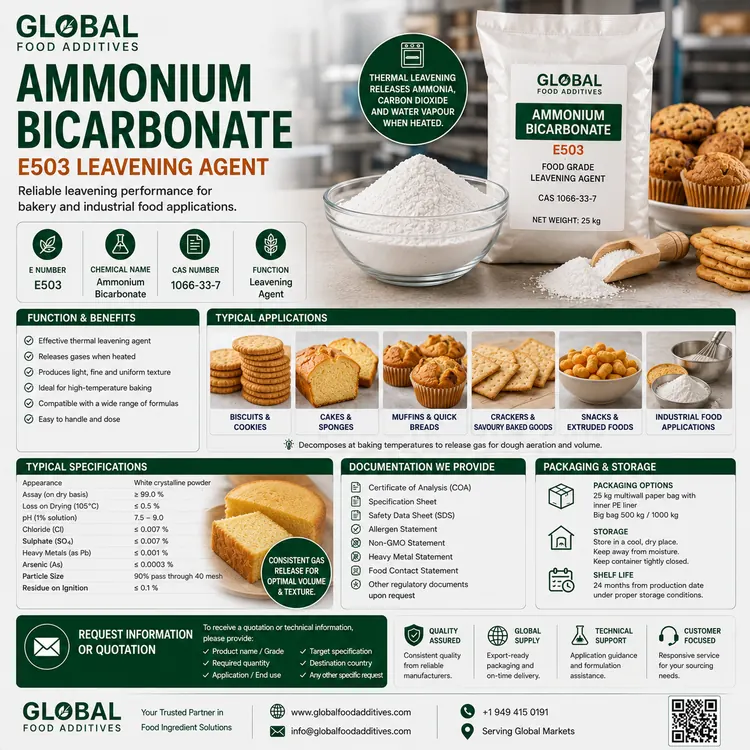
Product identity
| Product | Ammonium Bicarbonate |
|---|---|
| Common names | Ammonium Hydrogen Carbonate, Baker's Ammonia, Hartshorn Salt |
| Category | Leavening, Raising & Dough Systems |
| Function | Thermal leavening agent / gas-release raising agent / dough aeration ingredient |
| E / INS number | E503 group; often referenced as E503(ii) for ammonium hydrogen carbonate, subject to destination-market rules |
| CAS / identity | 1066-33-7 |
| Chemical formula | NH4HCO3 |
| Molecular weight | Approximately 79.06 g/mol |
| Typical form | White crystalline powder, fine powder or granular grade |
| Typical grade focus | Food grade, bakery grade or customer-specific specification |
Application fit
Ammonium Bicarbonate is most often considered where fast gas release, open structure, low residual moisture and crisp eating quality are required. Suitability must be validated by recipe, oven profile, product thickness, moisture, pH and sensory target.
- Biscuits and cookies requiring controlled spread and crisp texture
- Crackers, wafers and thin baked products with high surface area
- Dry bakery premixes and selected powder blends
- Low-moisture cakes, sponge-type systems or specialty bakery products after validation
- Industrial batters and dough systems requiring additional lift or porosity
- Bakery trials where sodium reduction, texture correction or leavening profile optimization is being reviewed
Technical function in bakery systems
In baking, Ammonium Bicarbonate decomposes when heated and releases carbon dioxide, ammonia and water vapor. Carbon dioxide contributes to dough or batter expansion, while ammonia volatilization can help open the structure and support crispness in products with adequate surface area and sufficient heat transfer. This makes the ingredient particularly useful in thin, dry and porous bakery items where retained ammonia is minimized during baking.
Performance considerations
- Gas release: Generates leavening gases during heating and helps create lift, expansion and open texture.
- Texture: Often selected for crisp bite, light structure and reduced density in low-moisture bakery products.
- Spread control: Can influence dough spread, surface checking and final dimensions depending on dosage and oven profile.
- Moisture impact: Best suited to applications where moisture loss and ammonia release are sufficient during baking.
- pH interaction: Formula pH, buffering ingredients, acids and other leavening agents should be reviewed during recipe development.
- Sensory control: Residual ammonia odor is a key quality checkpoint in finished goods.
Formulation checkpoints
- Target product moisture and baking loss
- Dough thickness, piece weight and surface area
- Oven temperature, belt speed, bake time and heat transfer
- Interaction with sodium bicarbonate, baking acids, phosphates or other raising systems
- Flour quality, protein level, sugar type, fat system and emulsifier package
- Finished-product pH, odor, color and shelf-life stability
Industrial use cases
For large-scale food manufacturing, Ammonium Bicarbonate is normally evaluated as part of a complete leavening system rather than as an isolated ingredient. Industrial value comes from consistent gas release, predictable particle behavior, reliable documentation and batch-to-batch uniformity. R&D teams may use it to improve dough expansion, reduce density, create a lighter bite, adjust surface texture or support crispness in dry bakery products.
Bakery production benefits
- Supports open crumb or porous internal structure in suitable products
- Helps develop crisp, dry texture in biscuits, cookies, crackers and wafers
- Can contribute to controlled spread and uniform piece geometry
- May reduce the need for certain sodium-based raising systems in selected formulas
- Useful for process trials where aeration, density and break strength are critical
Where caution is needed
- Moist cakes, thick bakery pieces and soft products where ammonia may not fully dissipate
- Applications with short baking time or low core temperature
- Products packed immediately while warm, which may trap volatile notes
- Recipes with sensitive flavors where even minor residual ammonia could be noticeable
- Markets with strict additive labeling, category limits or customer-specific restrictions
Typical specification points to review
Before purchasing, buyers should compare the offered grade with the target specification, applicable food regulation and finished-product requirement. The most important commercial difference between supplier offers is not only price; it is the reliability of assay, physical form, impurity profile, packaging, shelf life, documentation and export readiness.
Common technical parameters
| Assay / purity | Confirm according to supplier specification and applicable food-grade standard. |
|---|---|
| Appearance | White crystalline powder or granules, typically free from visible foreign matter. |
| Odor | Characteristic ammoniacal odor may be present; final product should be evaluated for residual odor. |
| Particle size | Important for dry blending, dispersion, dissolution and uniform reaction in dough systems. |
| Solubility | Relevant for premix preparation, batter distribution and process consistency. |
| Non-volatile residue | Useful impurity indicator for quality comparison between sources. |
| Chloride / sulfate | Often controlled in technical specifications depending on grade and customer requirement. |
| Heavy metals | Should meet food-grade and destination-market limits. |
| Microbiology | Usually reviewed according to customer policy and food safety risk assessment. |
Commercial purchasing parameters
| Packaging | Commonly supplied in multi-layer bags, PE-lined bags or customer-specified industrial packaging. |
|---|---|
| Net weight | Often requested in 25 kg bag format; availability depends on supplier and origin. |
| Palletization | Confirm pallet type, wrapping, bag count per pallet and container loading plan. |
| Shelf life | Confirm from supplier documents; depends on packaging, storage and manufacturing date. |
| Storage | Store tightly closed in a cool, dry and well-ventilated area away from heat, moisture and incompatible materials. |
| Shipping | Request SDS and transport classification before import or export planning. |
| MOQ | Depends on supplier, origin, current stock position and destination logistics. |
| Lead time | Depends on production schedule, documentation, inspection, booking and shipping route. |
Quality, food safety and compliance notes
Ammonium Bicarbonate for food manufacturing should be purchased only with a clear grade declaration and supporting documents. The buyer should verify that the material is suitable for the intended food category, destination country and internal quality system. For export or private-label production, regulatory status, additive labeling, maximum use level, contaminant limits and customer-specific declarations should be confirmed before shipment.
QA team checklist
- Confirm the product name, CAS number, E/INS reference and food-grade status.
- Review the technical specification against the finished-product formula.
- Check the certificate of analysis for the actual batch or representative lot.
- Verify allergen, GMO, halal, kosher, vegan or other customer-required declarations where applicable.
- Confirm packaging integrity, label information, production date, expiry date and batch traceability.
- Assess storage conditions, handling precautions and SDS information.
- Run a factory trial before changing source, particle size or grade.
Regulatory review points
- Destination-market additive permission and food category restrictions
- Maximum permitted level or quantum satis rules where applicable
- Finished-product labeling name, additive class and E/INS declaration
- Import requirements, customs description and local documentation needs
- Customer standards, retailer restricted-substance lists and clean-label policy
- Finished-product sensory, safety and compliance responsibility
Documents to request
A complete Ammonium Bicarbonate inquiry should include both technical and commercial document requirements. This helps avoid delays during supplier qualification, customs clearance, customer approval and first production trial.
Core documents
- Product specification or technical data sheet
- Certificate of analysis for available batch or representative lot
- Safety data sheet
- Food-grade statement or regulatory compliance declaration
- Origin statement and manufacturer information where available
- Shelf-life and recommended storage conditions
- Product label, packaging details and pallet configuration
Optional buyer-specific documents
- Halal certificate, kosher certificate or other market-specific certification
- Allergen statement and cross-contamination declaration
- GMO status declaration
- Vegan or vegetarian suitability statement where required
- Heavy metal statement or contaminant declaration
- Material safety, transport and handling confirmation
- Country-specific import, customs or registration documents
How to request this product
Send the product name, target grade or reference specification, quantity, destination country, packaging preference, delivery term, expected shipment date and required documents. If you already purchase Ammonium Bicarbonate, attach or describe your existing specification, label or certificate of analysis so supplier options can be compared more accurately.
Information that improves quotation accuracy
- Required annual volume and first-order quantity
- Preferred packaging size and pallet requirement
- Destination port, warehouse or delivery city
- Required Incoterms such as EXW, FOB, CFR, CIF or DAP
- Target specification, customer standard or reference COA
- Required certificates and destination-market declarations
- Expected approval timeline and sample requirement
Supplier comparison criteria
- Food-grade documentation completeness
- Consistency of assay and particle size
- Packaging strength and moisture protection
- Batch traceability and shelf-life remaining at shipment
- Export experience and document responsiveness
- Total landed cost, not only unit price
- Ability to support repeat supply and long-term planning
Useful answers
What is Ammonium Bicarbonate used for in food manufacturing?
Ammonium Bicarbonate is used as a thermal leavening agent in selected bakery systems. During baking, it decomposes into ammonia, carbon dioxide and water vapor. This helps create lift, porosity, spread and crisp texture in suitable low-moisture products such as biscuits, cookies, crackers and wafers.
Why is it common in biscuits, cookies, crackers and wafers?
These products usually have low moisture, thin geometry and high surface area, which helps released ammonia escape during baking. This supports crisp texture and open structure while reducing the risk of residual ammonia odor in the finished product.
Can it be used in cakes or soft bakery products?
It may be evaluated in selected formulas, but it is not automatically suitable for moist, thick or soft products. If ammonia cannot escape sufficiently during baking, the finished product may develop unwanted odor, taste or pH effects. Trials and sensory checks are essential.
Which technical parameters should be checked before purchasing?
Buyers should compare assay, appearance, particle size, non-volatile residue, chloride, sulfate, heavy metals, packaging type, shelf life, storage conditions and food-grade compliance. The offered specification should match the intended application and destination-market rules.
Can Global Food Additives source Ammonium Bicarbonate?
Global Food Additives can review sourcing options for Ammonium Bicarbonate according to target specification, grade, quantity, destination, packaging preference, delivery term and required documentation.
Which documents should be requested?
Buyers commonly request a technical data sheet, product specification, certificate of analysis, safety data sheet, food-grade statement, origin statement, allergen or GMO declaration where required, shelf-life information, label details and packing configuration.
Is this product permitted in every country?
No. Food additive use depends on destination-market rules, food category, use level, label requirements and buyer responsibility. The buyer should confirm local regulations and customer standards before commercial use.
What should be tested during factory trials?
Factory trials should evaluate dough handling, spread, volume, internal cell structure, surface color, moisture, break strength, crispness, finished-product pH, residual ammonia odor, packaging behavior and shelf-life stability.
Tell us which food additive or ingredient you need.
Send product names, target specifications, quantity, destination country, packaging preference, delivery term, and document requirements. Our team will review your inquiry and respond from orders@foodgradeadditives.com.
Your message has been received. You will be redirected to the home page.